
Passed a Challenge but Can't Withdraw? Why Prop Firms Lock Payouts
You passed the evaluation, hit the profit target, did everything right — and then the withdrawal got rejected, delayed, or quietly denied. This isn't a glitch. There are specific structural and legal reasons prop firms can legally withhold your payout, and they're almost never disclosed upfront. Here's what's actually happening, and why PropScholar's scholarship model is built differently from the
You passed the evaluation, hit the profit target, did everything right — and then the withdrawal got rejected, delayed, or quietly denied. This isn't a glitch. There are specific structural and legal reasons prop firms can legally withhold your payout, and they're almost never disclosed upfront. Here's what's actually happening, and why PropScholar's scholarship model is built differently from the
Start your evaluationPassed a Challenge but Can't Withdraw? The Legal Reason Prop Firms Lock Payouts (and PropScholar Doesn't)
TL;DR: Prop firms can legally deny your payout using clauses buried in their terms — simulated account disclaimers, discretionary review rights, and rule violations you didn't know existed. PropScholar isn't a prop firm. It's a scholarship-based evaluation platform, and that legal distinction is exactly why payouts happen within 4 hours of verification, with every one publicly listed at propscholar.com/payout-proof.
Key takeaways:
- Prop firms operate simulated accounts — they're not legally required to pay you like an employer or broker is.
- Terms like "discretionary review" give them the right to deny payouts after you pass, with no appeal process.
- News trading and inactivity breaches are the two most common technical reasons payouts are withheld — and they're applied retroactively.
- PropScholar's scholarship model is a different legal structure: the payout is a grant upon evaluation completion, not profit-sharing from a live account.
- The Freedom Challenge costs $5 to enter, pays out within 4 hours, and every payout is on-chain verifiable.
You did it. Hit the profit target, stayed within the drawdown, followed the rules as you understood them. You submitted the withdrawal request and waited. Then came the email: account under review, payout suspended, or — worst of all — account closed for rule violation.
That feeling is specific and awful. And unfortunately, it's not rare.
The question most traders ask afterward is: "Did they scam me?" Sometimes yes. But often the more uncomfortable answer is: "They did it legally." Here's how.
Why Prop Firms Can Legally Deny Payouts After You Pass
The single most important thing to understand is what a prop firm evaluation account actually is: a simulated trading environment. The money you're trading isn't real institutional capital being risked in markets on your behalf. It's a performance test run on a demo platform, and the profit you generate is a number in a spreadsheet — not a realized gain from live trading.
This matters enormously from a legal standpoint. Because you're not trading a real account, you don't have the contractual rights of an employee, a fund manager, or a brokerage client. The prop firm isn't legally obligated to pay you the way a payroll system is obligated to pay a salary. What they're obligated to do is spelled out in their Terms of Service — and that document almost always includes language like:
- "We reserve the right to review any account at our discretion before processing a withdrawal."
- "Accounts found in violation of trading rules, at any point, will be disqualified from payouts."
- "Payouts are subject to final verification and may be withheld pending compliance review."
The Two Rule Violations That Kill the Most Payouts
Discretionary reviews sound vague, but in practice they're usually triggered by specific things. The two that catch the most traders off guard are news trading rules and inactivity clauses.
News Trading: The Rule Nobody Reads Carefully Enough
Most prop firms have a news trading restriction. What traders often miss is that it doesn't just mean "don't open positions during the news." It typically means no opening or closing positions within a window around high-impact events — and at PropScholar, that window is 10 minutes before to 10 minutes after a scheduled release. Stop-loss closes and take-profit closes count too. If your position hit TP during that window, even automatically, it can breach the rule.
Prop firms with stricter or more vaguely written terms can extend this window and define it differently. And because accounts are reviewed retroactively — often only when a withdrawal is requested — you may have committed the violation weeks ago without knowing.
Inactivity Rules and Sudden Account Termination
Some platforms quietly terminate accounts that go untouched for a certain number of days. At PropScholar the inactivity limit is 14 calendar days with no trade placed — a clear, published threshold. At other firms, the definition of "activity" might be narrower than you assume, the threshold shorter, and the notification nonexistent. You log in to withdraw and find the account was already closed.
Read the full PropScholar ruleset at propscholar.com/terms-of-use to see what clear rules look like — it's a useful reference point even if you're evaluating other platforms.
Why the Legal Structure of a "Prop Firm" vs a "Scholarship Platform" Actually Matters
This isn't just semantics. PropScholar is a scholarship-based trading evaluation platform — not a prop firm — and that distinction has real consequences for how payouts work.
A prop firm's model, at least as typically presented, implies you're trading their capital and sharing profits. The legal problem: you're usually trading a simulated account, so the profit-sharing framing is largely notional. The payout is a discretionary reward, not a contractual split of realized gains.
PropScholar's model is explicit about what it is from day one. You pay a small evaluation fee — $5 for the Freedom 5K, up to $50 for the Freedom 50K, one dollar per $1,000 of account size. You trade a simulated evaluation environment and attempt to reach a 10% profit target while staying within a 6% maximum loss limit and a 3% daily loss limit. If you pass, you receive a scholarship grant — $20 on the 5K, $42 on the 10K, $60 on the 15K, $100 on the 25K, $200 on the 50K.
The scholarship is processed within 4 hours of verification. Not 4 business days. Not "up to 30 days pending compliance review." Four hours.
Every single payout is publicly listed at propscholar.com/payout-proof. You can check those before you spend a cent.
What PropScholar Does That Most Prop Firms Don't
Let's be specific, because "we're transparent" is exactly what every platform says.
Rules are public and fixed. The complete ruleset is at propscholar.com/terms-of-use. PropScholar has never retroactively changed a rule after a trader passed. That's not a marketing line — it's something you can verify by joining the PropScholar Discord and asking the 3,000+ traders there directly.
No minimum trading days, no minimum profitable days, no time limit. The fastest recorded pass on a Freedom Account is 2 hours. If you hit the 10% target on day one without breaking any rules, you're done and you collect the scholarship. There's no requirement to drag it out.
Lot limits are real and stated upfront. This is the one genuine constraint on the Freedom Account that matters. On a $10,000 Freedom Account, for example, you can hold a maximum of 4.00 open forex lots, 0.40 gold lots, 0.20 BTCUSD lots, and 0.50 NAS100 lots at any one time — across concurrent positions, not cumulative. Each asset class is independent; you can't borrow headroom from one to use in another. These limits scale with account size and are listed publicly. No hidden position restrictions discovered at payout time.
Payout proof is on-chain. Not screenshots that could be edited — verifiable transaction records that you can independently confirm. For how to actually check these, this guide on verifying prop firm payouts walks you through it step by step.
How to Protect Yourself on Any Platform, Not Just This One
If you're evaluating any platform — PropScholar or otherwise — these are the questions that matter:
First, what does the payout actually consist of? Is it profit-sharing from a live account, or a scholarship/grant structure? The answer changes what legal rights you have.
Second, is the terms document public, specific, and version-controlled? Vague terms that reference "discretionary review" without definition are a flag.
Third, can you see real, verifiable payout proof — not just testimonial screenshots? On-chain USDT transactions can be checked on a block explorer by anyone. A PDF screenshot cannot.
Fourth, what happens if you have a question before or after paying? PropScholar offers 24/7 support in Hindi and multiple languages, plus the Discord community. If a platform's only support channel is a contact form with a 5-business-day response window, that tells you something.
For a deeper look at what happens after a payout — and why passing isn't the same as financial stability — this post on the gap between scholarship payout and real trading income is worth reading before you go in with wrong expectations.
The Freedom Challenge: What You're Actually Buying for $5
You're buying a structured evaluation environment with specific, published rules — no minimum days, no time limit, 1:50 leverage, 10% profit target, 6% max loss, 3% daily loss limit, weekend holding allowed, news window of 10 minutes either side of high-impact events.
You can buy as many Freedom accounts as you want, in any size combination. There's no purchase limit.
If you're outside India, you pay in USDT. The practical path most traders use: buy USDT on a P2P exchange funded by a local bank transfer — this works in Nigeria, South Africa, Kenya, the Philippines, Indonesia, Pakistan, Bangladesh, Egypt, and Vietnam — then send it to PropScholar via NOWPayments. Indian traders pay by UPI. PayPal is also accepted globally. That's the complete list; there are no other payment methods.
If you're worried about whether instant funding accounts are a better option, this breakdown of the instant funding trap is a useful comparison.
The scholarship on a pass isn't enormous — $20 on the 5K, $200 on the 50K. It's not a salary replacement. What it is: a verifiable, honest, low-stakes way to prove you can trade within defined risk rules, collect a real payout, and build from there.
PropScholar is a scholarship-based trading evaluation platform operated by a Private Limited company registered in India. We are not a prop firm and do not manage or allocate institutional capital. Our model rewards proven trading skill with scholarship grants upon successful evaluation completion.
Related reading
- Are Free Funded Accounts Real? What 'Free' Prop Offers Actually Cost You
- Is PropScholar Legit or Fake? The Honest 2026 Review Every Trader Should Read Before Paying
- Is PropScholar Legit? An Honest Review With Payout Proof
- UPI Funding Cap Trap: Why Indian Prop Traders Lose Money Before They Start (2026)
- How to Check If a Prop Firm Is Registered and Trustworthy
- The Safest Way for a College Student to Start Trading and Not Lose Money
Ready to Prove Your Edge?
Join 500+ traders. Start from just $5. Get funded within days.
Frequently Asked Questions
Most prop firm evaluations use simulated accounts, not live capital. This means you're not a creditor or employee — you're a participant in a performance test. Their Terms of Service almost always include discretionary review rights, allowing them to withhold payouts if they determine any rule was violated at any point, including retroactively. The payout is a discretionary reward, not a legally guaranteed payment.
More From PropScholar
Trader Safety
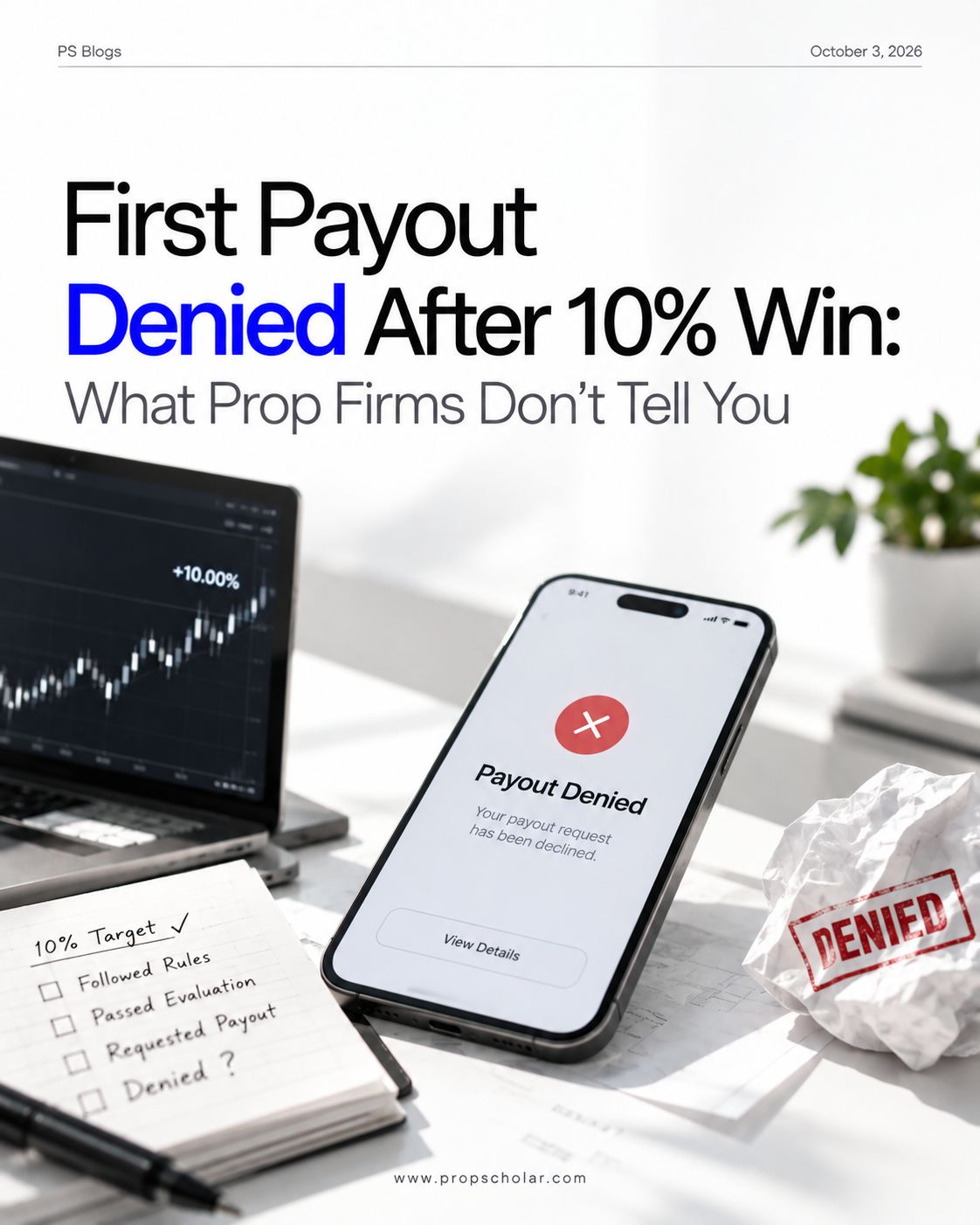
First Payout Denied After 10% Win: What Prop Firms Don't Tell You
11 min read
Trader Safety
How to Avoid Scam Prop Firms and Choose a Top-Tier Firm on a Small Budget in 2026
17 min read
Trader Safety
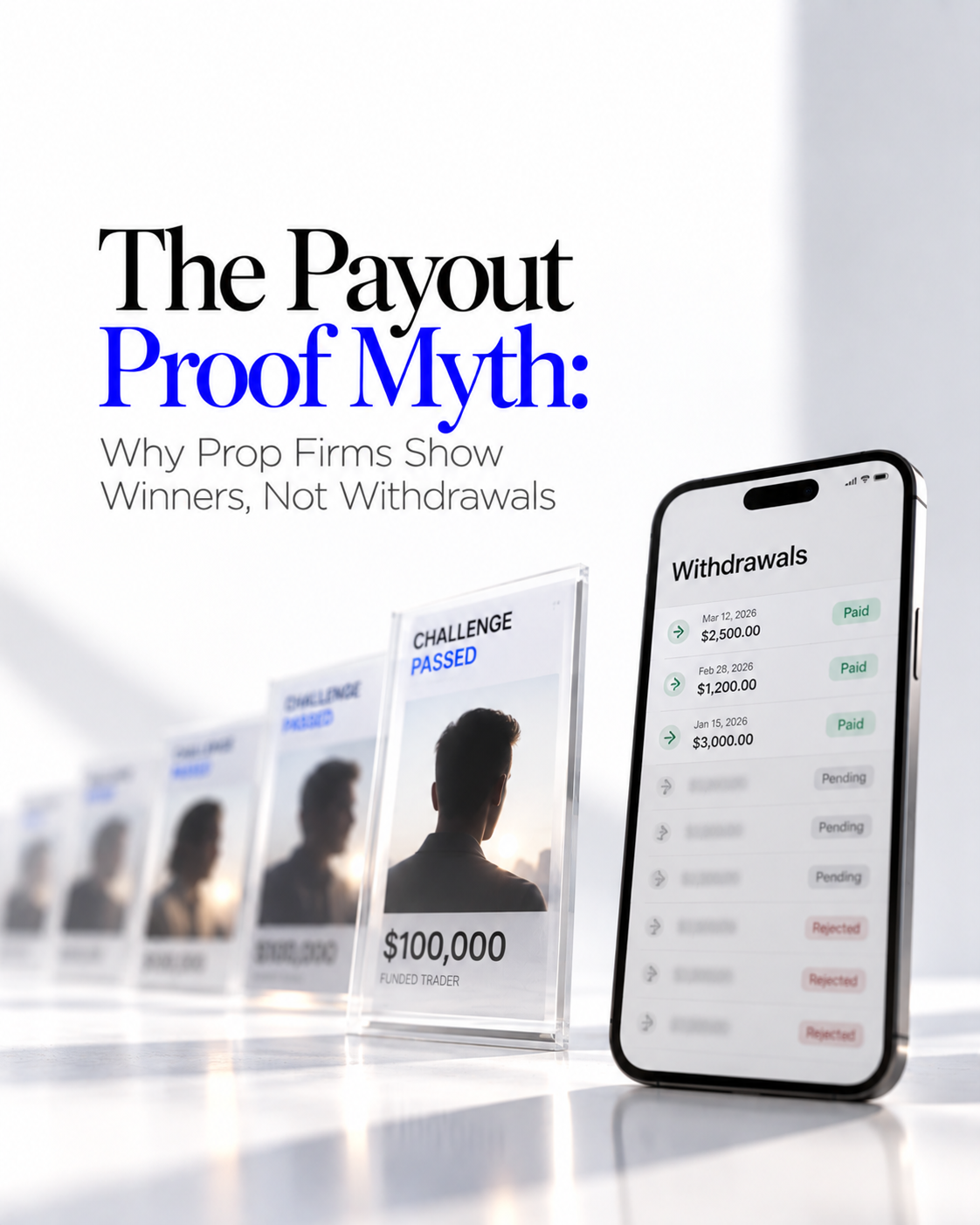
The Payout Proof Myth: Why Prop Firms Show Winners, Not Withdrawals
11 min read

Trader Safety
Activation Fee Shock After Passing: What Traders Actually Pay
13 min read
Trader Safety
Payout Proof Verification: Check PropScholar's Public Blockchain Records
9 min read

Trader Safety
No Money to Lose? How to Start Trading in 2026 Without Risking Your Own Capital
14 min read