
Fake Payout Proof: How to Check If a Prop Firm Really Pays in 2026
Screenshots lie. Canva certificates get recycled. This guide shows you exactly what real payout proof looks like, the five red flags that expose a fake, and a step-by-step method to verify before you pay a single cent to any evaluation platform in 2026.
Screenshots lie. Canva certificates get recycled. This guide shows you exactly what real payout proof looks like, the five red flags that expose a fake, and a step-by-step method to verify before you pay a single cent to any evaluation platform in 2026.
Start your evaluationFake Payout Proof: How to Check If a Prop Firm Really Pays in 2026
TL;DR: Payout screenshots can be edited in minutes. Real proof is public, independently verifiable, and tied to a unique reference anyone can look up. This guide shows you the exact checks to run before paying any evaluation platform, and uses PropScholar's public payout system as the standard to measure against.
Key takeaways:
- A single screenshot proves nothing. Anyone with a free image editor can create one.
- Real proof is a public, searchable record with a unique code, consistent amounts, and verifiable dates.
- Five specific red flags will expose a fake within two minutes of looking.
- PropScholar processes payouts within 4 hours of a pass and publishes every record at PropScholar's public payout proofs.
- Starting costs as low as $5 (Freedom 5K) mean the financial exposure while you check a platform is genuinely small.
You found a platform. The testimonials look convincing. There's a grid of screenshots: bank transfers, USDT receipts, PayPal confirmations, all with the platform's logo watermarked across the top. Some even have a trader's first name and country. It feels real.
It might not be.
Faking a payout screenshot takes about four minutes. A free tool, a real transaction image from Google, a credible amount, the right font. Done. The question you actually need to answer before you pay anything is not "do these screenshots exist" but "can I verify any of this independently, without trusting the platform itself?"
That distinction is everything.
Why Payout Screenshots Are So Easy to Fake
The problem isn't that traders are naive. It's that screenshots are structurally unverifiable. A screenshot is an image file. It carries no metadata that proves what was on screen when it was taken, no link back to a real transaction, and no way for a third party to confirm the amount moved.
An edited screenshot of a PayPal receipt or a USDT transfer looks identical to a real one. The font, the layout, the currency symbol. All of it can be reproduced in a few minutes using tools anyone can access for free. And once a platform has a convincing library of fake proofs, they look more credible than a legitimate platform that simply hasn't gotten around to building a public record.
This is the core asymmetry. Faking proof is cheap and fast. Building genuine, verifiable infrastructure is expensive and slow. So when you see a wall of screenshots, your first question should not be "do these look real?" but "where is the independent verification?"
The platforms that pay do not need you to trust screenshots. They have something better.
The Five Red Flags That Expose a Fake Payout Proof
You don't need technical skills to catch most fakes. You need to know what to look for.
No public, searchable record exists
If every payout is shown as a screenshot on the platform's own website or social media, and there is no independently searchable database where you can type in a reference number and confirm it, that is the single biggest warning sign. Real payment infrastructure generates transaction IDs. Real platforms publish them.
The amounts cluster suspiciously
Look at the numbers. If a platform claims to have paid hundreds of traders and the amounts are almost always round figures like $100, $200, or $500, ask why. Real payout distributions are uneven. They reflect the actual variety of evaluation sizes and profit splits traders earned. When every screenshot shows a suspiciously tidy number, someone chose those numbers.
Dates and amounts don't add up internally
If you see a payout certificate dated three months ago for an account that the platform only launched two months ago, that's a problem. Same if the payout amounts on certificates don't match the stated payout structure anywhere on the platform's public pages. These inconsistencies appear when proofs are assembled quickly without cross-checking.
The certificate has no unique identifier
A genuine payout certificate should carry a unique reference code that ties it to a specific transaction in the platform's records. If you can't take that code, go to the platform's verification page, enter it, and get a matching result, the certificate is not independently verifiable. It's a branded image, nothing more.
The trader community is thin or controlled
This one is softer, but it matters. A platform that genuinely pays traders will have an active community of people talking about their experience, including complaints, in a space the platform doesn't fully control. If every testimonial lives on the platform's own social media page and the Discord or Telegram has no real conversation, that's a signal. Real traders talk. If they're being paid, they tell people. If they're not, they tell people differently.
For patterns that go beyond payout proof, the activation fee shock article covers another way platforms collect money without delivering value.
What Real Payout Proof Actually Looks Like
Real proof has three properties: it's public, it's specific, and it's independently verifiable without trusting the platform's word.
Public means anyone can access the record, not just people logged into the platform. You shouldn't need an account to see that payouts are happening.
Specific means each record includes a unique transaction reference, the date it was processed, and an amount that matches the stated payout structure for that evaluation size.
Independently verifiable means you can cross-reference it. Enter a code and get a result. Check a date against an on-chain transaction if the payment was in crypto. Confirm the amount matches what the evaluation rules promised.
PropScholar publishes every payout at PropScholar's public payout proofs. No login required. No screenshot gallery. Each record is tied to the specific evaluation passed and the amount paid. When a trader in Nigeria or the Philippines passes a Freedom 10K evaluation at PropScholar, the $42 payout is processed within 4 hours and the record goes into that public list. Anyone can check it.
That's the standard to hold any platform against.
A Step-by-Step Verification Process Before You Pay
Run this before paying any evaluation platform, including PropScholar.
First, find the public payout page. Not a testimonials page, not a social media feed. A dedicated page where individual payout records are listed with reference numbers and dates. If it doesn't exist, stop.
Second, pick three records at random from different months. Check whether the amounts match the platform's stated payout structure. If the platform says passing a $10,000 evaluation pays $42, the records should reflect that. If numbers don't match the stated structure, ask why in writing.
Third, search the payout reference or any unique code on the page. For crypto payouts, a transaction hash can be entered into a block explorer to confirm it occurred. For PayPal or bank transfers, the platform should be able to provide a transaction reference you can verify independently.
Fourth, find the platform's community in a space they don't fully moderate. A Discord server they own is not independent. Look for mentions in trading forums, Reddit threads, or Telegram groups where traders discuss experiences freely. What do people say about actually receiving money?
Fifth, check company registration. PropScholar is registered as a Private Limited company in India (CIN U85499JH2026PTC027330). That's a real, verifiable record in a government database. If a platform can't tell you where it's legally registered and you can't find that registration, treat it with significant caution.
For a broader look at how some platforms mislead traders before you even reach the payout stage, the bootcamp accounts article is worth reading.
Why This Matters More in Emerging Markets
If you're trading from Nigeria, Pakistan, Bangladesh, the Philippines, or Indonesia, the stakes of getting this wrong are higher. You're converting local currency into USDT or using PayPal to pay an international platform. Getting it wrong doesn't just cost you the entry fee. It costs you the currency conversion, the time, and sometimes a significant portion of your monthly income.
Platforms that target emerging market traders with fake proof know this. They know the entry fee of $50 or $100 represents real sacrifice for many people. The fake proof is designed to give you just enough confidence to convert your Naira or Rupiah or Peso and send it.
The solution is not to avoid evaluation platforms entirely. It's to run the verification steps above before paying, and to start with platforms where the entry fee is small enough that your financial exposure is minimal while you check. A Freedom 5K at PropScholar costs $5. If you run the checks and something feels off, you haven't lost much. If everything checks out, you've paid $5 for an evaluation that pays $20 when you pass.
The mentor fee article covers a related pattern: how some trading educators build credibility with the same kind of selective proof that evaluation platforms use to fake legitimacy.
PropScholar's Payout Model: What Makes It Verifiable
PropScholar is not a prop firm. It's a scholarship-based trading evaluation platform operated by PropScholar Private Limited, a registered Indian company. That distinction matters for how payouts work.
When you pass a PropScholar evaluation, you receive a direct scholarship payout, processed within 4 hours of your pass. The Freedom 5K costs $5 and pays $20. The Freedom 10K costs $10 and pays $42. These numbers are fixed, published, and appear in the public payout records. There is no "pay after pass" catch, no activation fee, no monthly subscription.
Payments go out in USDT for international traders (India-based traders receive UPI transfers). PayPal is also available at checkout for international traders who prefer it. The 4-hour processing time is not a marketing claim. It's a commitment that appears in the public record: you can see the timestamp on each payout.
The lot limits on Freedom accounts are real and worth knowing. On the Freedom 10K, for example, you're capped at 4.00 lots open in forex, 0.40 in gold, 0.20 in BTCUSD at any one time. Those limits exist and they constrain certain strategies. Saying that upfront is part of what makes the rest of the model credible. Any platform that lists only benefits with no real constraints is worth scrutinizing harder.
The community around the platform is also publicly accessible. Over 3,000 traders are in the PropScholar Discord, where you can ask real questions of real people who have gone through the evaluation, including people who didn't pass.
The Connection Between Fake Proof and Other Trader Safety Issues
Fake payout proof doesn't exist in isolation. It's usually one part of a larger pattern that includes unverifiable credentials, vague terms that only become clear after you've paid, and communities that feel active but are actually controlled.
The Telegram signal groups article covers how the same logic applies to signal sellers: someone shows you a screenshot of a winning trade, you can't verify whether it's real, and by the time you find out it isn't, you've already paid the subscription fee.
The pattern is consistent: show selective, unverifiable proof of success, collect money before the proof falls apart, move on. The antidote in every case is the same question: can I verify this independently, without trusting you?
A Note on What Verification Cannot Tell You
Running these checks will catch most fraudulent platforms. But verification has limits. A platform can have real, genuine payouts in its public record and still have terms that make it very hard to pass its evaluation. It can pay some traders and find reasons to disqualify others.
Verification tells you the platform has paid people. It doesn't tell you the evaluation is fair or that you will pass. That's a separate question that requires reading the full ruleset carefully before you pay. PropScholar's complete terms are published at propscholar.com/terms-of-use. Any platform that doesn't have a publicly accessible ruleset is a reason to pause before paying.
Trading evaluations carry real risk of losing your entry fee if you don't pass. That's honest. The entry fee is small by design at PropScholar, specifically so that the downside of a failed attempt is manageable. But the risk is real and you should approach any evaluation with a strategy you've actually tested, not just confidence.
FAQs
How do I check if a prop firm's payout proof is real?
Look for a public, searchable payout record with unique reference numbers, not just screenshots. Check whether the amounts match the platform's stated payout structure. For crypto payouts, verify the transaction hash on a block explorer. If the only proof available is a gallery of screenshots on the platform's own website, treat that as insufficient evidence of real payments.Can a payout screenshot be faked?
Yes, easily. A PayPal receipt, a bank transfer confirmation, or a USDT transaction screenshot can be reproduced using free image editing tools in a few minutes. Screenshots carry no metadata that proves a real transaction occurred. That's why independently verifiable records with unique transaction references matter more than any screenshot, no matter how convincing it looks.What does PropScholar payout proof look like?
PropScholar publishes each payout in a public record at propscholar.com/payout-proof. No login is required to view it. Each entry includes the evaluation type, the amount paid, and a timestamp. Payouts are processed within 4 hours of a pass. This record exists independently of social media screenshots and can be checked by anyone before paying.Is PropScholar a legitimate company?
PropScholar is a Private Limited company registered in India under CIN U85499JH2026PTC027330. It is a scholarship-based trading evaluation platform, not a prop firm. It has been operating for over 1.5 years, maintains a Discord community of 3,000+ traders, and publishes its payout records publicly. Its full terms of use are publicly accessible before any purchase.What payment methods does PropScholar accept for international traders?
International traders can pay using USDT (crypto via NOWPayments) or PayPal. India-based traders pay via UPI. PropScholar does not accept bank transfers, mobile money wallets, or local payment apps as direct payment methods. The most common path for traders in Nigeria, Pakistan, the Philippines, and similar markets is buying USDT on a local P2P exchange and paying from there.How small can I start with PropScholar to test it first?
The Freedom 5K evaluation costs $5 (approximately Rs.499 in India). It's a one-step evaluation with a 10% profit target. Passing pays a $20 scholarship, processed within 4 hours. That's the smallest real starting point today, and the low entry cost means your financial exposure while checking the platform is genuinely minimal.What other red flags should I watch for beyond fake payout proof?
Watch for activation fees that appear only after you pass, monthly subscriptions that keep charging regardless of trading activity, evaluation rules that change retroactively, and terms only published after payment. A platform with genuinely fair terms will show you everything before you pay, including the constraints that work against you, not just the benefits.PropScholar is a scholarship-based trading evaluation platform operated by a Private Limited company registered in India. We are not a prop firm and do not manage or allocate institutional capital. Our model rewards proven trading skill with scholarship grants upon successful evaluation completion.
Related reading
- Are Free Funded Accounts Real? What 'Free' Prop Offers Actually Cost You
- Is PropScholar Legit or Fake? The Honest 2026 Review Every Trader Should Read Before Paying
- Is PropScholar Legit? An Honest Review With Payout Proof
- UPI Funding Cap Trap: Why Indian Prop Traders Lose Money Before They Start (2026)
- How to Check If a Prop Firm Is Registered and Trustworthy
- The Safest Way for a College Student to Start Trading and Not Lose Money
Ready to Prove Your Edge?
Join 500+ traders. Start from just $5. Get funded within days.
Frequently Asked Questions
Look for a public, searchable payout record with unique reference numbers, not just screenshots. Check whether the amounts match the platform's stated payout structure. For crypto payouts, verify the transaction hash on a block explorer. If the only proof available is a gallery of screenshots on the platform's own website, treat that as insufficient evidence of real payments.
More From PropScholar
Trader Safety
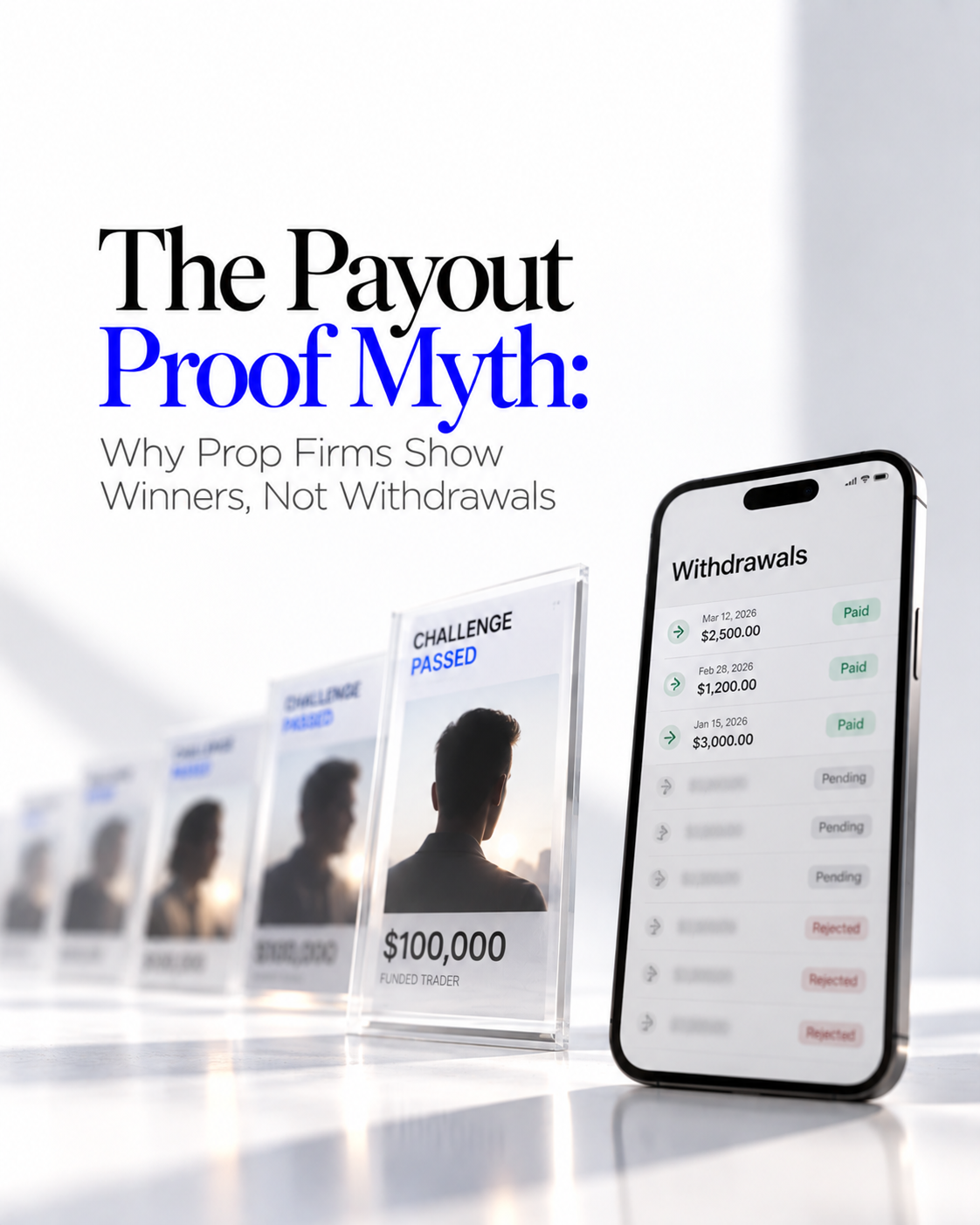
The Payout Proof Myth: Why Prop Firms Show Winners, Not Withdrawals
11 min read
Trader Safety
How to Avoid Prop Firm Scams in 2026: A PropScholar Checklist
12 min read
Trader Safety
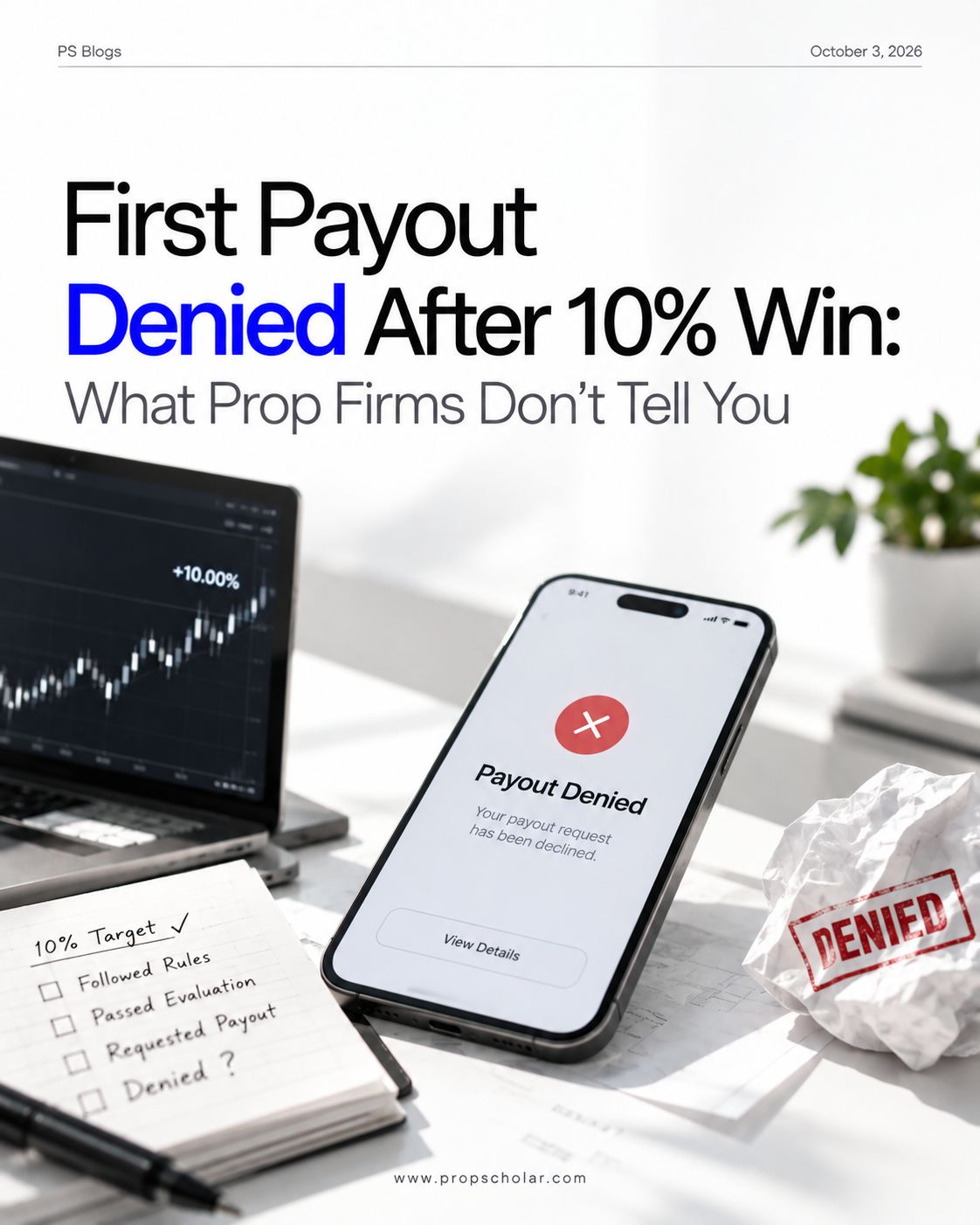
First Payout Denied After 10% Win: What Prop Firms Don't Tell You
11 min read
Trader Safety
Blockchain vs Screenshot: How to Check If a Prop Firm's Payout Proof Is Real
13 min read
Evaluation Models
Free Prop Firm Trials Are a Sales Funnel: What Rs.499 Gets You Instead
13 min read
Trader Safety
Verify Prop Firm Payouts Without a Lawyer: 3 Free Methods
11 min read