UPI Funding Cap Trap: Why Indian Prop Traders Lose Money Before They Start (2026)
Most Indian traders don't realize UPI's transaction limits and international payment restrictions can silently drain their budget before a single trade is placed. Here's exactly what the UPI funding cap trap looks like, why it catches so many beginners, and how a scholarship-based evaluation platform like PropScholar is designed to work around it.
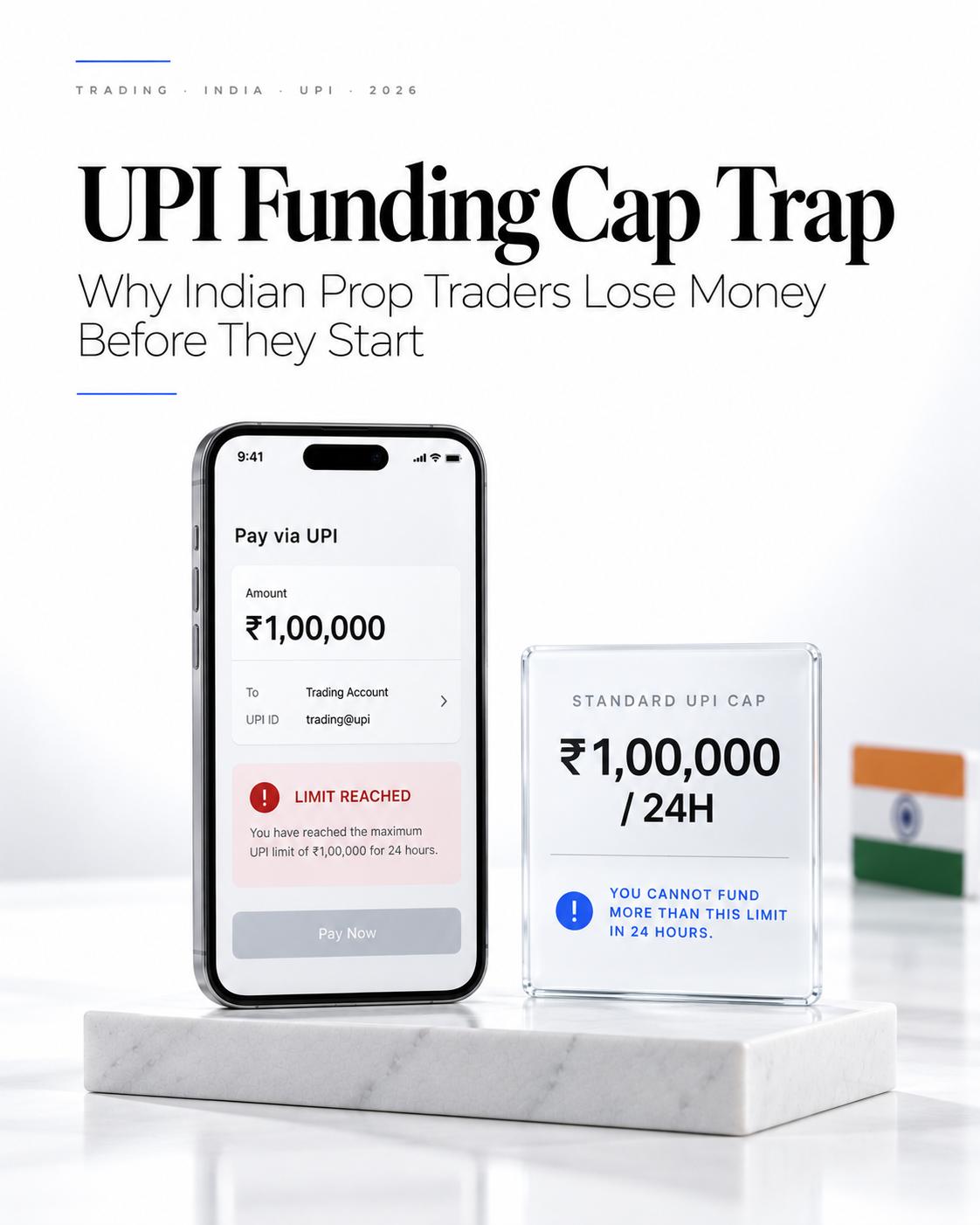
Most Indian traders don't realize UPI's transaction limits and international payment restrictions can silently drain their budget before a single trade is placed. Here's exactly what the UPI funding cap trap looks like, why it catches so many beginners, and how a scholarship-based evaluation platform like PropScholar is designed to work around it.
Start your evaluationUPI Funding Cap Trap: Why Indian Prop Traders Lose Money Before They Start (2026)
TL;DR: UPI's transaction limits, international merchant blocks, and currency conversion costs can silently eat into your trading budget before you've placed a single trade. Knowing the exact mechanics of this trap — and choosing platforms built around it — is the difference between starting smart and starting broke.
Key takeaways:
- UPI blocks most international merchant transactions by default, making it impossible to pay many overseas prop firms directly
- Currency conversion fees and payment gateway markups add invisible costs on top of the advertised evaluation fee
- Failed payments can still trigger gateway charges, meaning you pay for nothing
- PropScholar accepts UPI (PhonePe, Razorpay, Cashfree) for Indian traders with entry from Rs.400, eliminating the international payment problem entirely
- Scholarships of up to 400% are paid within 4 hours of verification — no waiting weeks for a wire transfer
You've done your research, picked an evaluation, and you're ready to pay. You open PhonePe, punch in the amount, hit confirm — and the payment fails. You try again. Fails again. You check your balance; the money's there. So you try a different UPI app. Still nothing. Then you notice a small charge has appeared anyway.
This is the UPI funding cap trap, and it catches thousands of Indian traders every year before they've even opened a chart.
It's not a glitch. It's a structural conflict between how UPI was designed and how most prop-style evaluation platforms are built. Understanding it properly takes about five minutes. Not understanding it can cost you real money.
What Exactly Is the UPI Funding Cap and How Does It Block Payments?
UPI — the Unified Payments Interface built by NPCI — was designed primarily for domestic Indian transactions. It is a genuinely brilliant system for paying your landlord, splitting a dinner bill, or buying groceries. International merchant payments are a different story.
NPCI sets per-transaction limits on UPI payments, and individual banks layer their own caps on top of those. Most bank-linked UPI accounts have a per-transaction cap somewhere between Rs.1 lakh and Rs.2 lakh depending on the bank and account type. That sounds like plenty for a trading evaluation, and for domestic payments it is.
The harder problem is merchant category restrictions. Many Indian banks flag or outright block UPI payments to certain international merchant category codes — particularly those associated with financial services, forex, and trading. Your bank's fraud prevention system sees an attempted payment to an overseas financial platform and treats it like a suspicious transaction. The payment fails at the authorization stage. Your UPI app shows a generic error. The money may or may not have briefly left your account before bouncing back, but in some cases the payment gateway has already logged an attempted transaction and charged a small processing fee.
So you've paid something and received nothing.
The Currency Conversion Cost You're Probably Not Counting
Even when a UPI payment to an international platform does go through, you're not paying the amount you think you are.
Prop evaluation fees are almost always priced in USD. When you pay in INR via UPI, your bank applies its own exchange rate — which is not the interbank rate you see on Google. The bank's retail rate includes a margin, typically between 1.5% and 3.5% above the real rate. On top of that, many payment gateways add a cross-border transaction fee, sometimes labeled as a foreign currency markup and sometimes not labeled at all.
On a $50 evaluation fee, this might add Rs.100 to Rs.400 to your actual cost. On a $150 evaluation, it can easily add Rs.500 to Rs.1,000. That's before you account for GST applied to certain financial service transactions.
None of this shows up clearly on the checkout page. It surfaces on your bank statement two or three days later, quietly.
Why Failed Payments Still Cost You Money
This is the part most traders don't realize until it happens to them.
When a UPI payment is initiated toward an international platform, your bank authorizes the amount and holds it. The funds leave your available balance. If the transaction is then declined on the merchant side — which happens frequently with international financial merchant codes — the authorization hold has to reverse. That reversal typically takes 5 to 7 working days depending on your bank.
During that window, the money is inaccessible. If you tried to pay and the reversal hasn't completed, your second attempt may fail too because your balance appears insufficient. You might attempt the payment three times, have three holds running simultaneously, and effectively have three times your intended evaluation fee tied up and unusable for nearly a week.
And if the gateway charged a small processing fee per attempt — which some do — you've paid for three failed transactions.
The Markup Inside the Prop Firm Marketplace Model
There's a second layer to this trap that's specifically relevant to traders who use reseller platforms or third-party marketplaces to access prop firm evaluations.
Some platforms that sell access to international prop challenges mark up the USD price, convert it to INR at a rate they set, and then offer "UPI payment" as a feature. The UPI part is real. But the INR price you're paying may already embed a 10% to 20% conversion premium over the actual evaluation cost if you'd somehow been able to pay in USD directly.
This isn't always dishonest — the platform is carrying real forex risk and administrative costs. But if you're not comparing the INR price against the real USD fee converted at the interbank rate, you're paying a hidden markup that you never see itemized.
The right question to ask before paying any Indian-facing trading platform is: what is the USD price of this evaluation, and what exchange rate is being applied to arrive at the INR figure? Legitimate platforms can answer that clearly.
RBI Rules and the Legal Wrinkle Most Traders Ignore
India's Liberalised Remittance Scheme (LRS) governs how Indian residents send money abroad. Under LRS, an individual can remit up to $250,000 per financial year for permitted capital account and current account transactions. Trading evaluation fees technically fall into a gray area in terms of classification — they're not straightforwardly investments, they're not exactly services in the traditional sense, and different banks interpret them differently.
Some banks will process these payments without issue. Others will ask for documentation. A few will decline the payment entirely on compliance grounds, not technical ones.
This means the same payment that goes through fine on one bank's UPI will get flagged on another. If your primary account is with a conservative public sector bank, your failure rate on international trading platform payments is likely higher than if you're using a more tech-forward private bank. This isn't something most traders know to check before they try to pay.
How PropScholar Is Structured to Avoid This Entire Problem
PropScholar is a scholarship-based trading evaluation platform — not a prop firm — registered in India as a Private Limited company. That registration detail matters more than it might seem.
Because PropScholar is incorporated in India, its payment infrastructure is domestic. Indian traders pay via UPI through PhonePe, Razorpay, or Cashfree. There's no cross-border transaction. There's no international merchant code triggering your bank's fraud system. There's no currency conversion markup hiding in the checkout flow.
Entry starts at Rs.400 (approximately $5). That's not a promotional price or a stripped-down version of the product — it's a genuinely accessible entry point designed for traders who can't absorb the Rs.3,000 to Rs.15,000 entry fees that global platforms charge, plus conversion costs on top.
For traders outside India, PropScholar accepts crypto globally, which sidesteps the UPI problem from a different angle — useful context if you're reading this from a market where your local payment rails have similar restrictions to what Indian UPI faces internationally.
Passting the evaluation unlocks a scholarship of up to 400%, paid within 4 hours of verification. Not 4 business days. Not "up to 2 weeks for processing." Four hours. That's a meaningful operational commitment that most platforms pricing at ten times the entry fee can't match.
PropScholar also operates a marketplace for international prop firm challenges — priced in INR, payable via UPI. If you want access to a specific global prop firm's challenge but don't want to deal with failed UPI payments and conversion markups, the marketplace handles that friction for you. The key is that PropScholar is transparent about what you're buying. This matters because, as we've covered on the question of funded account payouts being denied after profit, opacity at the payment stage usually signals opacity at the payout stage too.
What to Check Before Paying Any Evaluation Platform From India
Three things. That's genuinely all you need to verify.
First, confirm whether the payment is domestic or cross-border. If the platform is incorporated internationally, your UPI payment is a cross-border transaction regardless of how the checkout page is designed. Ask directly. A domestic INR payment to an Indian-registered entity is categorically different from an INR-to-USD conversion routed through a payment gateway.
Second, calculate the real INR cost including conversion and fees. Take the USD price, apply the Google interbank rate, then add 2% to 3% for your bank's forex markup, plus any gateway surcharge. Compare that to the INR figure on the checkout page. If the platform's INR price is higher than your calculated figure, you've found a hidden markup.
Third, check the refund and reversal timeline in writing. If a payment fails, how long until the hold releases? If you fail the evaluation, is any fee refunded? These terms should be in the platform's public documentation — not a live chat response, not a promise in a Discord message. Public, permanent documentation.
PropScholar's rules are public and have never been changed retroactively since launch. That's a standard worth holding every platform to.
For more on the real cost landscape of evaluations, comparing prop evaluations by total cost rather than just entry fee covers the full picture, including the recurring attempt cost that turns a "cheap" challenge expensive over time.
The Real Cost of Ignoring This Before You Start
Let's put some concrete numbers on what the UPI trap actually costs a typical Indian beginner.
Say you find a global evaluation platform advertising a $49 entry fee. You attempt to pay via UPI. The payment fails twice — two authorization holds of approximately Rs.4,100 each, both frozen for 5 to 7 days. On the third attempt it goes through, but you're charged at your bank's retail exchange rate plus a 2% gateway fee, bringing the real cost to roughly Rs.4,450. Two processing fees of Rs.50 each for the failed attempts. Total outlay: Rs.4,550, of which Rs.4,450 was the evaluation and Rs.100 was pure waste on failed transactions.
Now run that same scenario at PropScholar. You pay Rs.400 via PhonePe. It's a domestic UPI transaction. It processes in seconds. No holds, no conversion markup, no failed attempt fees. You're trading the same day.
That's not a sales pitch — it's just arithmetic. And it's the kind of arithmetic that cheap trading challenges often obscure with bad math elsewhere.
One thing we see consistently across PropScholar's 3,000+ trader Discord community: traders who hit the UPI trap with another platform often don't talk about it publicly because it feels embarrassing. It shouldn't. The trap is structural. It exists because global platforms weren't built with the Indian payment stack in mind. Choosing a platform that was built with it in mind isn't settling — it's just smart.
Frequently Asked Questions
Why does my UPI payment to a prop firm keep failing even though I have enough balance? The issue usually isn't your balance — it's your bank's merchant category block. Many Indian banks restrict UPI payments to international financial service merchants, particularly those in the trading and forex space. Your bank's system may be flagging the transaction at the authorization stage before it ever reaches the platform. Switching banks or using a payment method that bypasses this restriction is the practical fix.
Does the failed UPI payment charge me even though it didn't go through? Sometimes, yes. Some payment gateways charge a small processing fee per attempt regardless of outcome. More commonly, the bigger problem is an authorization hold — your bank freezes the funds for 5 to 7 working days even though the transaction failed. This means you can end up with money locked and inaccessible without getting anything in return.
Is PropScholar a prop firm, and how does its payment system work for Indian traders? PropScholar is not a prop firm. It's a scholarship-based trading evaluation platform registered as a Private Limited company in India. Because it's a domestic Indian entity, Indian traders pay via UPI — PhonePe, Razorpay, or Cashfree — with no cross-border transaction involved. Entry starts at Rs.400. Scholarships of up to 400% are paid within 4 hours of verification.
What is the LRS and does it affect my ability to pay prop firms from India? The Liberalised Remittance Scheme (LRS) governs international money transfers by Indian residents. Payments to overseas trading platforms fall into a regulatory gray area that different banks interpret differently. Some process them without issue; others request documentation or decline entirely. This inconsistency is one reason domestic platforms with INR-native payment processing eliminate significant friction for Indian traders.
How do I avoid hidden currency conversion costs when paying for trading evaluations? Calculate the real cost yourself before paying. Take the USD price, apply the Google interbank rate, add 2 to 3 percent for your bank's forex markup, and compare it to the INR figure on the checkout page. If the platform's price is higher than your calculation, there's a hidden markup. Choosing an Indian-registered platform that prices in INR from the start eliminates this entirely.
Can I use crypto to pay PropScholar if UPI doesn't work for me? Yes. PropScholar accepts crypto for traders globally. This makes it accessible in markets where local payment rails face restrictions similar to UPI's international limitations — and it means Indian traders who prefer crypto have that option alongside UPI.
Where can I verify that PropScholar actually pays out before I invest anything? The PropScholar Discord community at discord.gg/uTU85z4hft has over 3,000 traders and includes real payout proof from verified members. You can also check the blog at propscholar.com for documented trader stories. Evaluating payout proof before committing is exactly the right instinct — for a broader guide on what legitimate proof looks like, the article on spotting fake payout screenshots is worth reading first.
PropScholar is a scholarship-based trading evaluation platform operated by a Private Limited company registered in India. We are not a prop firm and do not manage or allocate institutional capital. Our model rewards proven trading skill with scholarship grants upon successful evaluation completion.
Related reading
- Are Free Funded Accounts Real? What 'Free' Prop Offers Actually Cost You
- Is PropScholar Legit or Fake? The Honest 2026 Review Every Trader Should Read Before Paying
- The Safest Way for a College Student to Start Trading and Not Lose Money
- Cheap Prop Firm No Consistency Rule 2026: Skip the 15% Trap
- Is PropScholar Legit? An Honest Review With Payout Proof
- Alternatives to Prop Firms That Change Rules After You Pass
Ready to Prove Your Edge?
Join 500+ traders. Start from just $5. Get funded within days.
Frequently Asked Questions
The issue usually isn't your balance — it's your bank's merchant category block. Many Indian banks restrict UPI payments to international financial service merchants, particularly those in the trading and forex space. Your bank's system flags the transaction at the authorization stage before it ever reaches the platform. Switching banks or using a platform with domestic INR payment processing is the practical fix.