
Prop Firm With No Minimum Trading Days: What Happens When You Hit Target on Day One
Most prop evaluations punish speed. They force you to trade for 10, 20, even 30 days before you can pass — even if you've already hit the profit target. This guide explains exactly what no-minimum-trading-days means, what actually happens when you hit your target on day one, and how PropScholar's Freedom Challenge is built around this principle with a fastest recorded pass of 2 hours.
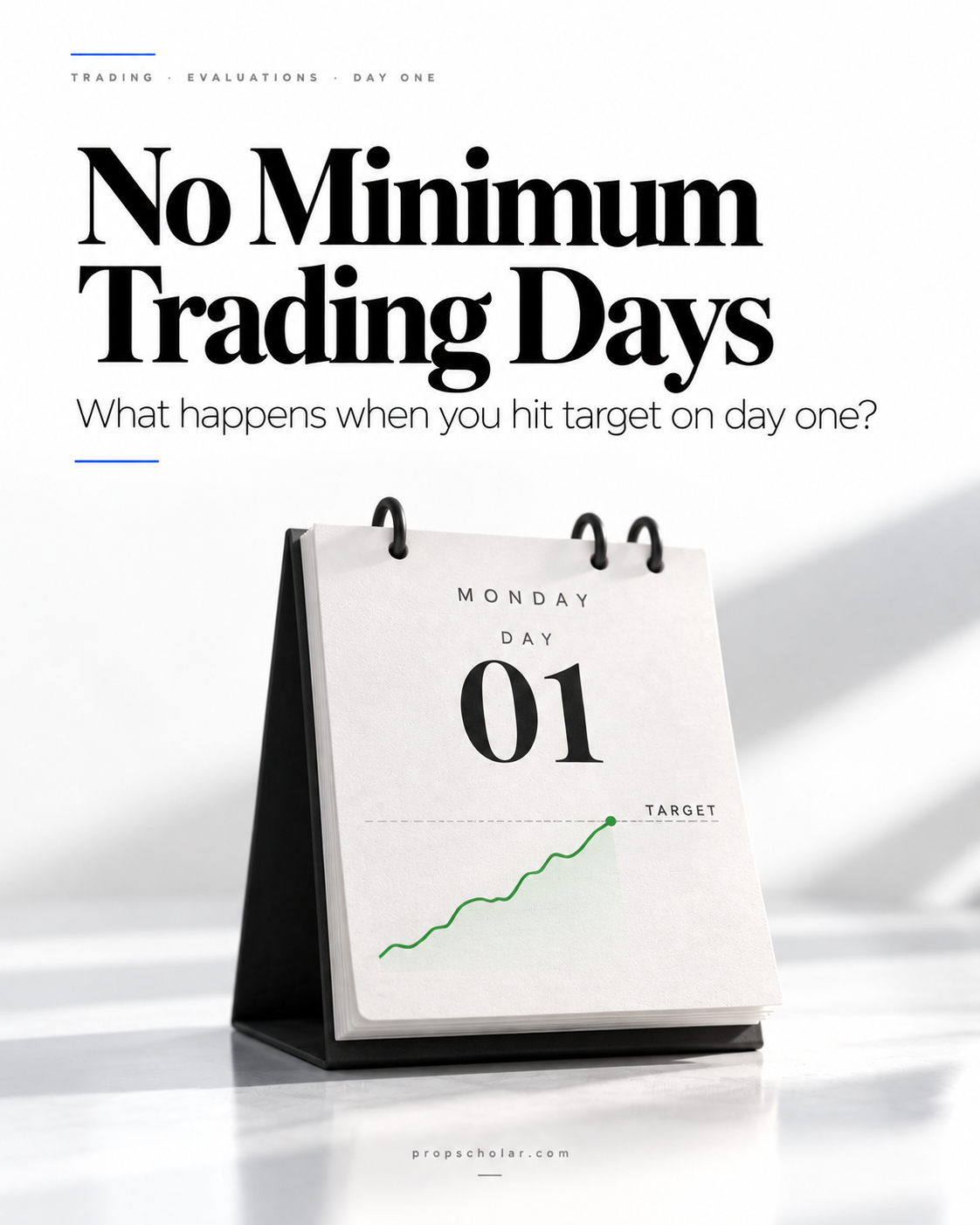
Most prop evaluations punish speed. They force you to trade for 10, 20, even 30 days before you can pass — even if you've already hit the profit target. This guide explains exactly what no-minimum-trading-days means, what actually happens when you hit your target on day one, and how PropScholar's Freedom Challenge is built around this principle with a fastest recorded pass of 2 hours.
Start your evaluationProp Firm With No Minimum Trading Days: What Happens When You Hit Target on Day One
TL;DR: Most evaluations make you trade for weeks even after you've hit the profit target. PropScholar's Freedom Challenge has zero minimum trading days — hit your 10% target on day one and you can request your scholarship the same day. The fastest recorded pass is 2 hours.
Key takeaways:
- No minimum trading days means the evaluation ends when you hit the target, not when a calendar says so.
- PropScholar's Freedom Challenge is a single-step evaluation starting from $5 entry, with a 10% profit target and a 6% max loss.
- There are no minimum profitable days and no consistency rules — your method is your own.
- Scholarships of $20, $42, or $100 (for $5K, $10K, $25K accounts respectively) are processed within 4 hours of your verification request.
- The fastest recorded pass on the Freedom Challenge is 2 hours. It's publicly verifiable at propscholar.com/payout-proof.
You've had that session. The kind where everything clicks — entries are clean, the market cooperates, and you bank your profit target before lunch. Under most evaluation structures, that win means absolutely nothing. You still have to grind through day five, day ten, sometimes day twenty, proving things that your P&L already proved in the first session.
That rule exists for a reason — platforms that impose minimum day counts argue it filters out lucky one-session traders. There's a version of that argument that makes sense. But taken too far, it penalizes traders who are genuinely skilled, fast-decision-makers, or scalpers by design. It turns a performance test into a waiting room.
This guide explains exactly how no-minimum-day evaluations work, what the real risks are on both sides, and why PropScholar's Freedom Challenge is built the way it is.
What Does "No Minimum Trading Days" Actually Mean?
It means the evaluation has no calendar floor. You are judged on whether you hit the profit target without breaching the loss rules — full stop. The clock doesn't decide your fate, your trading does.
In practice, this matters most to three types of traders. Scalpers who take 20 to 50 trades in a single session and capture target in hours. Swing traders who get an outsized move early, bank it, and don't want to risk giving it back to satisfy an arbitrary day count. And part-time traders who only have a handful of serious sessions available each month and need every one of them to count.
For all three, minimum trading day requirements are a structural punishment for competence. If you've hit the target cleanly without breaking any rules, you've demonstrated what you need to demonstrate.
How PropScholar's Freedom Challenge Is Structured
The Freedom Challenge runs across three account sizes: $5,000, $10,000, and $25,000. Entry fees start at $5 for the $5K account, $10 for the $10K account, and $25 for the $25K account. That's not a typo — the $10K evaluation genuinely costs $10.
It's a single-step evaluation. You don't pass phase one and then repeat the exercise in phase two. You pass once, you're done.
The rules are straightforward:
Profit target: 10% of initial account size. On a $10,000 account that's $1,000.
Max loss: 6% of the initial account size. On a $10,000 account that's $600 total drawdown from your starting balance. Not trailing, not from your peak — from the starting balance. That distinction matters enormously and we'll come back to it.
Daily loss limit: 3% of the higher of your starting equity or your current balance. If you've grown your account, that floor rises with you.
Leverage: 1:50.
No time limit. No minimum trading days. No minimum profitable days.
Weekend holding: allowed.
News trading: not allowed.
Inactivity rule: 14 consecutive days without a trade will close the account. Open at least one trade per fortnight.
All rules are publicly available at propscholar.com/terms-of-use. They've never been changed retroactively.
What Happens on Day One If You Hit the Target?
You request your scholarship. That's it.
Once you've hit your 10% profit target without breaching the max loss or daily loss rules, the evaluation is complete. PropScholar processes scholarship payments within 4 hours of the verification request being submitted. The fastest recorded pass on the platform is 2 hours from account open to evaluation complete.
The scholarships are: $20 for a $5,000 account pass, $42 for a $10,000 account pass, $100 for a $25,000 account pass. These are paid out on request; you're not waiting for a monthly cycle or a manual review window.
Payout proof is publicly verifiable at propscholar.com/payout-proof. We put it there because claims are cheap — actual transaction receipts are not.
The Max Loss Rule: Why Static Drawdown Changes Everything
This is the detail most traders miss when they compare evaluations. A 6% max loss calculated from your initial balance behaves very differently from a 6% trailing drawdown calculated from your peak equity.
With a trailing drawdown, a good early session can actually shrink your effective buffer. If you run a $10,000 account up to $10,800 and then give back $600, you're at $10,200 — but a trailing system might close you out because your drawdown from peak is $600, which equals or exceeds the limit. You banked a profit and still got flagged.
With a static drawdown from starting balance, your risk envelope is fixed. Your $600 buffer on a $10K account doesn't shrink because you had a good day. If you run the account up to $11,000 and then pull back to $10,401, you're still inside the rules. Your gains don't become a trap.
For traders who hit target early and fast, this is a meaningful difference. It means you can hold a runner into the second session without your earlier success becoming a liability.
The Lot Size Limits You Need to Know Before You Trade
PropScholar enforces maximum open lot limits per asset class on the $10,000 account. These are concurrent limits, not cumulative — meaning they apply to your total open positions at any one moment, not to your total traded volume over the session.
Forex
4.00 lots maximum open across all forex pairs combined.Gold (XAUUSD)
0.40 lots maximum open.Silver
1.00 lot maximum open.BTCUSD
0.20 lots maximum open.ETHUSD
1.00 lot maximum open.NAS100
0.50 lots maximum open.US30
0.30 lots maximum open.US500
0.75 lots maximum open.Each asset class is independent. You cannot borrow headroom from one class to apply to another. If you're at your forex limit, holding a gold position doesn't change that. Plan your sizing before the session, not during it.
This isn't a punitive rule — it's risk architecture. A platform that lets you pass in a day needs hard position limits to ensure that a single explosive move can't distort the evaluation results or create systemic exposure. The limits are enforced server-side, so there's no ambiguity.
One Account Per Trader: What the Server-Side Enforcement Means
Each trader is allowed one Freedom account at a time. This is enforced server-side, not on the honor system.
If you fail, you re-enter. You pay the entry fee again and you get a clean account. There's no compounding of failed accounts, no debt to the platform, no emotional baggage from the previous attempt lingering in your balance. You lose the entry fee and nothing else — $5 or $10 is a concrete, known cost.
For beginners, this structure has a real psychological advantage. There's a defined worst-case outcome before you start. It doesn't creep on you.
Who Benefits Most From a No-Minimum-Days Structure?
Scalpers are the obvious winners. If your edge is high-frequency intraday execution and you can clear 10% in a compressed timeframe, you shouldn't be penalized for the strategy working.
But swing traders benefit too, in a different way. The 14-day inactivity rule is permissive enough that a swing trader can take one or two positions per week, hold over weekends, and operate without the anxiety of a daily trade requirement. You're not forced to manufacture setups.
Part-time traders — people with day jobs, students with lecture schedules, parents with unpredictable hours — get the most structural relief. You don't need to be in front of the screen every day. You need to trade at least once every 14 days and not blow the risk rules. That's it.
The Freedom Challenge was designed around that reality. The name isn't marketing. It describes the actual constraint set.
Global Access: This Is Not India-Only
PropScholar accepts crypto deposits globally. If you're trading from Nigeria, the Philippines, Indonesia, South Africa, Kenya, Vietnam, or anywhere else where mainstream payment rails into international platforms are unreliable, crypto is the entry route and it works cleanly.
The $5 and $10 entry points were set deliberately low because the founding reality of this platform is that most talented traders in emerging markets are locked out by entry fees, not by skill. A $200 evaluation fee is a week's income in many of these markets. A $10 evaluation fee is not.
24/7 support runs in Hindi and multiple languages. The Discord has over 3,000 traders. There are people in that server from across South and Southeast Asia, West Africa, and beyond. If you want to see real payout proof from people in markets similar to yours before you commit, that's the right place to look.
How PropScholar Compares to Evaluations With Minimum Day Requirements
Evaluations requiring 5 to 10 minimum trading days
These are usually paired with a consistency rule — your best day's profit can't exceed a certain percentage of your total profit. Even if you're profitable across all five days, your pass can be rejected because one exceptional session skewed the ratio. PropScholar has no consistency rule and no minimum days. A 2-hour pass is a valid pass.Evaluations requiring minimum profitable days
Some platforms require you to close a set number of profitable trading days, separate from hitting the overall target. A single losing day resets the count. PropScholar's Freedom Challenge has no minimum profitable days. If you hit 10% net across any combination of winning and losing days without breaching the drawdown rules, you pass.Two-step evaluations with calendar-based phases
Phase one might run 30 days minimum, phase two another 60. The target resets. The risk rules sometimes tighten. PropScholar is one step. One target. One set of rules from start to finish.Evaluations with high entry fees
Global platforms frequently charge $100 to $500 for comparable account sizes. At those prices, a failed attempt is a genuine financial setback. PropScholar's $10 for a $10K account means a failed attempt costs less than a single bad trade at a retail broker.One Thing Worth Saying Clearly
No minimum trading days does not mean no rules. The max loss, the daily loss, the lot limits, the news trading restriction, the inactivity threshold — all of those still apply and they're enforced precisely. What doesn't apply is the calendar. You're not required to perform over a specific number of sessions. You're required to perform within specific risk parameters.
The distinction sounds small. In practice, it changes the entire psychology of the evaluation. You're managing your trading, not managing your trading plus a countdown timer.
We've seen traders from our community pass in two hours. We've also seen traders take several weeks, working carefully through volatile market conditions, holding positions over weekends, logging in every few days. Both are valid. Both paths are open under these rules.
If you want to read the full rule set before committing, they're at propscholar.com/terms-of-use. If you want to talk to other traders who've been through it, join the Discord. And if you're ready to start, the Freedom Challenge is in the shop.
FAQ
Can you really pass a prop firm evaluation in one day with no minimum trading days?
Yes. PropScholar's Freedom Challenge has no minimum trading days, no minimum profitable days, and no consistency rule. The fastest recorded pass on the platform is 2 hours. Once you hit the 10% profit target without breaching the 6% max loss or 3% daily loss rules, the evaluation is complete and you can request your scholarship immediately.What happens when you hit the profit target on day one in PropScholar's Freedom Challenge?
You request your scholarship. PropScholar processes scholarship payments within 4 hours of the verification request. There's no waiting period, no second phase, and no calendar delay. Your pass is valid regardless of how many days it took — even if it took one session.What is the max loss rule in the Freedom Challenge and how does it work?
The max loss is 6% of your initial account size, calculated from your starting balance — not from your peak equity. On a $10,000 account, your total drawdown limit is $600 from your opening balance. This static calculation means strong early performance doesn't shrink your risk buffer the way a trailing drawdown would.Is PropScholar's Freedom Challenge available outside India?
Yes. PropScholar is a globally accessible platform. Crypto deposits are accepted worldwide, making it accessible from Nigeria, the Philippines, Indonesia, South Africa, Kenya, Vietnam, and anywhere else. The entry fee starts at $5, specifically to remain accessible in markets where high evaluation fees are a barrier to participation.What are the lot size limits on the $10,000 Freedom Challenge account?
Maximum concurrent open positions on the $10K account: 4.00 lots forex, 0.40 lots gold, 1.00 lot silver, 0.20 lots BTCUSD, 1.00 lot ETHUSD, 0.50 lots NAS100, 0.30 lots US30, 0.75 lots US500. These are independent per asset class — headroom from one class cannot be applied to another.What disqualifies you from passing the Freedom Challenge even if you hit the profit target?
You can be disqualified by: breaching the 6% total max loss from starting balance, breaching the 3% daily loss limit, trading during news events (news trading is not allowed), or going 14 consecutive days without placing a trade. Hitting the profit target while breaching any of these rules does not result in a pass.How much is the scholarship payout for passing the Freedom Challenge?
Scholarship amounts are $20 for a $5,000 account pass, $42 for a $10,000 account pass, and $100 for a $25,000 account pass. Payments are processed within 4 hours of the verification request. Payout proof is publicly verifiable at propscholar.com/payout-proof.PropScholar is a scholarship-based trading evaluation platform operated by a Private Limited company registered in India. We are not a prop firm and do not manage or allocate institutional capital. Our model rewards proven trading skill with scholarship grants upon successful evaluation completion.
Related reading
- What Does a $1 Prop Firm Account Actually Get You?
- Best $1 Trading Challenge 2026: Why 1K 1-Step Wins
- The ₹90 Funded-Account Challenge: PropScholar's 1K 1-Step Trial for Indian Traders (Pay with UPI)
- Cheapest Legit Way to Access a Funded-Style Trading Account From $5
- Best Prop Firm in India 2026 (UPI-Friendly): Honest Comparison
- Best Prop Firm for Beginners in India 2026: Pay With UPI, Start Cheap, Trade Safe
Ready to Prove Your Edge?
Join 500+ traders. Start from just $5. Get funded within days.
Frequently Asked Questions
Yes. PropScholar's Freedom Challenge has no minimum trading days, no minimum profitable days, and no consistency rule. The fastest recorded pass on the platform is 2 hours. Once you hit the 10% profit target without breaching the 6% max loss or 3% daily loss rules, the evaluation is complete and you can request your scholarship immediately.