
Prop Firm Lot Limits Are Real Rules: Why the 0.40 Gold Cap Protects You (Pakistan USDT)
Pakistani traders using USDT to enter PropScholar's Freedom Challenge often ask why the 0.40 gold lot cap exists. The honest answer: it's not a restriction designed to frustrate you — it's the rule that stops a single bad XAU/USD trade from ending your evaluation in one candle. Here's the real math, the real risk logic, and what it means for your trading on a $10,000 account.
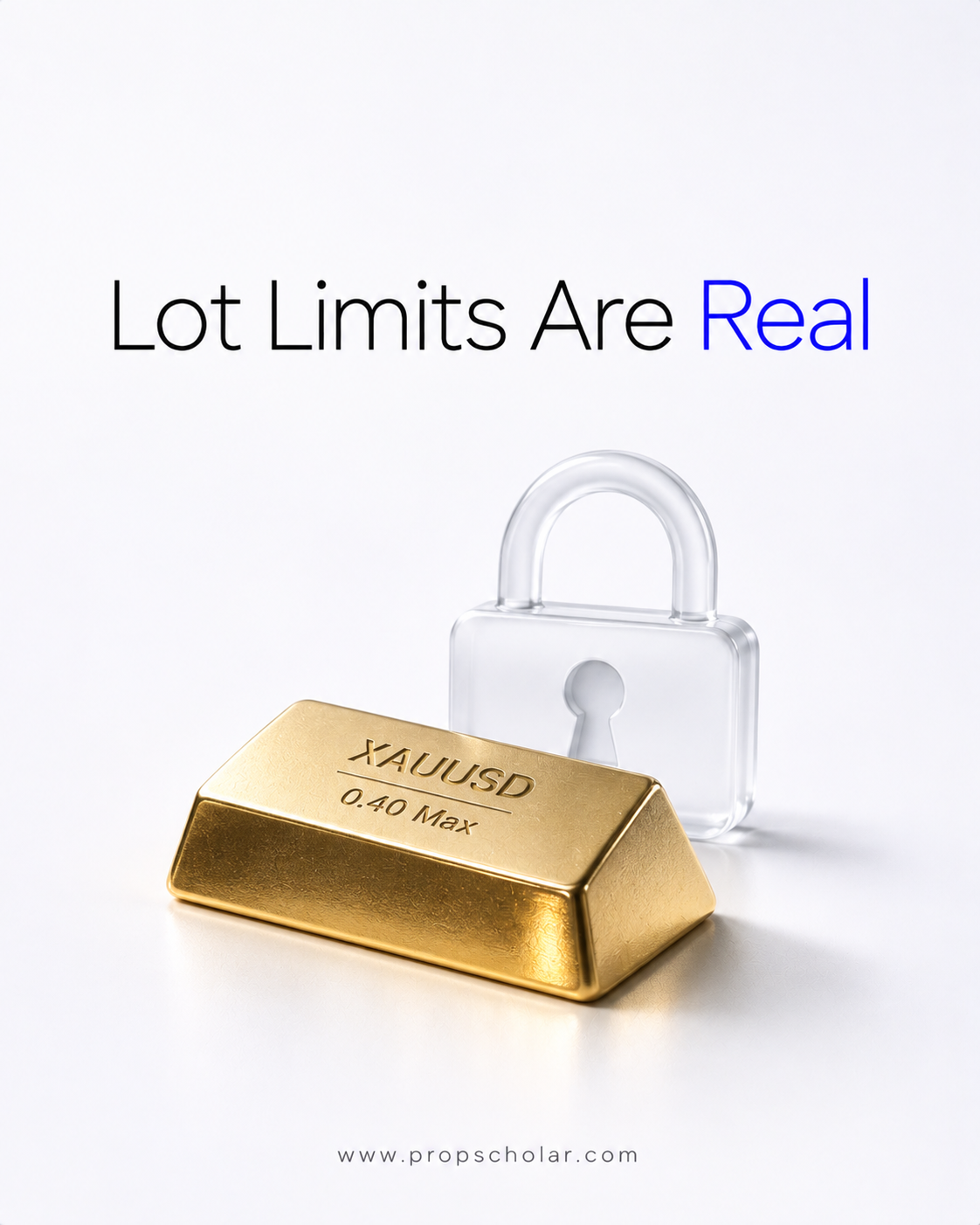
Pakistani traders using USDT to enter PropScholar's Freedom Challenge often ask why the 0.40 gold lot cap exists. The honest answer: it's not a restriction designed to frustrate you — it's the rule that stops a single bad XAU/USD trade from ending your evaluation in one candle. Here's the real math, the real risk logic, and what it means for your trading on a $10,000 account.
Start your evaluationProp Firm Lot Limits Are Real Rules: Why the 0.40 Gold Cap Stops You From Blowing Up (Pakistan USDT Edition)
TL;DR: PropScholar's 0.40 gold lot cap on a $10,000 Freedom Challenge account is not a nuisance — it's the mechanical guardrail that stops one bad XAU/USD trade from wiping your evaluation. Here's the math, the logic, and what it means for how you actually size gold positions from Pakistan using USDT.
Key takeaways:
- The 0.40 gold lot cap is a hard concurrent limit, not a daily total — it applies to what you have open at once
- On a $10K account with 1:50 leverage, 0.40 lots of gold is a meaningful position, not a tiny one
- PropScholar publishes all lot limits before you pay — that transparency alone sets it apart
- Pakistani traders pay in USDT (buy it on a P2P exchange, pay at checkout via NOWPayments) — no bank wire, no blocked card needed
- Scholarship on a passed $10K evaluation: $42, processed within 4 hours
Gold moved over 2,000 pips in a single session earlier this year. If you were holding 2.0 lots of XAU/USD when that happened, you didn't just lose a trade — you lost an entire evaluation account. That is not a hypothetical. It's the reason every serious evaluation platform imposes position limits on gold, and it's why PropScholar's 0.40 lot cap on a $10,000 account is worth understanding properly before you place your first trade.
Most Pakistani traders coming from retail forex or crypto are used to sizing whatever the broker allows. That mindset works when you're only risking your own deposit. Inside a funded evaluation, the math changes — and ignoring lot limits is one of the fastest ways to fail.
What the 0.40 Gold Lot Limit Actually Means
The limit is 0.40 lots of XAUUSD open at any single moment. Not per day, not per week — concurrent. That means if you open 0.40 lots of gold, you cannot add to that position until some or all of it is closed. Each asset class runs independently, so your gold headroom has nothing to do with your forex or silver positions.
On a $10,000 account at 1:50 leverage, 0.40 lots of gold controls roughly $48,000–$52,000 worth of exposure depending on the current gold price. Each pip (which on gold is $0.01 per lot, or $0.10 per standard lot — wait, let's be precise) on XAUUSD is worth $1 per 0.01 lot, so 0.40 lots = $4 per pip. Gold routinely moves 200–400 pips in a volatile session. At 0.40 lots, a 150-pip move against you costs $600. That's 6% of a $10,000 account — the entire maximum loss limit — in a single bad trade.
Read that again: even with the cap in place, one poorly managed gold trade can end your evaluation. Without the cap, the same volatility at 1.0 or 2.0 lots would end it in minutes.
The lot limit isn't preventing you from trading gold seriously. It's preventing you from accidentally treating a funded evaluation like a casino.
Why Gold Specifically Gets a Tighter Cap Than Forex
Forex pairs — EUR/USD, GBP/USD — move in tight, relatively predictable pip ranges during most sessions. Gold doesn't. XAU/USD is a commodity that reacts violently to US CPI prints, Federal Reserve language, geopolitical shocks, and sometimes no obvious catalyst at all.
That volatility is why the gold limit on a $10K account sits at 0.40 lots while forex sits at 4.00 lots — a 10:1 ratio. The limits are sized in rough proportion to typical volatility, not arbitrarily. Forex can absorb 10x the lot size because a 50-pip adverse move in EUR/USD costs far less in dollar terms than a 50-pip adverse move in gold at equivalent sizing.
Silver gets 1.00 lot — tighter than forex, looser than gold — for the same reason. Silver is volatile but moves in a narrower dollar range per pip. Each asset class has its own limit because each asset has its own risk profile.
This is worth understanding deeply: the same logic applies to leverage, as explained in our Ghana lot limit breakdown, and it's consistent across every PropScholar market.
The 6% Max Loss Rule and How Gold Exposure Interacts With It
PropScholar's Freedom Challenge has a 6% maximum loss rule — you lose no more than 6% of your initial account balance total, ever. On $10,000, that's $600. The 3% daily loss rule (measured from the higher of your starting equity or current balance) adds a second, daily ceiling.
Now run the gold math again. At 0.40 lots, $1 per pip. If gold drops 150 pips against a long in a fast session, you're down $600 — the full maximum loss. Without the lot cap, a trader holding 1.0 lots would hit $600 in just 60 pips. Gold moves 60 pips before most people even see the notification.
The lot cap is effectively a forced buffer. It slows down how fast a single position can eat into your maximum loss allowance, which gives you time to react. It doesn't stop losses from happening — your stop placement and trade management do that — but it stops the account from being irreversibly destroyed before you can close the trade.
This is why experienced funded traders treat lot limits as a feature, not a constraint. The limit is doing risk management work that emotional traders often skip.
How Pakistani Traders Actually Buy the Challenge (The USDT Route)
PropScholar doesn't accept JazzCash, Easypaisa, or bank transfers. For Pakistan — and frankly for most of the world outside India — the payment path is USDT, processed through NOWPayments.
Here's the realistic path:
Step 1 — Get USDT. Use a P2P exchange (Binance P2P is widely accessible in Pakistan) and buy USDT using a local bank transfer or whatever you have. For a $10 Freedom Challenge, you need $10 worth of USDT plus network fees — typically a few dollars total. Buy $15 to be comfortable.
Step 2 — Go to the PropScholar shop. Select the $10,000 Freedom Challenge ($10 entry). At checkout, choose the crypto payment option.
Step 3 — NOWPayments generates a wallet address. Send your USDT to that address. The confirmation usually lands within minutes to a few hours depending on network congestion.
Step 4 — Your evaluation account credentials arrive. You're live.
That's it. No international card, no wire transfer, no approval from a bank that blocked your forex account. The whole flow is designed for traders in markets where traditional payment rails are unreliable.
If you get stuck, PropScholar's Discord has 3,000+ traders and 24/7 multilingual support. Someone has already done this from Pakistan and can walk you through it.
Lot Limits on the Full $10K Freedom Account — The Honest List
Since this article is specifically about understanding limits, here they are for the $10,000 account, stated plainly:
Forex
Maximum 4.00 lots open concurrently across forex pairs. This is the highest single-class limit and reflects the comparatively lower pip volatility of major currency pairs.Gold (XAUUSD)
Maximum 0.40 lots. The number this entire article is built around. High-volatility commodity, tight limit — entirely logical.Silver (XAGUSD)
Maximum 1.00 lot. More permissive than gold, more restrictive than forex.Bitcoin (BTCUSD)
0.20 lots. Crypto volatility is extreme, so the cap is the tightest of any class.Ethereum (ETHUSD)
1.00 lot.Other Crypto
2.00 lots.Indices
NAS100: 0.50 lots. US30: 0.30 lots. US500: 0.75 lots. Other indices: 0.50 lots.Every class is independent. You can hold 4.00 forex lots and 0.40 gold lots simultaneously — those are separate limits, not a shared pool. What you cannot do is borrow headroom from one class to add to another.
The complete, official ruleset is at propscholar.com/terms-of-use.
What Happens If You Accidentally Exceed the Limit?
This is worth being direct about: breaching a lot limit is a rule violation. Don't treat it as something to test. The limits are stated upfront precisely so there's no ambiguity. If you're unsure whether a trade you're about to place will exceed your open exposure in a class, calculate it before you click.
The math is not complex. If you have 0.20 lots of gold open and want to add, you can add up to 0.20 more — not 0.21. If your platform shows your open XAUUSD exposure, check it before every gold entry.
This is also why understanding the inactivity rule matters — staying engaged with your account means staying aware of your open positions, not just leaving trades running and forgetting about them.
The Transparency Argument: Why Knowing This Before You Pay Matters
Here's something that often gets overlooked in discussions about evaluation rules: PropScholar publishes every lot limit, every loss percentage, every rule — before you hand over a dollar.
That's not standard. Some evaluation platforms bury lot limits in a PDF that appears after purchase. Others update their terms without notice. PropScholar's rules have never been changed retroactively, and they're publicly accessible at any point.
For a Pakistani trader considering spending $10 of USDT on an evaluation, this matters enormously. You're not gambling on what the rules might be. You know the gold cap is 0.40 lots. You know the max loss is 6%. You know there's no time limit and no minimum trading day requirement. You know the scholarship on a passed $10K account is $42, paid within 4 hours.
All of that is verifiable at propscholar.com/payout-proof — real payouts, publicly displayed. That is the transparency test, and PropScholar passes it.
If you're new to this world and want to understand how losses from options or other high-risk instruments compare to the controlled environment of a funded evaluation, this article on Nifty options losses puts the structural risk difference in plain terms.
Sizing a Gold Trade Correctly Within the 0.40 Cap
Knowing the limit exists is one thing. Actually using it in your trade planning is another.
If your strategy is to enter gold in two tranches — say, an initial entry and an add-on if price moves in your favor — you need to plan both entries within the 0.40 lot ceiling. For example: 0.20 lots initial, 0.20 lots add-on. That uses your full headroom and leaves no room for error. Many experienced traders prefer a single clean entry at 0.30–0.35 lots, holding back a small buffer in case a platform latency issue creates a brief overshoot on order fill.
Your stop-loss distance should determine whether 0.40 lots (or less) is appropriate for a given trade setup, not the other way around. If the technical stop requires 80 pips of room, that's $320 of risk at 0.40 lots — well inside the 6% maximum loss threshold. If the setup demands 200 pips of room, 0.40 lots puts you at $800 of risk, which exceeds the max loss. In that case, you either skip the trade or size down to 0.25 lots or lower.
The cap forces exactly this discipline. You cannot compensate for a wide stop by piling in more lots. You adjust the stop or you don't take the trade.
That's not a restriction. That's risk management.
PropScholar is a scholarship-based trading evaluation platform operated by a Private Limited company registered in India. We are not a prop firm and do not manage or allocate institutional capital. Our model rewards proven trading skill with scholarship grants upon successful evaluation completion.
Related reading
- Student Traders: How to Start With Pocket Money and Protect Every Rupee
- Position Sizing for $1 Challenges: Why Nigerian Traders Blow Accounts
- Can You Recover After Hitting the Daily Loss Limit? PropScholar vs Traditional Prop Firms
- Overthinking Every Trade? How Position Sizing Cures Analysis Paralysis—Bangladesh USDT Guide (2026)
- Leverage Explained for Beginners: How Much Is Too Much
- Risk Management Basics to Pass an Evaluation on the First Try
Ready to Prove Your Edge?
Join 500+ traders. Start from just $5. Get funded within days.
Frequently Asked Questions
The maximum open gold (XAUUSD) position on a $10,000 PropScholar Freedom Challenge account is 0.40 lots at any single moment. This is a concurrent limit — it applies to what you have open simultaneously, not a daily cumulative total. The limit is published openly before you purchase the evaluation.
More From PropScholar
Risk Management
Prop Firm Account Frozen After Profit? Why Lot Limits Exist and Why They Protect You
13 min read
Risk Management
Why Lot Limits on Silver and Gold Matter More Than Leverage for First Blowup Prevention—India UPI Trader Guide
10 min read
Risk Management
What Happens If You Trigger the 3% Daily Loss on Day 1? PropScholar Recovery Rules Explained (2026)
14 min read

Risk Management
Why Funded Account Lot Limits Beat Leverage for First-Time India Traders
14 min read
Risk Management
The Lot Limit Trap: Why Position Sizing Rules Stop Emotional Traders
11 min read

Trading Conditions
Inactivity Rule vs Your Day Job in Pakistan: Trade USDT When You Want
14 min read