
Overthinking Every Trade? How Position Sizing Cures Analysis Paralysis—Bangladesh USDT Guide (2026)
If you're a trader in Bangladesh who freezes before every entry, this is for you. Analysis paralysis isn't a personality flaw—it's what happens when you don't know how much you're risking. This guide shows exactly how position sizing kills the overthinking loop, how lot limits on a PropScholar Freedom Account keep you honest, and how to pay your $10 entry fee using USDT bought with bKash or a loca
If you're a trader in Bangladesh who freezes before every entry, this is for you. Analysis paralysis isn't a personality flaw—it's what happens when you don't know how much you're risking. This guide shows exactly how position sizing kills the overthinking loop, how lot limits on a PropScholar Freedom Account keep you honest, and how to pay your $10 entry fee using USDT bought with bKash or a loca
Start your evaluationOverthinking Every Trade? How Position Sizing Cures Analysis Paralysis—Bangladesh USDT Guide (2026)
TL;DR: Analysis paralysis in trading almost always comes from not knowing your actual risk per trade—not from lacking a better indicator. Fix the math first, and the hesitation dissolves. PropScholar's Freedom Account ($10 entry, 10% target, no time limit) gives Bangladesh traders a structured environment to practice exactly this, payable in USDT bought locally via P2P.
Key takeaways:
- Analysis paralysis is a risk-management problem disguised as a psychology problem.
- Position sizing—deciding your lot size before you open a chart—removes the biggest source of freeze.
- PropScholar's hard lot limits on the Freedom Account act as a second safety net while you build the habit.
- Bangladesh traders pay the $10 entry using USDT purchased on a P2P exchange funded by a local bank transfer or mobile wallet.
- Payouts are processed within 4 hours of request and publicly verifiable.
You've done the analysis. The setup looks clean. The trend is obvious. And yet you're still staring at the entry button fifteen minutes later, refreshing the chart, adding one more indicator, waiting for one more confirmation that will never feel final enough.
That's not indecision about the market. That's fear about money. Specifically, it's fear because somewhere in the back of your mind you don't actually know what it costs you if this trade goes wrong. When the downside is undefined, every trade feels existential—and you freeze.
Position sizing defines the downside before you click. The moment you know "if this stops out I lose 1% of my account and I'm still in the game," the paralysis breaks. Not because you've become braver. Because the question you were really asking—how bad can this get?—now has a clear, acceptable answer.
This guide explains the mechanics, shows you what that looks like on a PropScholar Freedom Account with real lot numbers, and walks through exactly how a trader in Bangladesh gets started paying in USDT.
Why Analysis Paralysis Is a Math Problem, Not a Mindset Problem
The trading psychology industry loves to frame hesitation as a confidence issue. Read more books, meditate more, "trust your edge." That advice isn't wrong, but it skips the root cause for most beginners.
When your position size is undefined—or worse, when you're sizing by feel—your brain can't evaluate the trade rationally. It's trying to simultaneously assess the technical setup AND compute a vague, open-ended financial consequence. That's cognitively expensive. The brain's default response to expensive, uncertain decisions is delay.
Give the brain one half of that equation in advance—"I will risk 1% of my account on every trade, always, before I open the chart"—and it only has to evaluate the setup. Decision fatigue drops sharply. The freeze lifts.
This is why professional traders don't look calmer because they're more enlightened. They look calmer because their position sizing is mechanical and predetermined. The emotional weight is pre-offloaded.
The Simple Position Sizing Formula That Fits Any Account
You don't need a spreadsheet. You need two numbers: your account size and your risk percentage per trade. Everything else is arithmetic.
Risk amount = Account size × Risk percentage
If you're on the $10,000 Freedom Account and you've chosen to risk 1% per trade:
- Risk amount = $10,000 × 0.01 = $100 per trade
On most standard forex pairs, 1 standard lot = roughly $10 per pip. So $100 ÷ $10 per pip ÷ 20 pips = 0.50 lots. That's your position size. Enter it, place the stop, click the button.
Notice what just happened: you didn't evaluate risk during your analysis. You locked it in beforehand. The chart analysis can now be just chart analysis.
Choosing Your Risk Percentage
This is the most personal variable. Beginners often default to 2% and blow up because compounding losses at 2% per trade is faster than it looks. On a $10,000 account, five consecutive losses at 2% each takes your balance to roughly $9,039—still fine, but psychologically bruising.
For the evaluation phase specifically, 0.5% to 1% per trade is far more sustainable. It gives you room for a realistic losing streak without threatening the 6% max loss boundary. More on that below.
How PropScholar's Lot Limits Work as a Built-In Safety Net
Here's something worth understanding about the Freedom Account: the lot limits aren't a punishment. They're a structural guardrail that enforces position discipline even when your own math slips.
On the $10,000 Freedom Account, the maximum open lots per asset class are:
- Forex: 4.00 lots
- Gold (XAUUSD): 0.40 lots
- Silver (XAGUSD): 1.00 lot
- BTCUSD: 0.20 lots
- ETHUSD: 1.00 lot
- NAS100: 0.50 lots
- US30: 0.30 lots
- US500: 0.75 lots
Why does this matter for analysis paralysis? Because when you know the ceiling, your position sizing decision is bounded. You're not staring at an infinite range of possible sizes. On gold, the question isn't "how many lots do I trade?"—it's "somewhere between 0.01 and 0.40 lots, what does my 1% risk rule say?" That's a much smaller cognitive task.
For a deeper read on why these limits exist and why they actually protect you rather than restrict you, the PropScholar blog has a detailed piece on why lot limits exist and what they prevent. And if you're specifically concerned about gold and silver sizing, this guide on why lot limits on silver and gold matter more than leverage is worth your time.
The 6% Max Loss Rule and What It Means for Your Sizing in Practice
The Freedom Account has a 6% maximum loss based on the initial account size. On a $10,000 account, that's $600. Breach it and the evaluation is over.
This is the number that should anchor everything else. If you work backwards from it:
- $600 total allowed loss
- If you risk 1% ($100) per trade, you can absorb 6 consecutive full stop-outs before the account closes
- If you risk 2% ($200) per trade, you're out after 3 full stop-outs in a row
The 10% profit target on a $10,000 account is $1,000. At 1% risk with a realistic 1:2 risk-reward ratio, you need roughly 10 winning trades more than losing trades to hit it. That's genuinely achievable at a measured pace, which is exactly the kind of trading that stops the analysis paralysis cycle—you're not scrambling to catch up after oversized losses.
For traders who've already felt the sting of blowing up on demo and want to understand how the 6% rule breaks that cycle, read the 6% max loss rule guide for South Africa—the psychology applies regardless of which country you're in.
The Daily Loss Limit: Your Second Line of Defence
Beyond the overall 6% maximum, the Freedom Account has a 3% daily loss limit calculated on the higher of your starting equity or your current balance. On a $10,000 account that's $300 per day.
This matters for position sizing because it creates a natural daily budget. Before you open your first trade of the day, the question isn't just "what's my risk per trade?"—it's also "how many trades am I planning, and does my per-trade risk fit inside $300 for the day?"
If you're planning three trades at 1% each ($100), you have $300 in daily headroom and you're right at the edge. Two trades at 1% gives you buffer for slippage and spread. This is not a constraint—it's a forcing function that makes your session planning concrete before you touch the chart.
Analysis paralysis often comes from session planning that's too vague. "I'll trade whatever looks good" is an invitation to freeze because there's no structure. "I'll take a maximum of two setups today, each risking 1%, and stop if I hit -$200" is a plan you can execute.
For a detailed comparison of what happens after hitting the daily limit on different platforms, the PropScholar post on recovering after the daily loss limit covers it clearly.
How Bangladesh Traders Pay: USDT via P2P
PropScholar accepts crypto payments globally through NOWPayments. For Bangladesh, the practical path is USDT—it's the stablecoin traders in emerging markets actually use, and buying it locally is straightforward.
Here's the real flow:
Step 1: Get USDT on a P2P exchange. Platforms like Binance P2P list local sellers in Bangladesh. You can filter by payment method—common options include local bank transfer (NPSB, BEFTN), Dutch-Bangla mobile banking, or other digital wallets. You're buying USDT from a local seller in Taka (BDT), and the seller sends you USDT directly to your exchange wallet.
Step 2: Withdraw to a personal wallet. Move the USDT to a wallet you control—Trust Wallet and MetaMask are both widely used. Make sure you're withdrawing on a supported network (TRC-20 is typically the cheapest for USDT transfers).
Step 3: Pay at checkout. On PropScholar's shop, select the Freedom Account ($10 for the $10,000 evaluation), choose USDT at checkout, and follow the NOWPayments instructions. The payment is typically confirmed within minutes.
The $10,000 account entry is literally $10. At current exchange rates that's roughly 1,100-1,200 BDT—well within reach for most working adults in Bangladesh. Pass the evaluation and the scholarship on the $10,000 account is $42, paid within 4 hours of your request.
Every payout PropScholar has ever made is publicly listed at propscholar.com/payout-proof. You don't have to take anyone's word for it.
Putting It Together: A Position Sizing Routine That Kills Overthinking
Here's the actual pre-trade routine I'd suggest building before you open a single chart:
Before the session: Decide your risk per trade (start at 0.5% if you're new), calculate the dollar amount, note your daily loss limit, and decide your maximum number of trades for the session. Write these down somewhere visible.
Before each trade: Identify your stop level from the chart first. Then—and only then—calculate your lot size so that the stop equals your predetermined risk amount. Enter the lot size into your order ticket. Confirm the stop is placed.
After entry: Walk away from the chart or set a price alert. The trade has defined risk. Your job is done until the stop or target is hit.
This routine takes the sizing decision out of the same mental space as the analysis. They're separate tasks done at separate times. The paralysis almost always occurs when they're mixed together—when you're trying to read the chart AND decide how much to risk simultaneously.
Separate the tasks. The freeze breaks.
Why PropScholar's No-Time-Limit Structure Supports This Approach
One reason traders oversize and overthink simultaneously is pressure. A 30-day evaluation clock creates urgency. Urgency pushes you toward larger positions to hit the target faster. Larger positions mean larger potential losses. The fear response kicks in. You freeze, or worse, you click in panic.
The Freedom Account has no time limit. There's no minimum number of trading days either. You can take one trade a week, apply your position sizing formula, and accumulate towards the 10% target without any artificial deadline forcing your hand.
The fastest recorded pass on the platform is 2 hours—but that's a data point about what's possible, not a benchmark to chase. The structure rewards consistency over speed, which is exactly what the position sizing habit requires to stick.
What the Scholarship Actually Pays
To be clear about the numbers: PropScholar is a scholarship-based evaluation platform. You pay a small entry fee, pass the evaluation by hitting the profit target without breaching the loss rules, and claim a scholarship payout.
On the three Freedom Account sizes:
- $5,000 account — entry from $5, scholarship on pass: $20
- $10,000 account — entry $10, scholarship on pass: $42
- $25,000 account — entry higher, scholarship on pass: $100
For Bangladesh traders, the $10,000 account is the clearest entry point: the fee is accessible, the scholarship is meaningful relative to the entry cost, and the lot limits give you a realistic structure to practice the position sizing habits this guide covers.
FAQs
What is analysis paralysis in trading and how does position sizing fix it? Analysis paralysis in trading is the inability to pull the trigger on an entry even when your setup is valid. It usually happens because the financial consequence of a loss feels undefined and open-ended. Position sizing fixes it by calculating your exact risk in dollar terms before you open the chart, so by the time you're analyzing the setup, the loss scenario already has a clear, pre-accepted answer.
Can a trader in Bangladesh pay for PropScholar using local payment methods? PropScholar does not accept local Bangladeshi wallets as direct payment. Bangladesh traders pay using USDT, which you buy on a P2P exchange like Binance P2P using a local bank transfer or mobile banking to pay a local USDT seller. Once you have USDT in your wallet, you pay at PropScholar's checkout through NOWPayments. The $10,000 account entry is $10, roughly 1,100-1,200 BDT at current rates.
What are the lot limits on PropScholar's $10,000 Freedom Account? On the $10,000 Freedom Account, maximum concurrent open lots are: 4.00 for forex, 0.40 for gold, 1.00 for silver, 0.20 for BTCUSD, 1.00 for ETHUSD, 0.50 for NAS100, 0.30 for US30, and 0.75 for US500. These are per-class maximums and are independent—unused headroom in one class cannot be applied to another.
How much can I lose before my PropScholar evaluation ends? The Freedom Account has two loss boundaries. The overall maximum loss is 6% of the initial account size—on a $10,000 account that's $600. The daily loss limit is 3% of the higher of your starting equity or current balance, so $300 per day on a $10,000 account. Breaching either ends the evaluation. Sizing at 1% risk per trade means you can absorb six consecutive full stop-outs before the overall limit is reached.
Is PropScholar legitimate and does it actually pay traders? PropScholar has been operating for over 1.5 years as a Private Limited company registered in India. Every payout it has made is publicly listed at propscholar.com/payout-proof. Payouts are processed within 4 hours of a request. The platform's rules are published at propscholar.com/terms-of-use and have never been changed retroactively. PropScholar is a scholarship-based evaluation platform, not a prop firm.
Does PropScholar's Freedom Account have a time limit or minimum trading days? No. The Freedom Account has no time limit and no minimum number of trading days required. You can trade at whatever pace your position sizing routine and schedule allow. The only active requirement is the 14-day inactivity rule—if you don't place a trade within 14 days, the account is marked inactive.
What risk percentage per trade should a beginner use on the Freedom Account? For the evaluation phase, 0.5% to 1% per trade is a reasonable starting range. At 1% on a $10,000 account, you risk $100 per trade and can survive six consecutive full stop-outs before hitting the 6% maximum loss limit. This gives you room for a realistic losing streak while making meaningful progress toward the 10% profit target without rushing into oversized positions.
PropScholar is a scholarship-based trading evaluation platform operated by a Private Limited company registered in India. We are not a prop firm and do not manage or allocate institutional capital. Our model rewards proven trading skill with scholarship grants upon successful evaluation completion.
Related reading
- Student Traders: How to Start With Pocket Money and Protect Every Rupee
- Position Sizing for $1 Challenges: Why Nigerian Traders Blow Accounts
- Risk Management Basics to Pass an Evaluation on the First Try
- Leverage Explained for Beginners: How Much Is Too Much
- Why Funded Account Lot Limits Beat Leverage for First-Time India Traders
- Position Sizing Math for $5 Trading Evaluations Egypt 2026
Ready to Prove Your Edge?
Join 500+ traders. Start from just $5. Get funded within days.
Frequently Asked Questions
Analysis paralysis in trading is the inability to pull the trigger on an entry even when your setup is valid. It usually happens because the financial consequence of a loss feels undefined and open-ended. Position sizing fixes it by calculating your exact risk in dollar terms before you open the chart, so by the time you're analyzing the setup, the loss scenario already has a clear, pre-accepted answer.
More From PropScholar
Risk Management
The Lot Limit Trap: Why Position Sizing Rules Stop Emotional Traders
11 min read
Trading Conditions
Night Shift Call Centre Worker in Bangladesh: Trading USDT Funded Accounts on 2-Hour Sleep Windows (2026)
12 min read
Risk Management
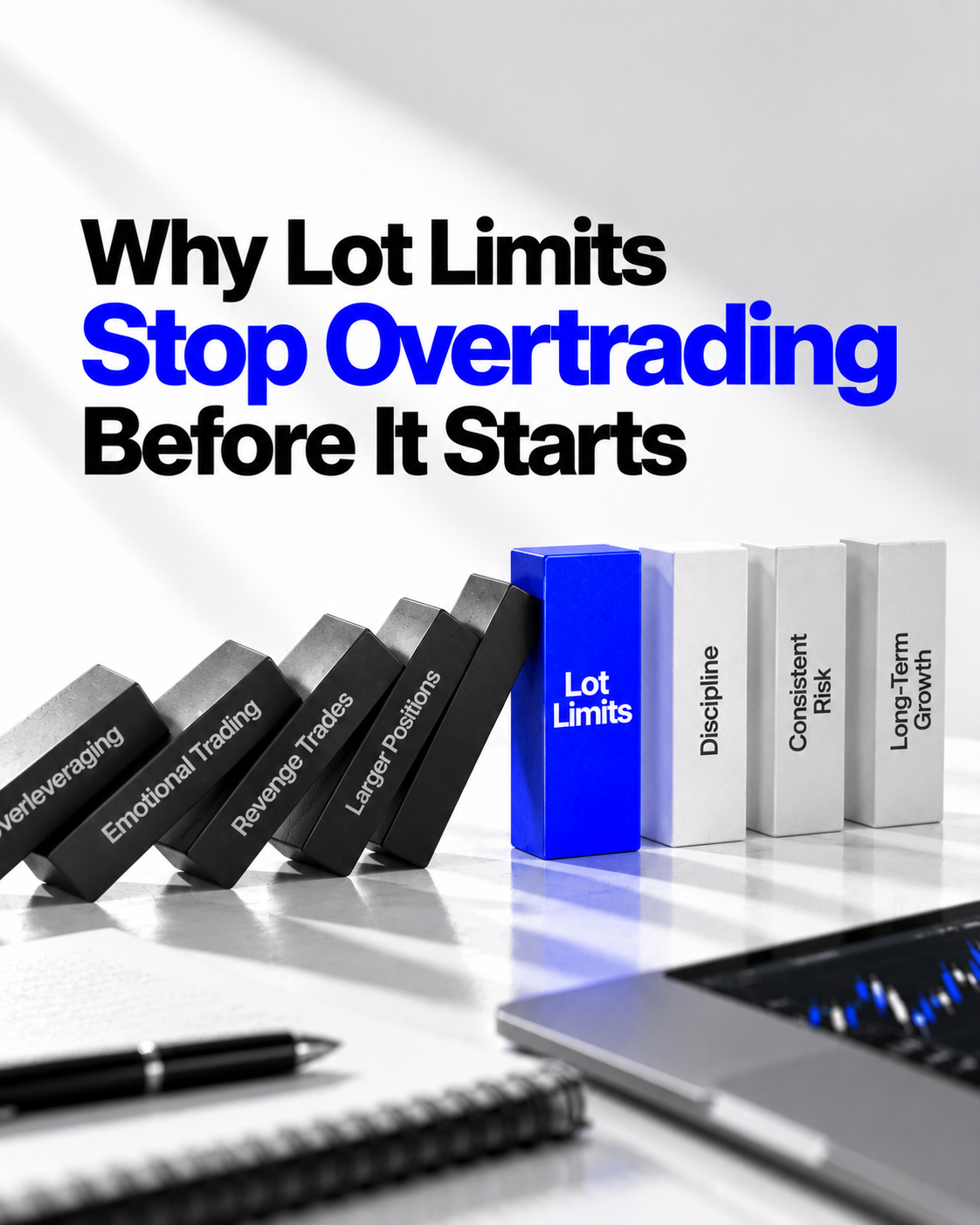
Why Lot Limits Stop Overtrading Before It Starts
13 min read
Beginner Trading
Teacher in Kenya on 40K Salary: Trade USDT Funded Accounts in Lunch Breaks (2026)
12 min read
Risk Management
The 6% Maximum Loss Rule Decoded: Your First Week as a Funded Trader (Egypt 2026)
11 min read
Risk Management
What Happens If You Trigger the 3% Daily Loss on Day 1? PropScholar Recovery Rules Explained (2026)
14 min read