
Alternative to the $1 Prop Firm Challenge in 2026: The $5 Freedom Account
PropScholar's old $1 trial is closed. The starting point today is the Freedom 5K for about $5, which pays $20 on a pass, has no minimum trading days, and processes payouts within 4 hours. Here's exactly how it works, what the rules cost you, and why it beats most $1 deals still advertised in 2026.
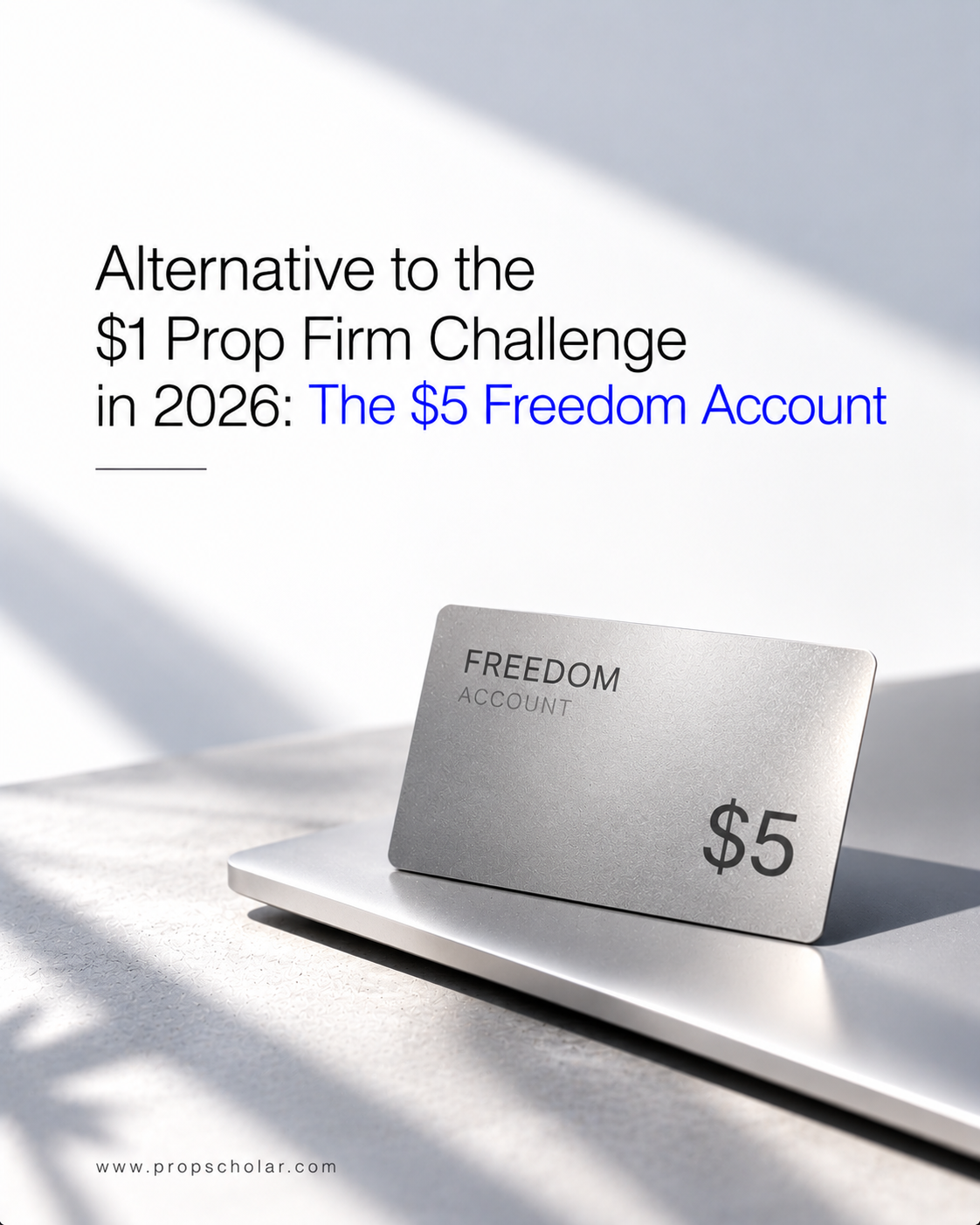
PropScholar's old $1 trial is closed. The starting point today is the Freedom 5K for about $5, which pays $20 on a pass, has no minimum trading days, and processes payouts within 4 hours. Here's exactly how it works, what the rules cost you, and why it beats most $1 deals still advertised in 2026.
Start your evaluationAlternative to the $1 Prop Firm Challenge in 2026: The $5 Freedom Account You Can Pass in One Day
TL;DR: PropScholar's $1 trial account is closed to new purchases. The entry point today is the Freedom 5K at about $5 (Rs.499), which pays $20 on a pass with no minimum trading days, meaning you can pass it on day one if your trading supports it. Payouts are processed within 4 hours and publicly verified.
Key takeaways:
- The Freedom 5K costs approximately $5 and pays a $20 scholarship on a pass, with accounts scaling up to $50K.
- There are no minimum trading days and no time limit, so a single strong trading day can finish the challenge.
- The rules are real: 10% profit target, 6% maximum loss, 3% daily loss limit, lot caps per asset class, and no opening or closing positions around high-impact news.
- International traders pay in USDT (crypto) or PayPal; Indian traders pay by UPI.
- Every payout is publicly listed at propscholar.com/payout-proof, processed within 4 hours of the request.
If you searched for a "$1 prop firm challenge" recently, you've probably noticed that the results are a mess. Some listings advertise $1 accounts that vanish behind add-on fees at checkout. Others show our own old trial, which is no longer open for new sign-ups. And a handful of firms have started using $1 as a marketing number while charging monthly fees, activation fees, or a "pay after pass" balance that adds up quietly.
So let's be direct: PropScholar's original $1 (Rs.90) trial account is retired. If you found a link to it somewhere, it's outdated. The starting point today is the Freedom Account, and the smallest size costs about $5. That's still the cheapest legitimate evaluation in this space, and it now comes with better structure than the old trial offered.
This article explains exactly what the Freedom Account is, what the rules actually cost you in practice, and why it's a stronger alternative than most "$1 challenge" products still being sold in 2026.
What Most $1 Prop Firm Challenges Actually Look Like
The number is usually real. The product behind it often isn't what it sounds like.
A common structure: the $1 buys you access to a tiny account, sometimes $1,000, with rules that seem fine until you read the fine print. You pass the evaluation and then discover there's an activation fee before the funded account goes live. Or the account is "pay after pass," meaning you only receive the payout if you fund a live account first. Or the $1 gets you into a monthly subscription model where you keep paying until you pass.
None of that is PropScholar's model. There is no activation fee. There is no monthly subscription. There is no "pay after pass" mechanic where you owe money on a pass. You pay once, you trade on a demo account, and if you pass, PropScholar pays you a scholarship within 4 hours. That's the complete transaction.
The old $1 trial was a genuine single-payment entry point, and the traders who used it understood that. But it was a 1K account, and the scholarship on a pass was small. The Freedom Account ladder starts at 5K and pays meaningfully more.
What the Freedom Account Actually Is
PropScholar is a scholarship-based trading evaluation platform, not a prop firm. The distinction matters: you're not trading real institutional capital. You trade on a demo account, you prove your skill against a defined ruleset, and PropScholar pays you a scholarship grant when you pass. No capital allocation, no live account promises, just a direct payment for demonstrated trading ability.
The Freedom Account is PropScholar's own one-step evaluation. One stage, one profit target, no minimum trading days, no time limit. The five account sizes and what they pay:
Freedom 5K
Costs Rs.499 (about $5). Scholarship on a pass: $20. You're trading a $5,000 demo account with a 10% profit target, meaning you need to reach $500 in profit.Freedom 10K
Costs Rs.999 (about $10). Scholarship on a pass: $42. The $10,000 demo account with the same 10% target, so $1,000 in profit.Freedom 15K
Costs Rs.1,499 (about $15). Scholarship on a pass: $60.Freedom 25K
Costs Rs.2,499 (about $25). Scholarship on a pass: $100.Freedom 50K
Costs Rs.4,999 (about $50). Scholarship on a pass: $200.You can buy as many Freedom accounts as you want, across any combination of sizes. There's no purchase limit.
The Rules That Actually Matter
This is the part most cheap-challenge articles skip, and skipping it is dishonest. The Freedom Account has real constraints, and you should understand them before you buy.
The profit target is 10% of the account size. That's achievable but not trivial, especially if you're sizing positions conservatively. The maximum loss is 6% of the initial account, so on the 5K that's $300 total. The daily loss limit is 3% of the higher of your starting equity or current balance. On a 5K account, that means you can't lose more than $150 in a single day. Hit that number and the day ends.
There are lot limits per asset class, concurrent not cumulative. On the 10K account the limits are 4.00 lots for forex, 0.40 lots for gold, 1.00 for silver, 0.20 for BTCUSD, 1.00 for ETHUSD, 2.00 for other crypto, 0.50 for NAS100, 0.30 for US30, 0.75 for US500, and 0.50 for other indices. You can't borrow headroom between asset classes. The 5K limits are proportionally smaller. These limits exist to keep position sizing honest, and frankly, they stop newer traders from blowing up on a single overleveraged trade.
News trading is not allowed on the Freedom Account. You cannot open or close a position from 10 minutes before to 10 minutes after a high-impact news event. That includes stop-loss and take-profit closes triggered during that window. If one fires during the restricted period, the account is breached. Mark your economic calendar and manage open trades accordingly.
The inactivity rule: if you go 14 days without placing a trade, the account closes. That's generous enough not to be a real issue for anyone actively trying to pass, but it's worth knowing.
There is no minimum number of trading days and no time limit. If your strategy generates 10% profit within a single session while staying inside the loss rules and the lot limits, the challenge is done. That's not marketing language. Several traders have passed the Freedom Account in under a day. The fastest recorded pass across all PropScholar evaluations is 2 hours.
Why No Minimum Trading Days Changes Everything
Most prop firm challenges, including the ones priced at $1, require a minimum number of trading days. Sometimes it's 5 days. Sometimes 10. The intent is to prevent traders from taking one enormous concentrated bet and calling it skill. That's fair reasoning. But the side effect is that you're forced to keep trading when your edge isn't present, which often means more risk, not less.
The Freedom Account removes that requirement entirely. If you pass on day one, you pass on day one. If your strategy takes three weeks, you have three weeks. There's no pressure to force trades on days when the market isn't giving you setups.
For traders in time-poor situations, this matters more than the price does. A teacher in Kenya trading during lunch breaks, a freelancer in the Philippines who can focus hard for two days then disappears into a project, a student in India who can trade intensively during semester break but not during exams: none of them need to engineer artificial trading activity just to satisfy a day count rule.
We've watched traders pass the Freedom Account and then come back to buy a larger size immediately because they wanted a bigger scholarship. The no-limit purchase policy makes that a real option.
How Traders Outside India Actually Pay
In India, you pay by UPI in rupees. The Rs.499 entry for the Freedom 5K maps to local pricing, which is part of why this is accessible for Indian beginners.
If you're in Nigeria, Ghana, Kenya, South Africa, Pakistan, Bangladesh, Indonesia, the Philippines, Vietnam, Egypt or anywhere else, you pay in USDT (crypto) or PayPal. The practical path most international traders use: buy USDT on a local P2P exchange, funded by a bank transfer in your local currency, and then send the USDT to PropScholar at checkout. The amount is small enough that it doesn't require a large exchange account or any special verification on most P2P platforms. PayPal is also available at checkout if you have a linked account.
This is the same path described in detail for specific countries on our blog, and it genuinely works today. No credit card required, no dollar bank account required, no international wire.
How the Freedom Account Compares to What $1 Deals Offer
The account size
Most $1 challenges are for accounts in the $1,000 to $2,000 range. The Freedom 5K starts at $5,000. That's a meaningfully larger account with a meaningfully larger scholarship on a pass. The $20 payout on the 5K is more than you'd see on most $1 mini accounts.The fee structure
The Freedom Account has one payment, made before you start. No monthly renewals. No activation fee when you pass. No deduction from your scholarship. The $20 is the $20.The payout speed
Payouts on the Freedom Account are processed within 4 hours of the request. Every payout is publicly listed at propscholar.com/payout-proof. You can check the timestamp and the amount for any payout we've made. That's not a claim you can fake at scale.The rules transparency
The full ruleset is at propscholar.com/terms-of-use. The lot limits are published before you pay. The news trading restriction is stated clearly. There are no rules that appear after you pass, and no retroactive changes to evaluation criteria. PropScholar has been operating for over a year and a half, and the rules have not been changed after the fact for any account.For a longer look at the upgrade path from the old $1 entry to the Freedom Account, the article From the $1 Challenge to the Freedom Account: The Smart Upgrade Path walks through the reasoning in detail. And if you want to understand why paying even a small fee beats a free trial, the comparison here makes that case concretely.
What to Do If Your Budget Is Exactly $5
Buy the Freedom 5K. That's the answer.
You're getting a $5,000 demo account, a one-step 10% target, no day count rules, no time pressure, and a $20 scholarship if you pass. The rules are published. The payouts are public. The platform has been operating for over a year and a half with no retroactive rule changes.
Before you start, be honest with yourself about two things: your strategy's typical daily return, and your largest single-session drawdown over the past month of trading. If your strategy regularly pulls 2-3% per session with drawdowns that stay inside 1.5% per day, the Freedom 5K is a straightforward pass. If you're not sure what your drawdown history looks like, that's the first thing to figure out before you spend the $5.
The 3% daily loss limit is the rule that catches most beginners. Not because it's unusually strict, but because traders who haven't tracked their own performance seriously don't realize how close their bad days come to that number. Know your own risk profile first. Then buy the account.
The lot limits on the 5K are tight at the small end. Gold is proportionally the most restricted. If your strategy is gold-focused, you might find the 10K account gives you enough room to work with. The $10 price difference is small.
The Honest Case for Starting Here
There are cheaper-sounding options out there. Some of them are genuine, most of them carry fees or conditions that reveal themselves after you pay. PropScholar's position is simple: the Freedom 5K at $5 is the cheapest legitimate evaluation we're aware of at this account size, with a published ruleset, a verifiable payout record, and no hidden fees.
We're not the right choice if you want to trade without lot limits or trade through news events. The two-step evaluation model on PropScholar's platform, used by traders going after specific firm-account scholarships, has more flexibility there. But if you want the lowest barrier entry to a structured evaluation with real payouts and transparent rules, the Freedom Account is the answer.
The full range of account sizes, prices, and scholarships is in the shop at propscholar.com/shop. If you have questions before buying, the PropScholar Discord at discord.gg/uTU85z4hft has over 3,000 traders who've been through the same questions, plus the PropScholar team available 24/7 in Hindi and multiple other languages. You can also reach out directly at business@propscholar.com.
Frequently Asked Questions
What is the alternative to the $1 prop firm challenge in 2026?
The best alternative is PropScholar's Freedom 5K, which costs about $5 (Rs.499). It offers a $5,000 demo account with a 10% profit target, no minimum trading days, and a $20 scholarship paid within 4 hours on a pass. PropScholar's original $1 trial is no longer open to new purchases, making the Freedom 5K the current entry point.Can you really pass the Freedom Account in one day?
Yes. There are no minimum trading days and no time limit on the Freedom Account. If you reach the 10% profit target while staying inside the 6% maximum loss and 3% daily loss rules, the challenge is complete regardless of how many days it took. The fastest recorded pass across PropScholar evaluations is 2 hours.What are the lot limits on the Freedom 5K?
The Freedom Account has per-asset lot limits scaled to account size. The 10K account limits give a clear reference: 4.00 lots for forex, 0.40 for gold, 0.20 for BTCUSD. The 5K limits are proportionally smaller. These limits are independent per asset class; you cannot borrow headroom from one class to use in another.How do traders outside India pay for the Freedom Account?
International traders pay in USDT (crypto) or PayPal at checkout. The practical path is buying USDT on a local P2P exchange funded by a bank transfer, then sending USDT to PropScholar. Indian traders pay by UPI in rupees. There are no credit cards, wire transfers, or other payment methods available.Is the $20 scholarship the only payout, or is there a recurring income?
The $20 scholarship on the Freedom 5K is a one-time payment on a successful pass. There is no recurring funded account or profit-split after that. PropScholar is an evaluation platform: you pay the entry fee, pass the evaluation, and receive the scholarship. You can purchase additional Freedom accounts in any size, and each pass earns its own scholarship.What happens if I breach the Freedom Account rules?
The account is closed and the entry fee is not refunded. Common breach triggers include hitting the 6% maximum loss, exceeding the 3% daily loss limit, opening or closing a position during the 10-minute news window around high-impact events, or leaving the account inactive for 14 days. The full ruleset is published at propscholar.com/terms-of-use before you pay.How do I verify that PropScholar payouts are real?
Every payout is publicly listed at propscholar.com/payout-proof with timestamps and amounts. PropScholar has been operating for over 1.5 years. The payout record is cumulative and verifiable by anyone, at any time, without an account or login.PropScholar is a scholarship-based trading evaluation platform operated by a Private Limited company registered in India. We are not a prop firm and do not manage or allocate institutional capital. Our model rewards proven trading skill with scholarship grants upon successful evaluation completion.
Related reading
- 1K1Step Explained: PropScholar's $1 One-Step Evaluation from Purchase to Payout
- $5 Prop Firm Challenge: What the Cheapest Legit Evaluation Really Gets You
- $1 Challenge vs Free Prop Firm Trial: Why Paying $1 Teaches You More
- Pay-After-Pass Funded Trading: Does It Actually Exist?
- The Honest Alternative to No-Evaluation Instant Funding Offers
- 2-Step Evaluation Explained: Safer for New Traders?
Ready to Prove Your Edge?
Join 500+ traders. Start from just $5. Get funded within days.
Frequently Asked Questions
The best alternative is PropScholar's Freedom 5K, which costs about $5 (Rs.499). It offers a $5,000 demo account with a 10% profit target, no minimum trading days, and a $20 scholarship paid within 4 hours on a pass. PropScholar's original $1 trial is no longer open to new purchases, making the Freedom 5K the current entry point.
More From PropScholar

Trader Safety
How to Avoid Prop Firm Scams in 2026: A PropScholar Checklist
12 min read

Evaluation Models
Why PropScholar's 10% Target Is Easier Than Demo Consistency
12 min read

Risk Management
Lot Limit Confusion on Forex? Why 4.00 Lots Stops Blowups Better Than High Leverage—Indonesia USDT Guide
12 min read
Beginner Trading
$1 Trading Challenge for College Students: Prove Skill for a Cup of Chai
13 min read
Evaluation Models
Simulated Capital vs Real Money: What a Funded Account Actually Proves
13 min read
Evaluation Models
Copy Trading Between Two Funded Accounts: Why Prop Firms Ban It and What It Costs Malaysia Traders
13 min read