2-Step Evaluation Explained: Safer for New Traders?
2-step trading evaluations split targets into two phases — here's why that structure genuinely suits beginners better than rushing a single phase.
2-step trading evaluations split targets into two phases — here's why that structure genuinely suits beginners better than rushing a single phase.
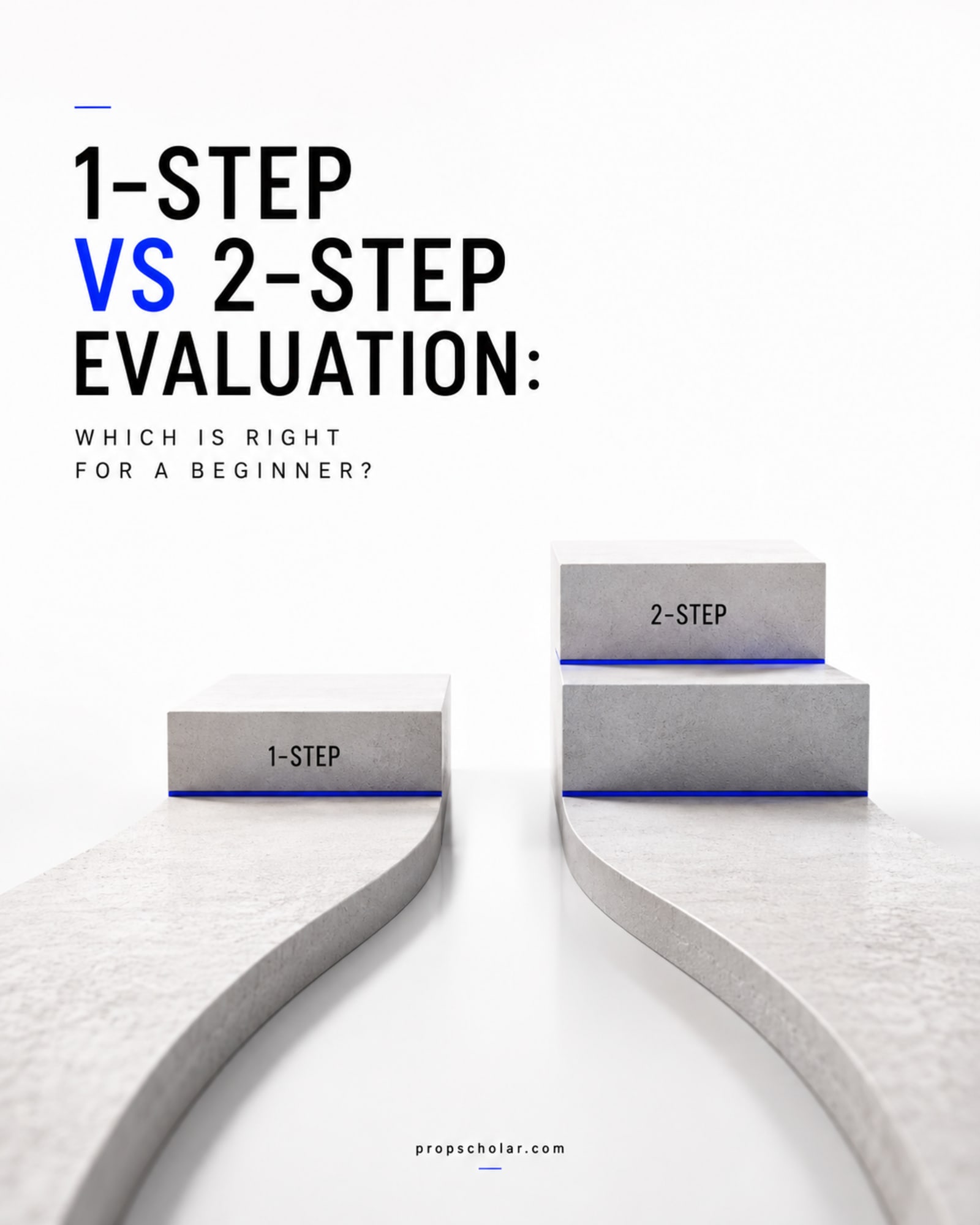
Start your evaluation1-Step vs 2-Step Evaluation: Which Is Right for a Beginner?
TL;DR: A 1-step evaluation gets you to a scholarship faster but demands a higher profit target in one go. A 2-step evaluation spreads the challenge across two phases with more forgiving targets — but takes longer. For most beginners, the 2-step model is actually safer. Here's exactly why.
Key takeaways:
- 1-step evaluations have a single, higher profit target (often 8–10%) with no second phase
- 2-step evaluations split the challenge into Phase 1 and Phase 2, each with a lower target (typically 8% then 5%)
- Beginners who rush tend to blow 1-step accounts trying to hit the target fast
- The 2-step model forces a consistency habit that genuinely serves you long-term
- PropScholar offers scholarship-based evaluations starting from just $5 (around Rs.400), with payouts within 4 hours of verification
You've found your first evaluation platform. You see two options: one phase or two. You think — fewer steps must mean easier, right?
Not quite. This is one of the most common assumptions that sends beginners straight into a breach on day three. The number of steps doesn't tell you how hard an evaluation is. The rules inside each phase do.
Let me walk you through both models properly, so you can pick the one that actually matches where you are right now as a trader.
How Does a 1-Step Evaluation Actually Work?
In a 1-step evaluation, you have a single phase to demonstrate your trading ability. You're given a simulated account — say $10,000 or $25,000 — and you need to hit one profit target without breaching any of the loss limits.
A typical 1-step structure looks something like this: a profit target of around 8–10%, a maximum daily loss of 4–5%, and a maximum total drawdown of 8–10%. Hit the target without breaking the rules, and you move straight to the scholarship payout stage.
The appeal is obvious. One phase. No waiting around. If you can nail it, you get there faster.
The problem? That single target is almost always set higher than either phase in a 2-step evaluation. You're being asked to prove your edge in a compressed timeframe, under a single set of high-stakes rules. If you're the kind of trader who still sometimes gets overconfident midway through a good week, that setup can punish you hard.
How Does a 2-Step Evaluation Work?
A 2-step evaluation breaks the assessment into two consecutive phases. Phase 1 usually carries a higher profit target — around 8% — while Phase 2 drops to something lower, like 5%. The loss limits (daily and total) are typically the same across both phases.
Passing Phase 1 proves you can hit a meaningful target. Passing Phase 2 proves that wasn't a fluke. It's designed to filter out lucky streaks and reward traders who have a repeatable process.
Yes, it takes longer. But consider what that extra time actually gives you: another full cycle of trading under real pressure, against a slightly easier target, with the same risk rules. If your trading holds up through both phases, the confidence you arrive at the scholarship stage with is genuinely earned.
That matters more than most beginners expect.
The Real Risk of Choosing 1-Step Too Early
Here's something we see often: a beginner trader finds a 1-step evaluation, gets excited about the shorter path, deposits their entry fee, and blows the account on day five trying to sprint to 10% profit.
The 1-step model rewards traders who already know their edge, who can execute calmly without chasing, and who can hit an above-average target without going off-script. Those are skills you develop over time, not on your first or second evaluation attempt.
If you're still building your system — still learning which pairs you trade well, still figuring out your optimal position size — the 2-step model gives you room to make small mistakes in Phase 1, recalibrate, and then execute more cleanly in Phase 2. You can't do that recalibration if you're already breached.
This isn't a knock on 1-step evaluations. They're excellent for traders who already have a tested strategy. They're just a rough starting point if you haven't built that foundation yet.
Where PropScholar Fits Into This Comparison
PropScholar is a scholarship-based trading evaluation platform, not a prop firm. It doesn't manage or allocate institutional capital. What it does is evaluate your trading skill and, if you pass, rewards you with a scholarship grant of up to 400% of your entry fee — paid within 4 hours of verification.
Entry starts at $5 (around Rs.400 for Indian traders). That's real. It's not a gimmick — it's a deliberate decision to make evaluation accessible to traders in markets where $100+ entry fees are a genuine barrier.
Payment works globally. Traders in India use UPI via PhonePe, Razorpay, or Cashfree. Traders everywhere else — Nigeria, the Philippines, Indonesia, South Africa, Egypt, anywhere — can pay with USDT crypto. PropScholar is not an India-only platform. The low-cost, crypto-friendly setup is specifically built for emerging-market traders who've been priced out of the bigger names.
PropScholar's Evaluation Structure
PropScholar offers evaluations that follow clear, publicly posted rules — rules that have never been changed retroactively. That detail matters more than it sounds. One of the most common complaints against certain evaluation platforms is that the rules shift after you've already paid. At PropScholar, the ruleset you see when you buy is the ruleset you trade under.
The evaluations are built to be fair, and the scholarship payouts are real and verifiable. You can find payout proof in the PropScholar Discord community, where over 3,000 active traders discuss strategy, share results, and get support in Hindi and multiple other languages — 24 hours a day.
PropScholar as a Marketplace
PropScholar also runs a marketplace where you can buy real prop firm challenges — from major global names — at INR pricing. If you want to eventually take on a traditional prop firm challenge but the dollar pricing has always been the blocker, the marketplace lets you pay in Indian Rupees via UPI. That's a genuinely useful bridge for traders who are working toward bigger challenges but aren't there budget-wise yet.
1-Step vs 2-Step: The Real Trade-Offs Side by Side
Speed of Completion
A 1-step evaluation can technically be completed faster. If you're a seasoned trader with a proven edge, you could be at the scholarship stage in days rather than weeks. For a beginner, though, speed is often the enemy. Rushing to hit a higher single target is exactly the pressure that leads to overtrading and rule violations.
Profit Target Difficulty
The combined profit requirement across a 2-step evaluation (e.g. 8% then 5%) might look bigger than a single 10% target at first glance. But those two targets are hit under less pressure, with time to reset between phases. Psychologically, hitting 5% in Phase 2 when you're already in a winning position feels very different from grinding toward 10% with no fallback.
Cost and Risk of Re-Entry
If you fail either model, you're looking at re-entry fees. On a $5 PropScholar evaluation, that cost is minimal — far lower than what most global platforms charge. But the principle holds regardless of the platform: failing a 1-step means you spent the entry fee and got nothing. Failing Phase 1 of a 2-step means the same. Failing Phase 2, having already passed Phase 1, stings more — but it also means you almost certainly have the skills to pass a fresh attempt.
Learning Value
This is where the 2-step model genuinely wins for beginners. Two phases means two full rounds of trading under real rules, with real consequences for breaches. That repetition builds the discipline and emotional control that actually makes you a better trader. A 1-step evaluation gives you a single shot and a result. A 2-step gives you a process.
Which Should You Actually Choose?
If you've been trading consistently for six months or more and you have a strategy you can write down, explain, and execute under pressure — the 1-step evaluation is a legitimate option. You know your risk parameters. You know your edge. A single, focused phase suits your profile.
If you're still building your approach, still figuring out when to cut losses, still working out your ideal holding times — go 2-step. The extra phase isn't a punishment. It's a structured opportunity to prove your system works twice, not just once.
And on the question of platform: the entry fee matters. Paying $200 to find out a 1-step isn't right for you yet is a painful lesson. Paying $5 on a PropScholar evaluation to work through a 2-step structure, learn what you need to learn, and earn a scholarship when you're ready — that's a proportionate first step.
Start at the level that matches your actual skill, not the level that sounds most impressive to describe.
Getting Support Before You Choose
If you're genuinely unsure which evaluation model fits your trading right now, that's a perfectly reasonable place to be. You can reach the PropScholar team directly at business@propscholar.com or jump into the PropScholar Discord where real traders — many of whom are in the same early stage you're at — discuss exactly these decisions every day. The support is 24/7 and available in multiple languages, including Hindi.
No one there is going to push you toward a challenge size that doesn't suit you. The community operates on the basis that a trader who's genuinely ready passes. A trader who's rushed fails and re-enters, which helps nobody.
Frequently Asked Questions
Is a 1-step evaluation easier than a 2-step for beginners? Not necessarily. A 1-step evaluation has a higher single profit target — often 8–10% — which you must hit without any second chance. A 2-step breaks the challenge into two lower targets. Most beginners find the 2-step model more forgiving because it allows a reset between phases and rewards consistent trading rather than a single big run.
What is the difference between a 1-step and 2-step prop firm evaluation? A 1-step evaluation requires you to pass one trading phase with a single profit target and defined loss limits. A 2-step evaluation requires you to pass two consecutive phases — typically a higher target in Phase 1 and a lower target in Phase 2 — before you qualify for a funded account or, in PropScholar's case, a scholarship grant.
How much does it cost to start a PropScholar evaluation? PropScholar evaluations start from $5, which is approximately Rs.400 for Indian traders. Indian traders can pay via UPI through PhonePe, Razorpay, or Cashfree. Traders in other countries — including Nigeria, the Philippines, Indonesia, South Africa, and beyond — can pay using USDT crypto. Payouts of up to 400% of the entry fee are processed within 4 hours of verification.
Can a beginner pass a 1-step evaluation? Yes, but it requires more preparation than many beginners expect. You need a clearly defined trading strategy, strong risk management habits, and the emotional discipline to avoid overtrading under pressure. If you're still developing any of those, a 2-step evaluation gives you more structured practice before you reach the scholarship stage.
How long does a 2-step evaluation take to complete? It depends on your trading frequency and account size, but most active traders complete both phases within two to four weeks. There's no minimum time requirement in most evaluations — only profit targets and loss limits. Trading consistently but not aggressively is usually the fastest sustainable route through a 2-step structure.
Is PropScholar available outside India? Yes. PropScholar serves traders globally. While UPI payment is available for Indian traders, international traders can join and pay using USDT crypto. The platform provides 24/7 support in multiple languages and has a community of over 3,000 traders on Discord from markets across Asia, Africa, the Middle East, and beyond.
What happens if I fail a 2-step evaluation in Phase 2? You don't carry Phase 1 progress over — you'd need to purchase a new evaluation entry and start from Phase 1 again. That said, reaching Phase 2 means you already demonstrated the ability to hit a meaningful profit target once. Most traders who reach Phase 2 and fail learn something specific about their Phase 2 behaviour that makes a retry more targeted and more likely to succeed.
PropScholar is a scholarship-based trading evaluation platform operated by a Private Limited company registered in India. We are not a prop firm and do not manage or allocate institutional capital. Our model rewards proven trading skill with scholarship grants upon successful evaluation completion.
Related reading
- 1K1Step Explained: PropScholar's $1 One-Step Evaluation from Purchase to Payout
- The Honest Alternative to No-Evaluation Instant Funding Offers
- $5 Prop Firm Challenge: What the Cheapest Legit Evaluation Really Gets You
- Demo Trading vs Funded Evaluation: Which Actually Builds a Trading Career
- Scholar Trading Explained: How It Works Step by Step
- Consistency Rule in Prop Trading Explained: What Counts as a Breach
Ready to Prove Your Edge?
Join 500+ traders. Start from just $5. Get funded within days.
Frequently Asked Questions
Not necessarily. A 1-step evaluation has a higher single profit target — often 8–10% — which you must hit without any second chance. A 2-step breaks the challenge into two lower targets. Most beginners find the 2-step model more forgiving because it allows a reset between phases and rewards consistent trading rather than a single big run.