
Pay After Pass vs Upfront Fee in 2026: Which Really Costs Less?
Pay after pass sounds cheaper until you read the activation clause. This guide breaks down the full cost of pay-after-pass challenges versus a small upfront evaluation fee, with real numbers, so you know exactly what you're committing to before you trade a single candle.
Pay after pass sounds cheaper until you read the activation clause. This guide breaks down the full cost of pay-after-pass challenges versus a small upfront evaluation fee, with real numbers, so you know exactly what you're committing to before you trade a single candle.
Start your evaluationPay After Pass vs Upfront Fee in 2026: Which Really Costs Less?
TL;DR: Pay after pass sounds cheaper on day one, but it almost always involves an activation fee after you pass that equals or exceeds what a normal upfront challenge costs. A third option, a small one-time evaluation fee with no fee after passing and a direct payout, often costs the least of all.
Key takeaways:
- Pay after pass does not mean pay nothing. It means pay later, usually more.
- Upfront challenges charge a fixed fee regardless of outcome; if you fail, you lose it.
- PropScholar's evaluation model charges one small fee, pays you a scholarship when you pass, and charges nothing after.
- The Freedom 5K costs $5 (Rs.499 in India) and pays a $20 scholarship within 4 hours of passing.
- For non-Indian traders, payment is USDT crypto or PayPal. No local wallet required.
You've seen the ads. "Pass first, pay after." It sounds almost too considerate, like a prop firm that trusts you before it charges you. But there's a reason these models are spreading fast in 2026, and it has everything to do with the activation fee buried in step two.
This isn't a scare piece. It's a cost breakdown. By the end you'll know exactly what each model charges, when it charges, and what happens to your money if you fail. Then you can make a real decision.
What "Pay After Pass" Actually Means
Pay after pass evaluation platforms let you attempt a trading challenge for free or for a token deposit, then charge you a fee once you've passed. The idea is that you only pay when you've already proven you can trade.
On the surface that sounds fairer. In practice, the fee charged after you pass, usually called an activation fee or account activation cost, tends to sit at roughly the same level as a standard upfront challenge for the same account size. Sometimes it's higher. You haven't saved money; you've just moved the payment to a moment when you're emotionally invested in getting the account activated.
There's a reason activation happens at that exact point. You just spent days or weeks passing the evaluation. Walking away from a passed challenge feels like throwing effort in the bin. That's real psychology, and fee structures built around it aren't accidental.
The Full Cost of a Pay After Pass Challenge
Let's map this out clearly because the total figure is what matters.
Phase one: you get access to a demo evaluation account at zero cost or a minimal holding deposit. You trade to the profit target. That part feels free.
Phase two: you pass. The platform now charges an activation fee to convert your passed evaluation into a live funded account. This fee is non-negotiable at this stage. You pay it or you don't get the account.
Phase three: some platforms also charge a monthly subscription to keep the funded account active. Not all do, but enough that it's worth checking before you start.
So your real cost is: activation fee, plus any monthly fee, plus any re-evaluation fee if you lose the funded account later and want another shot. Add those up across a few months and compare the number to what a standard upfront evaluation would have cost.
The comparison often surprises people. It surprised us too, and we looked at a lot of these structures when building our own model.
The Standard Upfront Challenge: Straightforward, But You Carry All the Risk
The traditional prop challenge model is simpler: pay a fixed fee upfront, trade the evaluation on a demo account, pass and get funded, fail and lose the fee. Some platforms offer resets or discounts on retries, others don't.
The upside is transparency. You know the number before you start. There's no activation fee waiting on the other side. If you're a confident trader with a proven edge, paying upfront is often the cheapest path to a funded account because you pass once and you're in.
The downside is that if you're still refining your approach, you can burn through retry fees fast. And for traders in emerging markets where $100 or $200 is a real sum of money, a failed challenge stings.
That's precisely why PropScholar exists in its current form. We've looked at both models and built something different.
A Third Model: One Small Fee, No Activation Fee, Direct Payout
PropScholar is not a prop firm. It's a scholarship-based trading evaluation platform. The model works differently from both options above.
You pay a small one-time evaluation fee. You trade a demo account to a 10% profit target under real risk rules. When you pass, PropScholar pays you a scholarship in cash, processed within 4 hours of verification, with every payout publicly listed at propscholar.com/payout-proof. There is no activation fee, no monthly fee and no additional charge after passing.
The Freedom 5K costs $5 (Rs.499 in India) and pays a $20 scholarship. The 10K costs $10 and pays $42. The 25K costs $25 and pays $100. The 50K costs $50 and pays $200. One dollar per $1,000 of evaluation account size, every time.
You can buy as many Freedom accounts as you want, in any size, simultaneously. If you want to run five Freedom 10K evaluations at once, that's $50 total entry and a potential $210 in scholarships if you pass them all.
If you fail, you lose the entry fee only. There's no activation fee to avoid, no funded account to lose, and no monthly subscription that continues billing. The maximum you can lose on any single evaluation is the entry fee you paid to start it.
For traders in Nigeria, the Philippines, Pakistan, Bangladesh, Indonesia, South Africa or anywhere outside India, you pay in USDT crypto (the most practical route is to buy USDT on a local P2P exchange funded by your bank transfer, then pay at checkout) or via PayPal. Indian traders pay in rupees via UPI.
Comparing the Three Models Side by Side
Cost When You Pass
With a pay after pass model, you pay the activation fee after passing. That fee varies by platform and account size but is rarely zero. It's the whole business model.
With a standard upfront challenge, you've already paid. No additional charge after passing, but that upfront fee was typically much larger than $5.
With PropScholar, you've already paid the small entry fee. After passing, you receive money. The direction of payment reverses.
Cost When You Fail
With a pay after pass model, you usually lose nothing if you fail the evaluation phase since you hadn't paid yet. That's the genuine upside of this structure.
With a standard upfront challenge, you lose the full fee you paid at the start. Retry fees compound if you fail more than once.
With PropScholar, you lose only the small entry fee: $5, $10, $25 or $50 depending on account size. That's the floor.
Total Cost Transparency
Pay after pass models can be harder to cost in advance because activation fees aren't always prominently displayed before you start. Always locate the activation fee number before you begin, not after.
Standard upfront challenges are transparent by design. The fee is stated at checkout.
PropScholar's pricing is a fixed one dollar per thousand at entry, then a scholarship paid to you on pass. Total cost is unambiguous.
The Rules You're Trading Under Matter as Much as the Fee
Cost isn't only about money. The rules determine how hard the evaluation is to pass and how likely you are to pay the entry fee more than once.
PropScholar's Freedom Account has a 10% profit target, a 6% maximum loss, a 3% daily loss limit, no minimum trading days, and no time limit. You could technically pass in a single day if the trades go your way, as explored in this breakdown of same-day passes.
The one real constraint on Freedom is lot limits. The $10,000 account caps you at 4.00 open forex lots, 0.40 gold lots, and 0.20 BTCUSD lots simultaneously. Those limits exist per asset class and can't be shared between classes. If you trade heavy size, that's the number to plan around before you buy.
News trading is also off the table on Freedom: no opening or closing positions from ten minutes before to ten minutes after high-impact news events. That includes stop-loss and take-profit triggers. Breaching it ends the account.
No trading restrictions matter less than ones you'll actually hit. Check your strategy against those two rules before entering.
For a fuller look at how PropScholar evaluations compare to demo accounts in terms of what they actually measure, this article on demo accounts vs PropScholar evaluations covers the gap in detail.
Which Model Actually Wins on Total Cost?
It depends entirely on one variable: do you pass on the first try?
If you're confident you'll pass once and never again, a standard upfront challenge at a reputable firm can be cost-efficient. The fee is stated, the rules are clear, and you walk away funded.
If you're worried about failing the evaluation, pay after pass has one real advantage: you don't pay if you fail the demo phase. That can matter for traders who aren't yet consistent.
But if you're a beginner, still building an edge, or simply cautious with money, the low-fee model at PropScholar limits your downside to $5 per attempt. The scholarship on passing means your first successful evaluation more than covers the cost of entry. The firm account guides at propscholar.com/guides explain the specific challenge structures we evaluate against.
One more thing: the PropScholar evaluation is a scholarship evaluation on a demo account, not a live firm account. You receive a cash scholarship, not a funded trading account. If your goal is a live funded account with a specific prop firm, you spend the scholarship on that account, or on anything else. The payout itself is yours.
If you want to understand how that model compares to starting with a broker incubation program or going the traditional capital-raising route, this article on the low-capital alternative to incubation programs puts the numbers side by side.
Who Each Model Suits
Pay After Pass
This works best for traders who are confident they'll pass the evaluation but want to protect their cash until they've proven it. The activation fee is the cost of admission, so know that number in advance. If the activation fee is comparable to a standard upfront challenge, there's no real saving.
Standard Upfront Challenge
Best for traders who have passed evaluations before, know their edge is consistent, and want a clean, transparent fee structure. The risk is the retry cost if something goes wrong.
PropScholar Scholarship Evaluation
Best for traders on a small budget, beginners who expect to fail once or twice before getting it right, and traders in emerging markets who need USDT or UPI pricing. The entry cost is as low as $5, and passing pays you money rather than charging you more. For context on how this stacks up against other low-cost evaluation formats, see the comparison with micro and bootcamp prop accounts.
A Note From Experience
We've spoken with thousands of traders across the PropScholar Discord, and the most common version of regret we hear isn't "I failed the evaluation." It's "I passed and then couldn't afford the activation fee" or "I didn't realise there was a monthly subscription." The emotional cost of passing something and then watching it expire because of an unexpected charge is significant. Transparent pricing, stated in full before you start, isn't a small thing. It's the entire basis of trust between a platform and a trader.
FAQs
What is a pay after pass prop firm? A pay after pass prop firm lets you attempt a trading evaluation for free or at no cost, then charges an activation fee after you successfully pass. The fee is not paid until you've completed the evaluation, but it is typically comparable to a standard upfront challenge fee for the same account size. Always locate the activation fee before you start.
Is pay after pass cheaper than paying upfront? Not necessarily. If you pass on the first try, the total cost of a pay after pass model is usually the activation fee alone, which can be similar to an upfront challenge. The genuine advantage is that you pay nothing if you fail the evaluation phase. If you're confident you'll pass, the cost difference is often small.
What does PropScholar charge after you pass? Nothing. PropScholar is a scholarship-based evaluation platform. When you pass a Freedom Account evaluation, PropScholar pays you a scholarship within 4 hours of verification. The Freedom 5K pays $20, the 10K pays $42, the 25K pays $100, and the 50K pays $200. There is no activation fee, no monthly fee, and no charge after passing.
How do non-Indian traders pay for a PropScholar evaluation? Outside India, PropScholar accepts USDT (crypto) via NOWPayments or PayPal. The practical path for traders in Nigeria, Pakistan, the Philippines, Bangladesh, Indonesia or Kenya is to buy USDT on a local P2P exchange funded by a bank transfer, then pay at checkout. No local wallet or bank card is required.
What are the lot limits on PropScholar Freedom accounts? Freedom accounts do have per-asset lot limits on open positions. On the $10,000 account: 4.00 forex, 0.40 gold, 0.20 BTCUSD, and 1.00 ETHUSD simultaneously. Each asset class is independent. These are the main trading constraint on Freedom accounts and worth checking against your strategy before buying.
What happens if I fail a PropScholar evaluation? You lose only the entry fee you paid: $5 for the Freedom 5K, $10 for the 10K, up to $50 for the 50K. There is no activation fee to forfeit because none was charged. You can purchase a new evaluation immediately with no waiting period.
Can I buy multiple PropScholar evaluations at once? Yes. There is no purchase limit. You can run multiple Freedom evaluations across different account sizes simultaneously. Each evaluation has its own lot limits and risk rules, and each is independent of the others.
PropScholar is a scholarship-based trading evaluation platform operated by a Private Limited company registered in India. We are not a prop firm and do not manage or allocate institutional capital. Our model rewards proven trading skill with scholarship grants upon successful evaluation completion.
Related reading
- 1K1Step Explained: PropScholar's $1 One-Step Evaluation from Purchase to Payout
- $5 Prop Firm Challenge: What the Cheapest Legit Evaluation Really Gets You
- $1 Challenge vs Free Prop Firm Trial: Why Paying $1 Teaches You More
- Pay-After-Pass Funded Trading: Does It Actually Exist?
- Alternative to the $1 Prop Firm Challenge in 2026: The $5 Freedom Account
- The Honest Alternative to No-Evaluation Instant Funding Offers
Ready to Prove Your Edge?
Join 500+ traders. Start from just $5. Get funded within days.
Frequently Asked Questions
A pay after pass prop firm lets you attempt a trading evaluation for free or at no cost, then charges an activation fee after you successfully pass. The fee is not paid until you've completed the evaluation, but it is typically comparable to a standard upfront challenge fee for the same account size. Always locate the activation fee before you start.
More From PropScholar

Trader Safety
Are Prop Firm Bootcamp Accounts a Scam? What the Cheap Entry Fee Really Costs You in 2026
16 min read
Trading Comparison
Funding Pips 5K Price in 2026: 2 Phase, 1 Phase and Instant Compared
13 min read
Evaluation Models
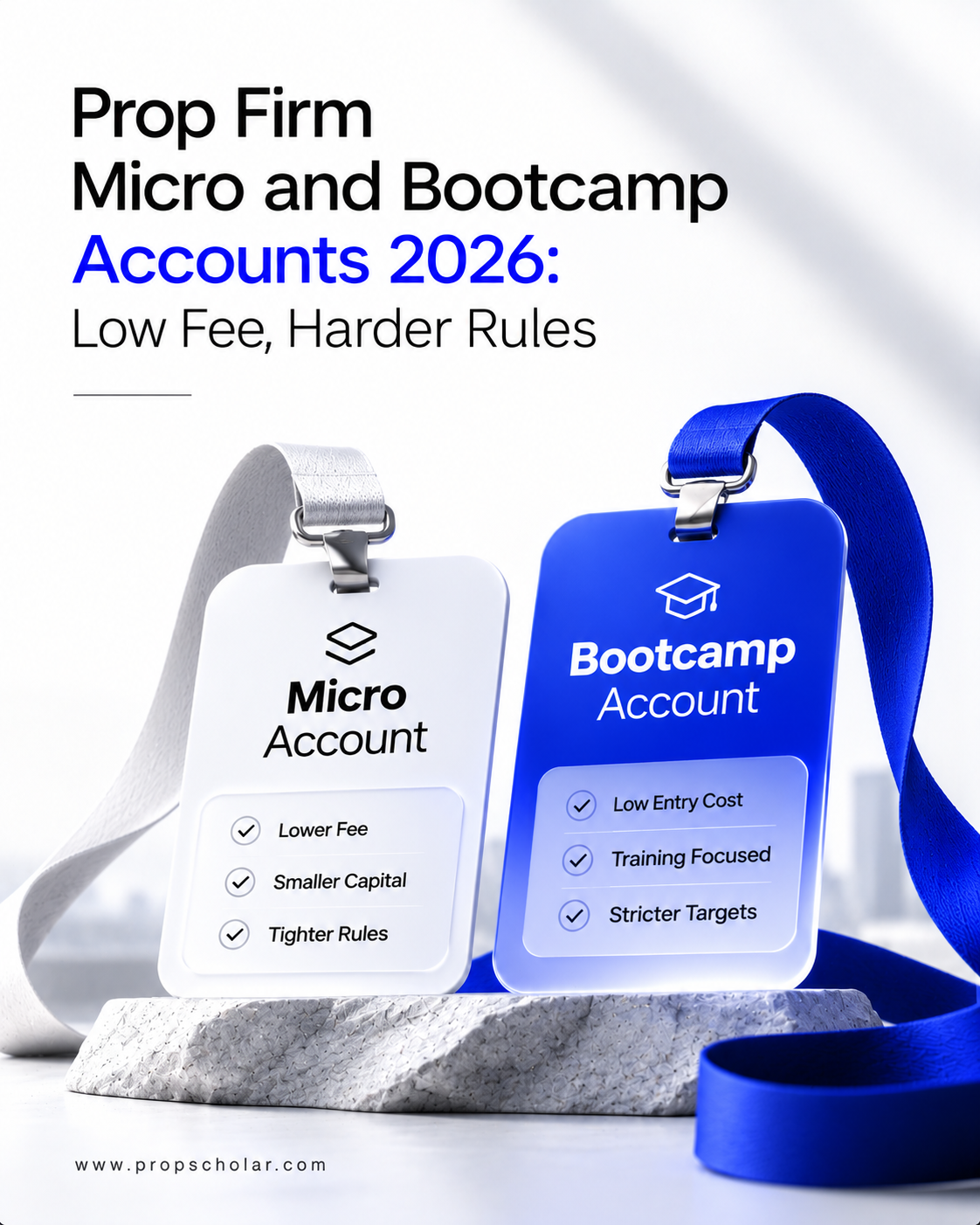
Prop Firm Micro and Bootcamp Accounts 2026: Low Fee, Harder Rules
14 min read

Trader Safety
How to Avoid Scam Prop Firms and Choose a Top-Tier Firm on a Small Budget in 2026
17 min read
Evaluation Models
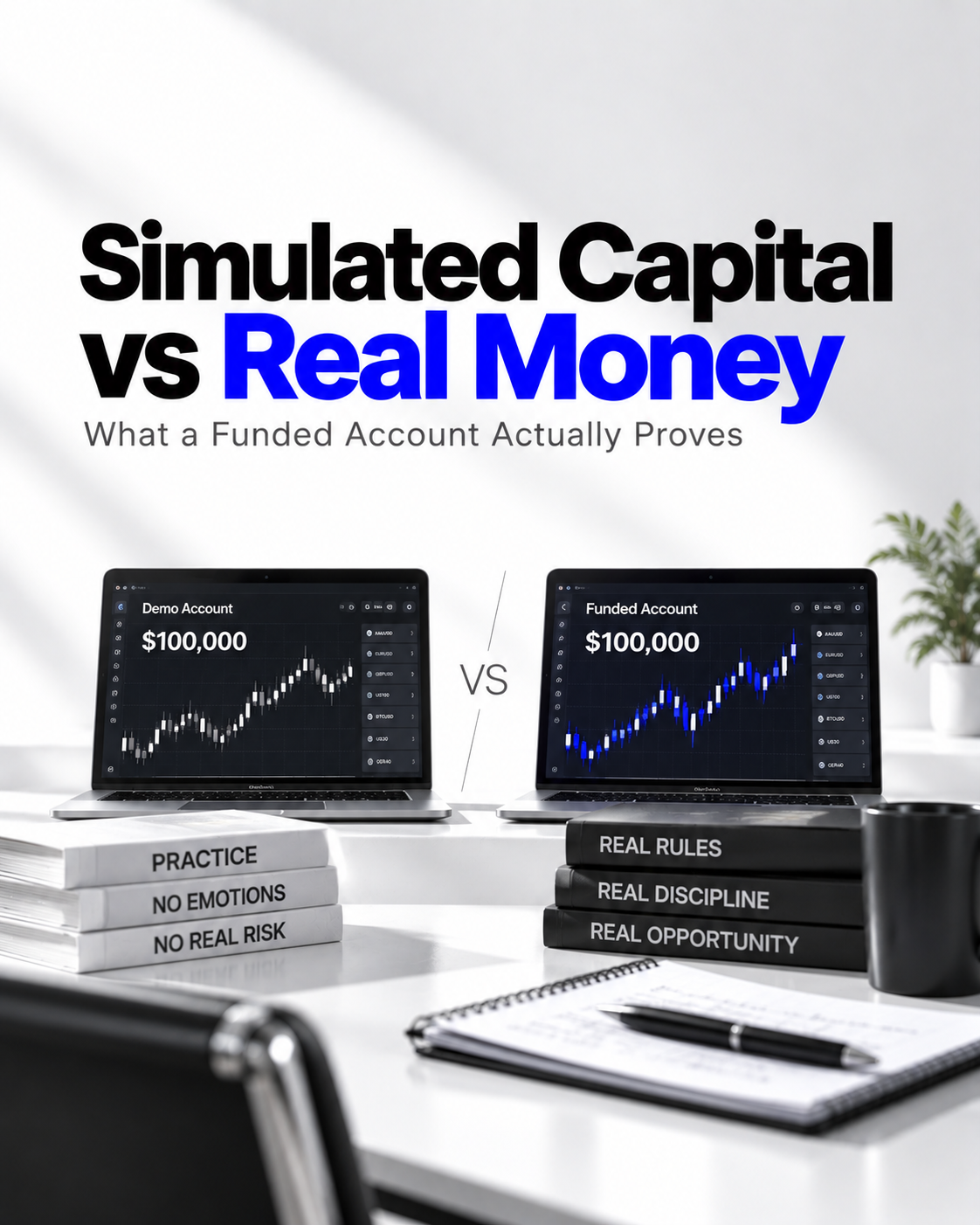
Simulated Capital vs Real Money: What a Funded Account Actually Proves
13 min read

Evaluation Models
From the $1 Challenge to the Freedom Account: The Smart Upgrade Path
11 min read