
Are Prop Firm Bootcamp Accounts a Scam? What the Cheap Entry Fee Really Costs You in 2026
Bootcamp accounts and micro prop firm entries look cheap on the surface. But low fees almost always come with harder rules, stricter targets, and payout conditions that trip up beginners. This guide breaks down exactly what to check before paying, what patterns signal a bad deal, and how PropScholar's direct payout model works differently.
Bootcamp accounts and micro prop firm entries look cheap on the surface. But low fees almost always come with harder rules, stricter targets, and payout conditions that trip up beginners. This guide breaks down exactly what to check before paying, what patterns signal a bad deal, and how PropScholar's direct payout model works differently.
Start your evaluationAre Prop Firm Bootcamp Accounts a Scam? What the Cheap Entry Fee Really Costs You in 2026
TL;DR: Bootcamp and micro prop accounts are not automatically scams, but a low entry fee almost always comes with harder rules, tighter targets, or restrictive payout conditions that most beginners don't read until it's too late. Use the checklist in this article before paying anything, and if you want a genuinely low-cost evaluation with a direct payout model, look at PropScholar's Freedom Account from $5.
Key takeaways:
- A cheap headline fee rarely means a cheap total cost; the rules doing the real work are buried in the terms.
- Common patterns that turn a bootcamp account into a bad deal: impossible profit targets, aggressive daily loss limits, hidden reset fees, and vague payout language.
- PropScholar is not a prop firm; it's a scholarship-based evaluation platform that pays you directly within 4 hours of passing, publicly verifiable.
- The Freedom 5K starts at $5 (Rs.499) with a one-step 10% target, and the full ruleset is public at propscholar.com/terms-of-use.
- Read every rule before you pay, no matter how small the fee.
You saw an ad. A prop firm offering a funded account, a bootcamp account, or a micro evaluation for a few dollars, maybe less. The headline is tempting, especially if you've been quoted $99 or $149 for a standard challenge somewhere else. You're wondering whether it's real or whether it's another way to take money from traders who can't afford to lose it.
Here's the honest answer: low-cost prop entries are not automatically scams. Some are genuinely accessible and fairly structured. But the economics of the model mean that when a firm charges you less upfront, the rules tend to compensate elsewhere. The question isn't just "is the entry fee cheap?" It's "what exactly am I agreeing to for that fee?" Those are two very different questions, and most traders only ask the first one.
This article is about reading the second question clearly.
What Is a Bootcamp Account, Really?
The term "bootcamp" isn't standardised across the industry. Different firms use it to mean different things: sometimes it's an introductory or diagnostic evaluation at a lower cost, sometimes it's a smaller account size bundled with educational content, sometimes it's just a marketing label for what is essentially a standard funded challenge with a lower headline price.
What they have in common is the pitch: start for less, prove yourself, get funded. The framing puts the emphasis on accessibility. That's not dishonest in itself. The real question is always what the evaluation actually requires of you.
Why "Cheap" Almost Never Means "Easy"
This is the core thing to understand about the prop firm business model, and it applies to bootcamp accounts more than almost anything else.
A firm offering funded accounts charges traders a fee to take an evaluation. When a trader passes, the firm has to pay out. When a trader fails, the firm keeps the fee. The fee is therefore the firm's main revenue when traders fail, and a successful trader costs the firm money in payout, so the firm's incentive is to price the evaluation in a way that covers those costs.
When the entry fee is very low, something has to compensate. It's usually one or more of these:
A harder profit target. Standard challenges typically sit around 8 to 10 percent. Some low-cost bootcamp accounts push this to 15 percent or higher to offset the lower fee volume.
A tighter daily loss limit. A 2 percent daily loss limit on a volatile market session is genuinely difficult to manage for a beginner. Some bootcamp structures use limits this tight.
A shorter time window. If you have ten calendar days to hit a 12 percent target with a 2 percent daily loss limit, the math is punishing. You either take too much risk or you can't reach the target in time.
A reset fee. The entry looks cheap, but every time you breach a rule and need to restart, you pay again. Three resets at $8 each costs more than a single $20 standard entry. If resets are encouraged or framed as normal in the firm's messaging, that's a signal worth noticing.
Vague payout language. "Up to 80% profit split" sometimes means 80 percent of a profit that only vests after specific conditions are met, such as minimum trading days, a minimum number of profitable months, or an account review period. If the payout terms aren't as clear and specific as the entry terms, that asymmetry is intentional.
None of these things is automatically fraudulent. But none of them is accidental either. They're structural features of a model that has to balance low fees with operational costs.
For a deeper look at how to evaluate these patterns before you commit, this guide on how to avoid scam prop firms and choose a top-tier firm on a small budget walks through the comparison in detail.
The Checklist: What to Read Before You Pay
Before you pay any entry fee for a bootcamp or micro evaluation, open the terms of use and work through this list.
What is the exact profit target?
Get the number. Don't accept "competitive" or "beginner-friendly" in the marketing copy as a substitute for an actual percentage. A 10 percent target on a one-step is reasonable. Anything above 12 percent starts to require either luck or risk levels that a beginner cannot consistently control.
What is the daily loss limit, and how is it calculated?
This one catches a lot of traders. Some firms calculate daily loss on your starting equity for that day. Some calculate it on your peak balance. Some calculate it on the account's initial balance. The same percentage can behave very differently depending on the calculation method. If the terms don't specify the method explicitly, ask support before paying.
What is the maximum loss, and is it trailing or fixed?
A trailing drawdown means your maximum allowable loss moves up as your balance increases. On a volatile day where your account briefly peaks and then drops, you can breach a trailing drawdown without ever feeling like you were overexposed. Fixed drawdowns are simpler and more beginner-friendly.
Is there a reset fee, and what triggers it?
Check whether a reset is required for any rule breach, or only for account blowouts. If minor infractions require a reset payment, factor that into your real expected cost.
What are the payout conditions exactly?
Look for specific numbers: minimum trading days before a payout request, minimum profit thresholds, account review windows, and any clause that allows the firm to review or delay a payout without a stated timeline. If these conditions aren't written down with specific numbers, they are not conditions, they are discretion.
Are payout proofs publicly available?
A firm that pays traders should be able to show it. Public, verifiable payout records are one of the clearest signals that a platform actually follows through. If you can't find any, ask for them specifically.
Is the evaluation on a demo account?
Most prop firm evaluations, including bootcamp and micro entries, are conducted on demo accounts. That's not a red flag on its own. Demo evaluations are a standard industry format. The relevant question is whether the rules on the demo account reflect how real markets actually work, specifically whether spreads, slippage and execution conditions are realistic.
The Other "Cheap" Alternatives and Why They Have the Same Problem
Bootcamp accounts are one option that gets marketed to beginners with limited budgets. There are several others, and they share a similar pattern: the low or zero cost shifts the difficulty or the risk somewhere else.
Free demo accounts let you trade without any money at stake, which sounds ideal. The problem is that nothing is at stake. Without a real consequence attached to a loss, the psychological conditions of demo trading are completely different from the conditions you'll face when real money is involved. A demo account can teach you to execute a trade mechanically. It cannot reliably diagnose how you'll behave when your stomach drops on a bad open.
Broker-hosted incubation programs often require you to deposit real capital with the broker, typically a minimum that can reach $100 or more, and trade your own money under observation before being considered for a funded account. The barrier isn't the label, it's the requirement to put your own capital at risk first.
Monthly trading competitions are won by the highest percentage return over the period, which means they're structurally won by people taking maximum risk. A beginner trading sensibly, using proper position sizing and disciplined risk management, is almost never going to win a competition structured this way. These competitions select for gamblers, not for traders.
Self-funding is sometimes suggested as an alternative. It means depositing your own money into a retail broker and trading it yourself. Even a modest $100 deposit is real money, and it can be lost. For a trader who genuinely cannot afford to lose anything, self-funding is not a lower-risk entry, it's a different kind of risk.
The pattern across all of these is that the cost gets shifted, not eliminated. You pay with your own capital, or with harder rules, or with conditions that make passing genuinely unlikely at a beginner skill level.
For a broader look at what your real options are when you don't have capital to risk, this article on how to start trading in 2026 without risking your own capital covers the full picture.
What PropScholar Does Differently
PropScholar is not a prop firm. It's a scholarship-based trading evaluation platform, operated by PropScholar Private Limited, a company registered in India (CIN U85499JH2026PTC027330). The distinction matters because the model is genuinely different.
Here's how it works. You pay a small one-time fee to enter an evaluation on a demo account. When you pass, PropScholar pays you a direct scholarship payout, processed within 4 hours of your request, with no activation fee, no monthly fee, and nothing owed after you pass. The payout is yours to spend however you choose, including on a prop firm challenge if that's what you want.
Every payout is publicly listed at verified payout proofs. That's not a marketing claim. It's a public record you can check before you pay anything.
The Freedom Account specifics
The Freedom Account is PropScholar's own one-step evaluation. The entry fee is one dollar per $1,000 of account size, and the structure is transparent.
The Freedom 5K costs $5 (Rs.499) and pays $20 on a pass. The 10K costs $10 and pays $42. The 15K costs $15 and pays $60. The 25K costs $25 and pays $100. The 50K costs $50 and pays $200.
The rules are: one step, 10% profit target, 6% maximum loss, 3% daily loss limit, no minimum trading days, no time limit. The fastest recorded pass is 2 hours.
There are lot limits, and it's worth naming them because they're real. On the 10K account the maximums are: 4.00 lots forex, 0.40 lots gold, 1.00 lots silver, 0.20 lots BTCUSD, 1.00 lots ETHUSD, 2.00 lots other crypto, 0.50 lots NAS100, 0.30 lots US30, 0.75 lots US500, and 0.50 lots for other indices. These are concurrent limits, not cumulative. Each asset class is independent.
News trading is not allowed: you cannot open or close positions in the 10-minute window before or after a high-impact news event. That includes stop-loss and take-profit closes. Breaching this rule ends the account.
No other significant surprises. The complete ruleset is at propscholar.com/terms-of-use.
Why this model exists
From our experience running evaluations across more than 1.5 years and thousands of traders, the single most common reason a beginner chooses a bad deal is that the headline fee crowded out the rule-reading. A $4 entry looks too small to worry about. So the terms go unread. And then a daily loss limit or a payout condition the trader never noticed causes the evaluation to end without a payout.
The PropScholar model is designed to remove that asymmetry. The rules are public, fixed, and have never been changed retroactively. The payout is a direct scholarship, not a funded account that requires further conditions. You pass, you get paid, the relationship is complete.
For anyone who wants to go deeper on how to evaluate whether any platform is legitimate before paying, this detailed breakdown at PropScholar's 2026 scam checklist applies to any evaluation platform, not just ours.
Payment: How This Actually Works Outside India
In India, PropScholar accepts UPI, so the Freedom 5K costs Rs.499 by a standard UPI transfer.
Outside India, payment is USDT (crypto) via NOWPayments, or PayPal. For traders in Nigeria, the Philippines, Indonesia, South Africa, Pakistan, Bangladesh, Kenya, Egypt or Vietnam, the most practical path is to buy USDT through a P2P exchange funded by a local bank transfer, then pay PropScholar directly in USDT. That's it. No complicated setup, no special wallet required beyond one that holds USDT.
Before You Pay Anything: A Short Summary
If you're looking at a bootcamp account or any low-cost prop evaluation right now, do this before paying.
Find the profit target. Find the daily loss limit and confirm the calculation method. Find the maximum drawdown and confirm whether it trails. Find the payout conditions and count the specific numbers in them. Search for public payout records. If any of those aren't findable in under five minutes of reading the terms, that's your answer.
A legitimate evaluation platform should be able to answer all of those questions in plain language before you pay a cent. If the information is hidden behind a support ticket or buried in a PDF that isn't linked from the main site, the terms are structured that way deliberately.
The PropScholar Freedom Account's full ruleset is at propscholar.com/terms-of-use. The payout history is public. The CIN number is published. That's what a legitimate platform looks like.
If you want to read the platform's own transparency breakdown, including the lot limits, the payout verification process, and why that matters, this article covers it in full: Is PropScholar Legit? Payout Proof, Lot Limits, and Why Transparency Beats Hype.
FAQs
Are prop firm bootcamp accounts a scam? Not automatically, but many are structured so that the low entry fee is offset by harder rules, stricter targets, aggressive daily loss limits, or vague payout conditions. The fee itself isn't the problem; the terms attached to it are. Read the profit target, the drawdown rules, and the payout conditions in full before paying. If any of those aren't written down with specific numbers, treat that as a warning sign.
What is the cheapest legitimate trading evaluation in 2026? PropScholar's Freedom 5K is one of the lowest-cost evaluations available: $5 (Rs.499 in India), one step, 10% profit target, and a direct scholarship payout of $20 processed within 4 hours of passing. The full ruleset is public at propscholar.com/terms-of-use, and every payout is publicly verifiable.
How do bootcamp accounts make money if the fee is so low? The same way any evaluation-based model does: traders who fail the evaluation don't receive a payout, so the fee they paid is kept. When the entry fee is low, the model typically compensates with a higher failure rate, achieved through harder targets, tighter loss limits, or a shorter time window. Reset fees on failed accounts are another common revenue mechanism.
What should I look for to tell if a prop firm evaluation is legitimate? Four things: a publicly stated ruleset with specific numbers (not vague ranges), a clear payout process with a named timeline, publicly verifiable payout records, and a way to contact the firm before you pay. If the platform is registered and publishes its registration information, that's an additional marker of accountability.
How do traders outside India pay for a PropScholar evaluation? With USDT (crypto) via NOWPayments or PayPal. For traders in Nigeria, the Philippines, Indonesia, South Africa, Pakistan, Bangladesh, Kenya, Egypt or Vietnam, the standard path is to buy USDT on a P2P exchange funded by a local bank transfer, then send it to PropScholar at checkout. No special wallet beyond a standard USDT-compatible one is needed.
Does PropScholar have lot limits on the Freedom Account? Yes, and it's important to know them before you trade. On the 10K account: 4.00 lots forex, 0.40 lots gold, 1.00 lots silver, 0.20 lots BTCUSD. These are maximum concurrent open positions per asset class, and headroom cannot be shared between classes. Lot limits exist on all Freedom Account sizes and scale with account size. Full limits are in the terms of use.
Is PropScholar a prop firm? No. PropScholar is a scholarship-based trading evaluation platform operated by PropScholar Private Limited, a company registered in India. It doesn't manage or allocate institutional capital. You pay a small one-time fee, complete an evaluation on a demo account, and if you pass, you receive a direct scholarship payout. There is no funded account to manage after passing.
PropScholar is a scholarship-based trading evaluation platform operated by a Private Limited company registered in India. We are not a prop firm and do not manage or allocate institutional capital. Our model rewards proven trading skill with scholarship grants upon successful evaluation completion.
Related reading
- Are Free Funded Accounts Real? What 'Free' Prop Offers Actually Cost You
- Is PropScholar Legit or Fake? The Honest 2026 Review Every Trader Should Read Before Paying
- Is PropScholar Legit? An Honest Review With Payout Proof
- The Safest Way for a College Student to Start Trading and Not Lose Money
- Prop Firm Shut Down or Stopped Paying? Do This First
- How to Check If a Prop Firm Is Registered and Trustworthy
Ready to Prove Your Edge?
Join 500+ traders. Start from just $5. Get funded within days.
Frequently Asked Questions
Not automatically, but many are structured so that the low entry fee is offset by harder rules, stricter targets, aggressive daily loss limits, or vague payout conditions. The fee itself isn't the problem; the terms attached to it are. Read the profit target, the drawdown rules, and the payout conditions in full before paying. If any of those aren't written down with specific numbers, treat that as a warning sign.
More From PropScholar
Evaluation Models
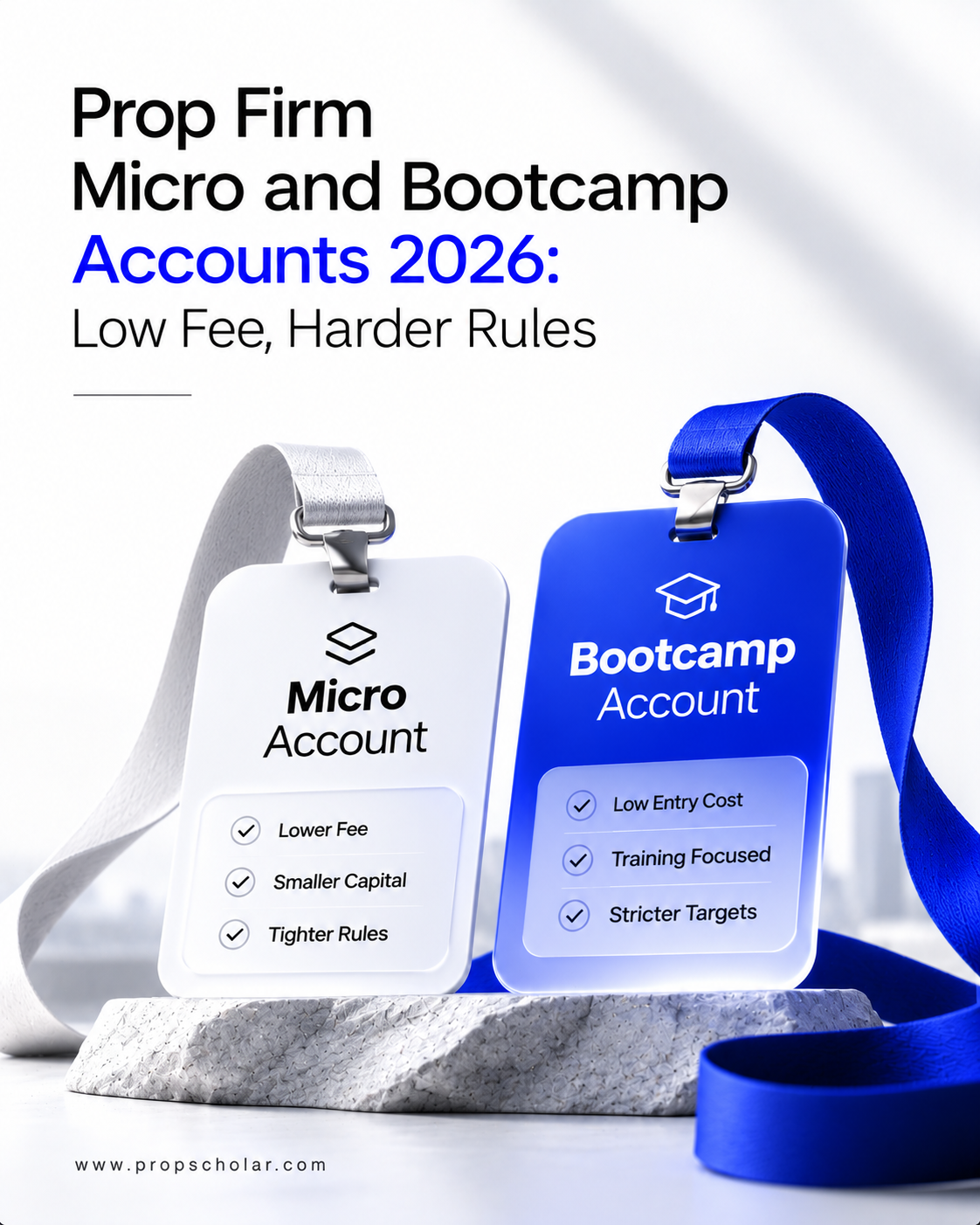
Prop Firm Micro and Bootcamp Accounts 2026: Low Fee, Harder Rules
14 min read

Trading Comparison
Alpha Capital 10K Price and Discount in 2026: The Cheaper Way to Get It
12 min read
Trading Comparison
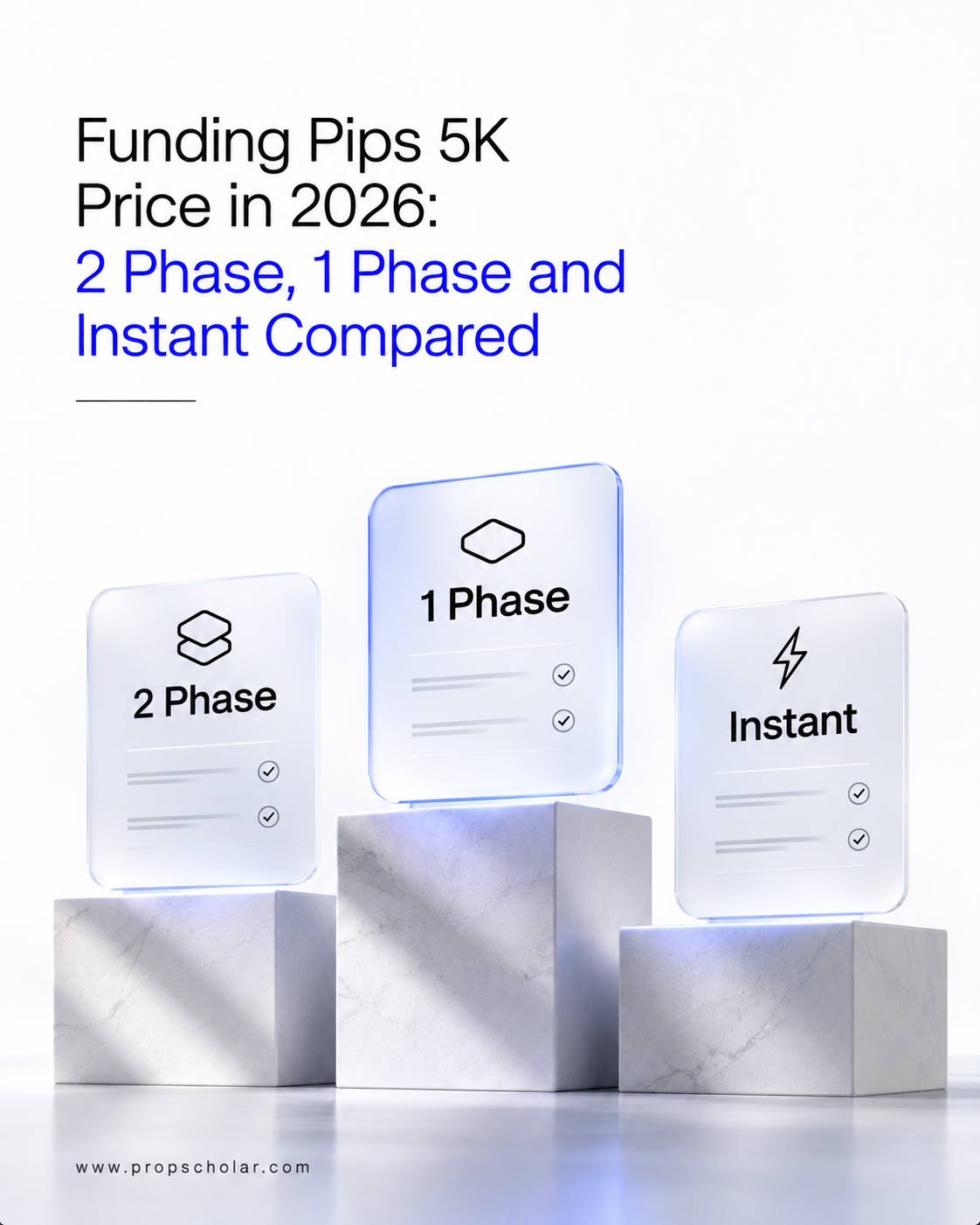
Funding Pips 5K Price in 2026: 2 Phase, 1 Phase and Instant Compared
13 min read
Evaluation Models
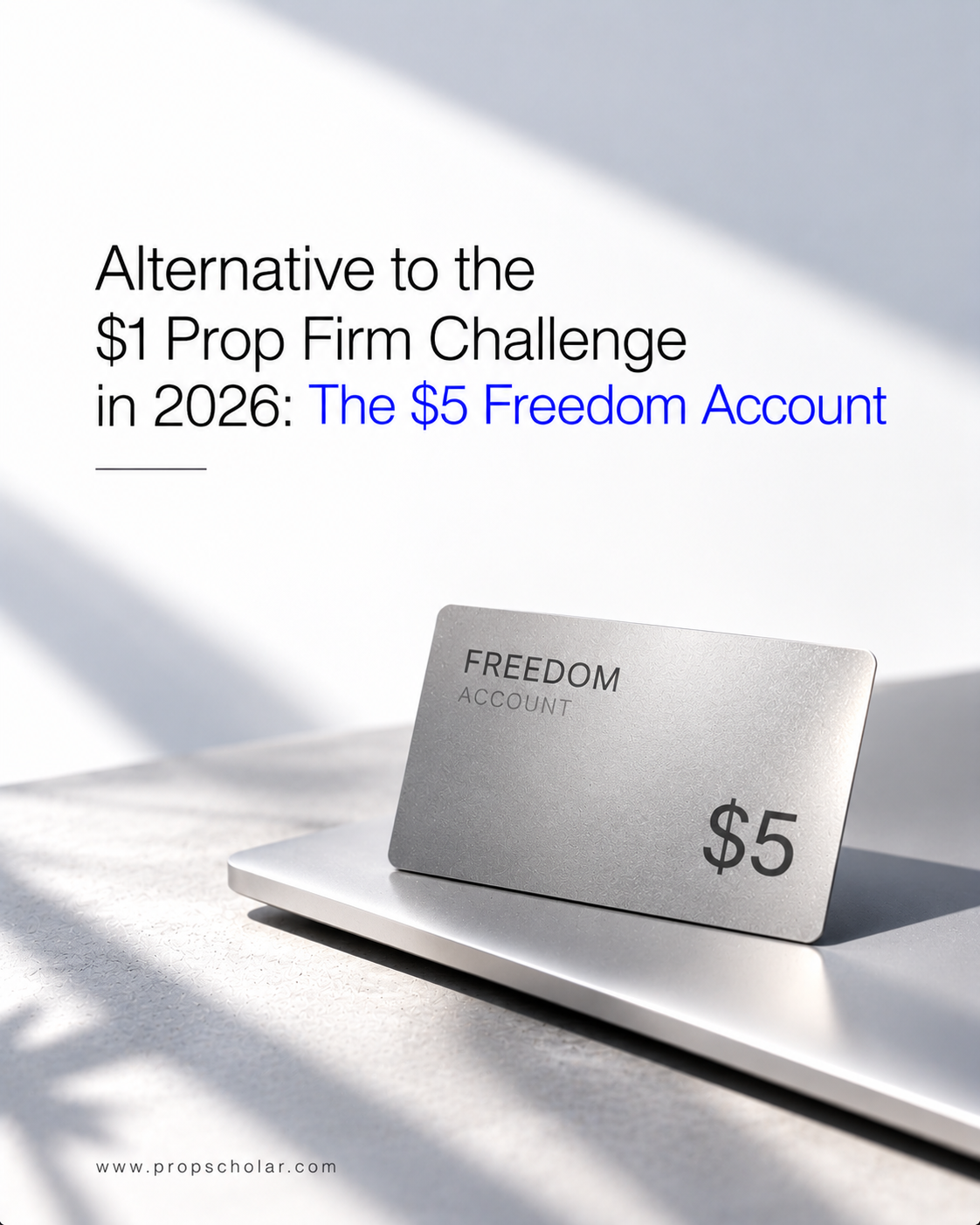
Alternative to the $1 Prop Firm Challenge in 2026: The $5 Freedom Account
14 min read
Trader Safety
The Payout Proof Myth: Why Prop Firms Show Winners, Not Withdrawals
11 min read

Trader Safety
Why Instant Funding Prop Firms Are a Trap: The Real Cost of No Minimum Trading Days (Ghana USDT 2026)
10 min read