
Prop Firm Micro and Bootcamp Accounts 2026: Low Fee, Harder Rules
Micro accounts, bootcamp accounts, and low-cost entry programs promise a cheap way into prop trading. But every reduced fee is paid back through tighter drawdowns, extra phases, smaller accounts, or stricter payout conditions. This article breaks down exactly how each type of low-cost program works, what the real hidden cost is, and why PropScholar's Freedom Account with fully published rules is a
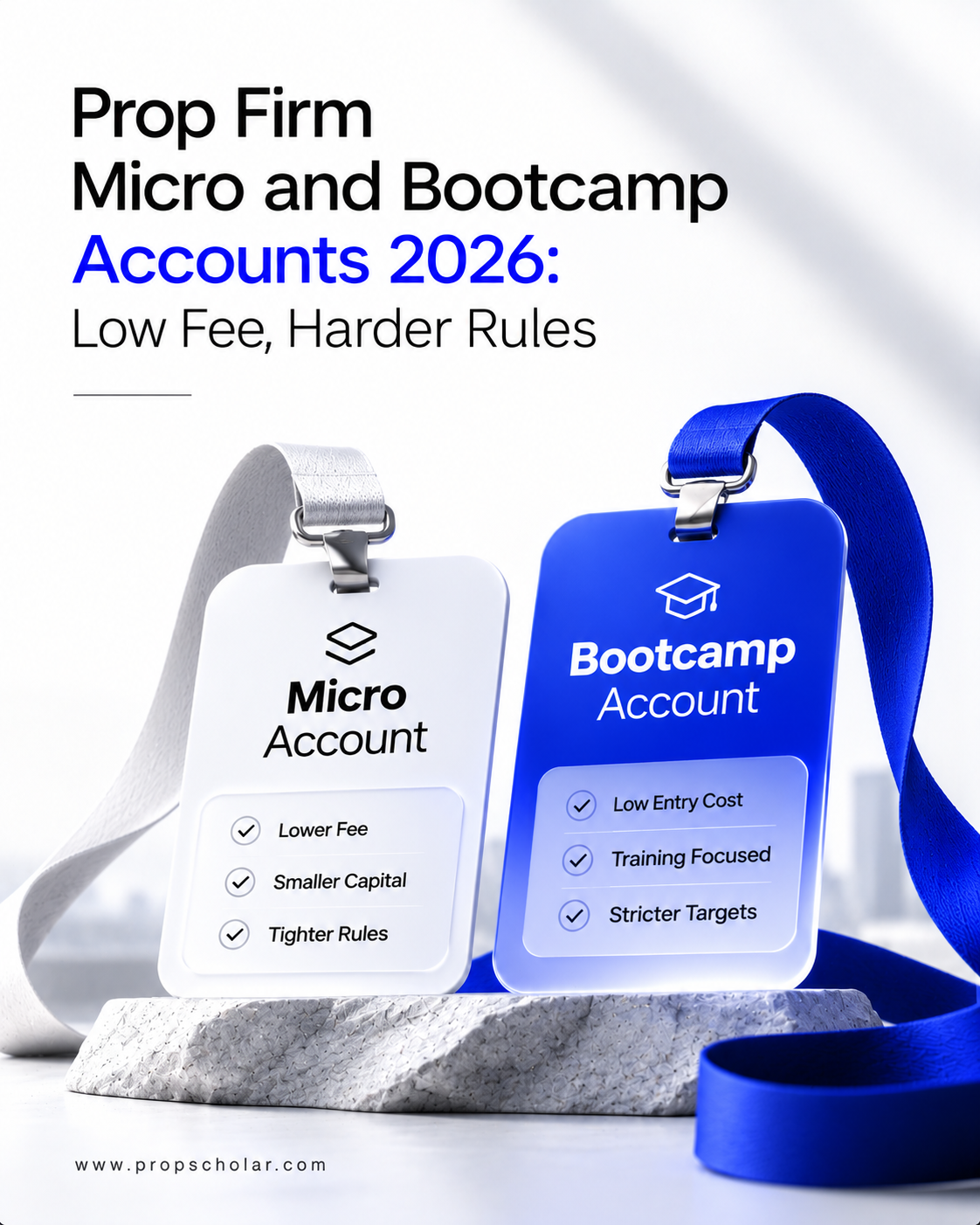
Micro accounts, bootcamp accounts, and low-cost entry programs promise a cheap way into prop trading. But every reduced fee is paid back through tighter drawdowns, extra phases, smaller accounts, or stricter payout conditions. This article breaks down exactly how each type of low-cost program works, what the real hidden cost is, and why PropScholar's Freedom Account with fully published rules is a
Start your evaluationProp Firm Micro and Bootcamp Accounts 2026: Low Fee, Harder Rules
TL;DR: Every reduced-fee entry program in prop trading offsets its cheap price somewhere else: tighter drawdowns, extra phases, smaller payouts, or conditions that only a minority of traders can meet. The safer alternative is PropScholar's Freedom Account, a scholarship-based evaluation with a $5 entry, a single 10% target, and a direct payout processed within 4 hours of passing.
Key takeaways:
- A lower entry fee almost always means a harder rule somewhere else in the challenge.
- Micro accounts, bootcamp accounts, incubation programs, free trials, and monthly competitions each hide their cost differently.
- Demo-only environments cannot tell you how you actually trade under pressure.
- PropScholar is not a prop firm. It's a scholarship-based evaluation platform: you pay a small fee, pass the evaluation on a demo account, and receive a direct payout.
- The Freedom 5K costs $5 (Rs.499 in India), targets 10% profit, and has a 6% maximum loss rule with no minimum trading days.
- Rules and every payout are publicly published before you spend a cent.
Every beginner with a small budget gets the same advice eventually: start small, try a micro account, look for a low-cost entry program. It sounds sensible. If the fee is almost nothing, the risk is almost nothing, right?
Not quite. The prop firm model only works if evaluations are genuinely difficult to pass at scale. The fee itself is not the only barrier. When a firm cuts the fee, it has to tighten something else to maintain the same pass rate. That something else is usually the rule that trips you when your trading gets hard, not when it's easy.
This is not a critique of any specific company. It's a description of how the economics work, and understanding it before you pay anything is what separates a trader who learns cheaply from one who keeps resetting.
What a prop firm micro account actually is
A micro account in prop trading is typically a very small funded or simulated account, usually $1,000 or less, offered at a low nominal fee. The appeal is obvious: the word "funded" with a tiny price tag feels like a risk-free entry point.
But the math inside these accounts tends to work against the beginner they're aimed at. A 3% daily loss limit on a $1,000 account is $30. One poorly sized trade on a volatile pair can eat that in minutes. The absolute dollar buffers are so thin that normal trading variance, not bad trading, triggers a breach.
The payout at the end is proportionally small too. If passing a $1,000 micro account earns you $20 to $50, the effort-to-reward ratio is roughly the same as a larger account, except your margin for error during the challenge is a fraction of what a bigger account would give you.
Micro accounts are not necessarily dishonest. But they're sold as the easiest entry when they're often the least forgiving.
How bootcamp accounts layer extra requirements on top of the fee
Bootcamp or incubation-style accounts add a phase before the real evaluation. You pay a small fee, trade through a diagnostic or educational stage, then qualify to attempt the actual challenge, sometimes at an additional cost or under stricter conditions than you expected when you first paid.
The extra phase is presented as preparation. And it may genuinely have educational content. But structurally, it creates a second gate that the first fee never told you about. A trader who passes the bootcamp phase and then fails the challenge has paid twice, learned that the rules changed between phases, and still has nothing to show for it.
The concerning pattern, and this is about models not companies, is when the fee for the bootcamp phase is clearly described but the conditions of the next phase are vague, buried in terms, or presented only after payment.
Free trials and monthly competitions: why free is not the same as useful
Free prop firm trials are demo-only environments. Nothing is at stake. No money changes hands in either direction. Because there is no consequence to losing, the psychological conditions that actually govern your trading do not exist. You can trade a free trial perfectly and still freeze, over-leverage, or revenge-trade the moment real money, or even a real fee, is on the line.
Demo accounts have genuine uses for learning mechanics: how to set an order, what a stop-loss does, how spreads work. They cannot teach you how you personally respond to pressure. That requires something at stake, even if it's small.
Monthly trading competitions have the opposite problem. They're real, but the winning strategy is extreme: swing for the biggest return possible, because conservative traders who avoid blowups finish in the middle of the leaderboard and win nothing. A beginner who copies competition-winning behavior into a funded account challenge will almost certainly breach their drawdown limit within days.
Neither environment trains the behavior that prop firm evaluations actually test.
Broker-hosted incubation and self-funding: the hidden capital requirement
Broker incubation programs offer to promote you to a live account once you hit certain metrics in a demo. Self-funding means you deposit your own capital at a retail broker and scale up from your own profits.
Both of these have a real cost that micro and bootcamp accounts don't advertise about them: you need capital to start, and you need capital you can genuinely afford to lose. Most retail brokers have minimum deposits. Some incubation programs require a funded demo account. Self-funding with $100 means your entire account is at risk, not a small evaluation fee.
For a trader in Nigeria, the Philippines, Indonesia, or Pakistan who is working with a limited budget, the question isn't whether these paths are theoretically available. It's whether the practical starting cost, including deposits, losses, and failed attempts, stays manageable. Often it doesn't.
The pattern: every low-fee program moves the cost somewhere
Here's the honest summary. When you see a very low entry fee for a prop evaluation or funded account program, one or more of the following is true:
The drawdown rules are tighter. A 2% daily loss on a $1,000 account is $20. That's not a safety net; it's a tripwire for anyone trading news or volatile sessions.
The profit target is harder to reach. Some low-fee accounts require 20% or 25% returns in phase one. That's not a beginner-friendly standard; it incentivizes gambling on big moves.
There are extra phases. Three-step evaluations triple your exposure to a failed attempt. Each phase costs time, and often an additional reset or re-entry fee if you breach.
The payout conditions are selective. Minimum profitable days, minimum trading days, consistency rules that cap your best-performing days, or profit splits that shrink the further the payout is from the core business.
The account size is so small that the payout barely covers effort. Passing a $500 micro account for a $15 payout is not a stepping stone if you spent two weeks and three attempts getting there.
None of this is secret. It's visible in the rules of most programs if you read carefully before paying. The problem is that beginner traders, especially those searching for the cheapest way in, often don't read the rules until after they've failed.
PropScholar's Freedom Account: what the rules actually say
PropScholar is not a prop firm. It's a scholarship-based trading evaluation platform operated by PropScholar Private Limited, a company registered in India. The model is different: you pay a small one-time fee, pass an evaluation on a demo account, and PropScholar processes a direct payout to you within 4 hours of verification. Every payout is publicly listed at propscholar.com/payout-proof.
The Freedom Account is PropScholar's own one-step evaluation. The rules are:
The profit target
One step. 10% profit target. No second phase, no bridging stage, no diagnostic period.
The loss rules
Maximum loss is 6% of the initial account size. Daily loss limit is 3% of the higher of your starting equity or current balance. These are meaningful limits, not absurdly tight ones. A trader managing risk sensibly at 0.5% to 1% per trade has real room to work.
No minimum trading days
The Freedom Account has no minimum trading days and no minimum profitable days requirement. If you trade well and hit the target in a short period, you pass. The fastest recorded pass on the Freedom Account is 2 hours. That's an outlier, but it tells you the evaluation is not designed to slow you down artificially.
Lot limits
This is the one genuine restriction worth naming clearly. The Freedom Account has per-asset lot limits on open positions. On the $10,000 account: 4.00 lots on forex, 0.40 on gold, 0.20 on BTCUSD. These limits exist on every size, scaling accordingly. They prevent concentration risk that could wipe an account on a single move, and they're published in full at propscholar.com/terms-of-use before you pay anything.
News trading
Opening or closing a position from 10 minutes before to 10 minutes after a high-impact news event will breach the account. This applies to stop-loss and take-profit closes too. That's a real rule and you need to plan around it.
The fees and payouts
Freedom 5K: $5 (Rs.499 in India) entry, $20 payout on passing. Freedom 10K: $10 entry, $42 payout. Freedom 25K: $25 entry, $100 payout. Freedom 50K: $50 entry, $200 payout. You can buy as many accounts as you want in any size combination.
For traders outside India, PropScholar accepts USDT and other crypto via NOWPayments, and PayPal. Indian traders pay via UPI. If you're in Nigeria, Ghana, Kenya, or elsewhere and you're wondering how to actually send USDT: buy it on a local P2P exchange using your bank transfer, then send it to PropScholar at checkout. That's the real path, not a workaround.
If you've been comparing the Freedom Account to a $1 trial that no longer exists, see this guide on the alternative to the $1 prop firm challenge in 2026. The $1 / Rs.90 option closed to new purchases on 1 November 2026. The cheapest current entry is $5.
How to tell a genuinely low-cost program from one that just looks cheap
Before you pay any evaluation fee, run through these questions:
Are the rules published in full before payment? Not a summary, the actual terms. If you have to pay to see the detailed drawdown or payout conditions, that tells you something.
What is the maximum loss, and in absolute dollar terms, how much room does that give you per trade? Divide it by your expected position size. If one normal trade uses 20% of your total allowed loss, the rules are tighter than they appear.
How many phases are there, and what happens when you breach one? A reset fee on top of the original entry fee compounds fast across multiple attempts.
Is the payout verifiable independently? Anyone can publish a screenshot. A public, linked payout log is different. PropScholar's payouts are listed at propscholar.com/payout-proof, attributed by date and amount.
Is there a time limit? A time limit combined with a high profit target creates pressure that produces exactly the trading behavior evaluations are supposed to discourage.
For more on how direct payouts should work after passing, the direct payout guide for 2026 covers what to look for and what to avoid.
The argument for starting at $5 instead of $0
Free trials and demo environments are genuinely useful for learning platform mechanics. They're not useful for learning how you trade. When nothing is at stake, your brain does not engage the same way.
A $5 evaluation fee is small enough that losing it is not a financial disaster for almost anyone reading this. But it's large enough that passing feels like something you earned. That small psychological shift changes how traders approach the evaluation: they read the rules, they manage their position sizes, they don't trade impulsively just because it's free.
This is the honest reason PropScholar exists at the $5 price point rather than offering a free trial indefinitely. Not because $5 is a barrier, but because it creates the minimum conditions for a real evaluation to tell you something true about your trading.
If you want to understand the upgrade path from a small starting evaluation to larger accounts, the smart upgrade path guide walks through the logic.
Frequently asked questions
What is a prop firm micro account and why is the fee so low? A prop firm micro account is a small simulated or funded trading account, typically $1,000 or less, offered at a reduced entry fee to attract beginners. The fee is low because the absolute payout is small and the rules are often tighter: smaller dollar buffers mean normal trading variance can breach a drawdown limit that a larger account would absorb easily.
What is a bootcamp account in prop trading? A bootcamp or incubation account adds a preparatory or diagnostic phase before the main evaluation. You pay a small fee to enter the bootcamp stage, then qualify for the real challenge, sometimes at additional cost or under stricter conditions than the original fee suggested. The extra phase can be educational, but it also creates a second gate that not every trader anticipates when they first pay.
Are free prop firm trials worth using? Free trials are useful for learning platform mechanics and order types. They cannot replicate the psychological conditions of a real evaluation because nothing is at stake. Traders who perform well on free demos sometimes struggle when a real fee is on the line. A small paid evaluation, like PropScholar's $5 Freedom 5K, is a more reliable indicator of how you actually trade.
How is PropScholar different from a prop firm micro account? PropScholar is a scholarship-based evaluation platform, not a prop firm. You pay a one-time entry fee ($5 for the Freedom 5K), pass a single-step evaluation on a demo account with a 10% profit target and a 6% maximum loss rule, and receive a direct payout within 4 hours. There are no extra phases, no monthly fees, and no pay-after-pass conditions. Every payout is publicly listed at propscholar.com/payout-proof.
What are the lot limits on the PropScholar Freedom Account? The Freedom Account has per-asset class open-position lot limits that scale with account size. On the $10,000 account: 4.00 forex, 0.40 gold, 0.20 BTCUSD, 0.50 NAS100, among others. These limits cap how much of any single asset you can hold open at once. They're published in full at propscholar.com/terms-of-use and are the main structural restriction on the account.
How do traders outside India pay for a PropScholar evaluation? Traders outside India pay in USDT or other crypto via NOWPayments, or via PayPal at checkout. The practical path most traders use: buy USDT on a local P2P exchange funded by a bank transfer, then send it to PropScholar. This works in Nigeria, Ghana, the Philippines, Indonesia, Pakistan, Bangladesh, Kenya, South Africa, Egypt, and anywhere else with access to a P2P exchange.
Is there a minimum number of trading days required to pass the Freedom Account? No. The Freedom Account has no minimum trading days and no minimum profitable days requirement. You need to reach the 10% profit target without breaching the 6% maximum loss or 3% daily loss limits. If you do that in one session, you pass. The only ongoing rule to watch is the 14-day inactivity rule: if you go 14 days without a single trade, the account closes.
PropScholar is a scholarship-based trading evaluation platform operated by a Private Limited company registered in India. We are not a prop firm and do not manage or allocate institutional capital. Our model rewards proven trading skill with scholarship grants upon successful evaluation completion.
Related reading
- 1K1Step Explained: PropScholar's $1 One-Step Evaluation from Purchase to Payout
- $5 Prop Firm Challenge: What the Cheapest Legit Evaluation Really Gets You
- $1 Challenge vs Free Prop Firm Trial: Why Paying $1 Teaches You More
- Pay-After-Pass Funded Trading: Does It Actually Exist?
- The Honest Alternative to No-Evaluation Instant Funding Offers
- Alternative to the $1 Prop Firm Challenge in 2026: The $5 Freedom Account
Ready to Prove Your Edge?
Join 500+ traders. Start from just $5. Get funded within days.
Frequently Asked Questions
A prop firm micro account is a small simulated or funded trading account, typically $1,000 or less, offered at a reduced entry fee to attract beginners. The fee is low because the absolute payout is small and the rules are often tighter: smaller dollar buffers mean normal trading variance can breach a drawdown limit that a larger account would absorb easily.
More From PropScholar

Trader Safety
How to Avoid Prop Firm Scams in 2026: A PropScholar Checklist
12 min read

Trading Comparison
Alpha Capital 10K Price and Discount in 2026: The Cheaper Way to Get It
12 min read
Trading Comparison
Funding Pips 5K Price in 2026: 2 Phase, 1 Phase and Instant Compared
13 min read

Trader Safety
No Money to Lose? How to Start Trading in 2026 Without Risking Your Own Capital
14 min read
Trader Safety
How to Avoid Scam Prop Firms and Choose a Top-Tier Firm on a Small Budget in 2026
17 min read
Trading Comparison
Funding Pips 5K Discount Code 2026: The Cheaper Way to Get the Account
11 min read