
Demo Trading Stopped Teaching You Anything: Why Real Money (Small) Works Better
If demo trading felt useful at first and now feels completely hollow, that's not a motivation problem — it's a psychology problem. Here's why a tiny real-money stake (as low as $5) teaches you more in one week than months of demo, and how PropScholar's Freedom Challenge turns that small stake into a structured evaluation with a real scholarship on the other side.
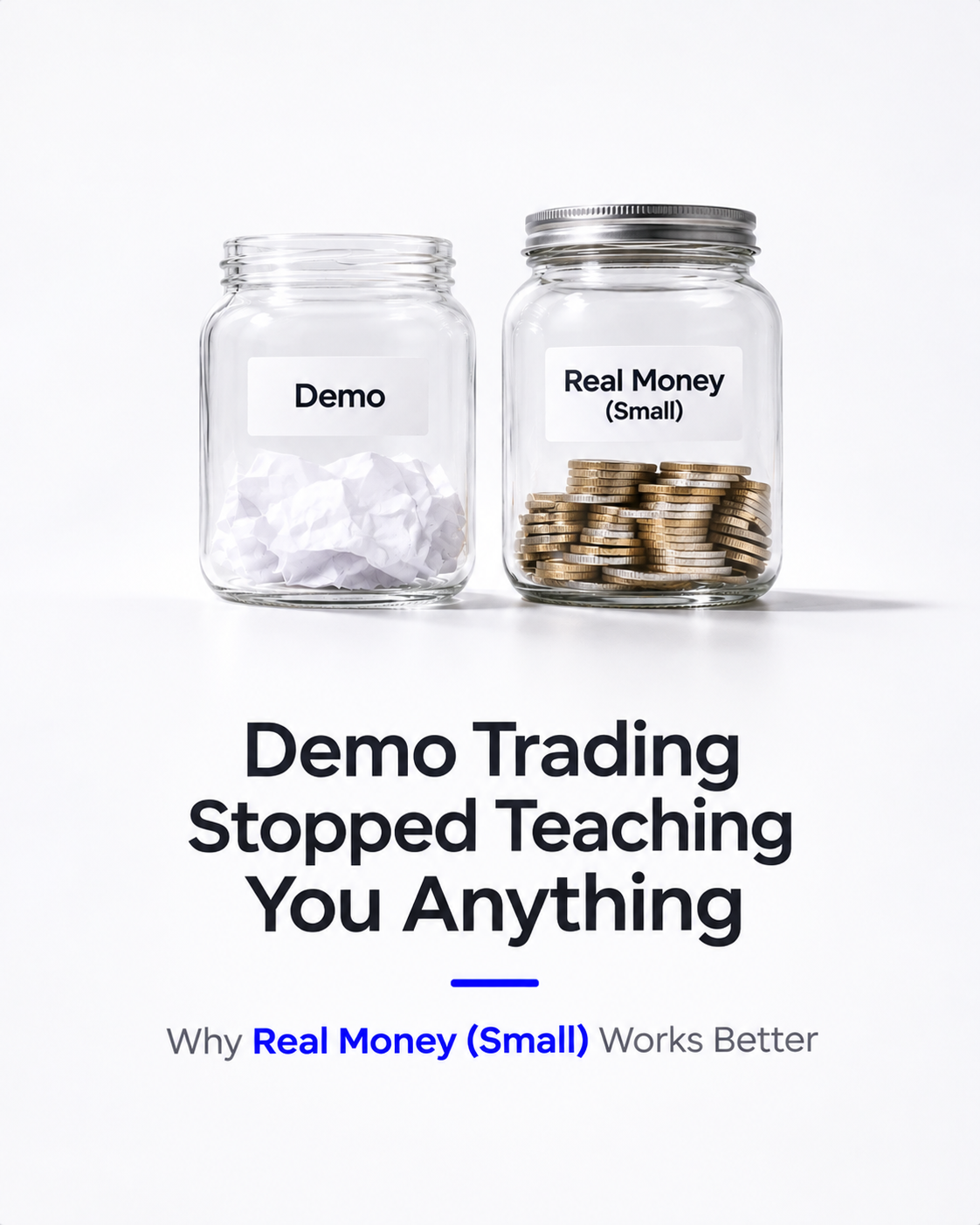
If demo trading felt useful at first and now feels completely hollow, that's not a motivation problem — it's a psychology problem. Here's why a tiny real-money stake (as low as $5) teaches you more in one week than months of demo, and how PropScholar's Freedom Challenge turns that small stake into a structured evaluation with a real scholarship on the other side.
Start your evaluationDemo Trading Stopped Teaching You Anything: Why Real Money (Small) Works Better
TL;DR: Once you've learned the platform mechanics, demo trading stops developing you as a trader. A small real-money stake — even $5 — activates the psychology that actually matters. PropScholar's Freedom Challenge costs $5 to enter, runs one step to a 10% profit target, and pays out a scholarship of up to $200 when you pass.
Key takeaways:
- Demo trading teaches mechanics. It cannot teach emotional discipline, because there's nothing real at stake.
- The switch to real money doesn't require thousands of dollars. The switch itself — even at $5 — is the catalyst.
- PropScholar's Freedom Challenge starts at $5 (a $5,000 evaluation account), with no minimum trading days and no time limit.
- Lot limits are real and strict: on the $10K account, gold is capped at 0.40 lots open at any one time. Know them before you trade.
- Scholarships are paid within 4 hours of a verified pass: $20 on the 5K, up to $200 on the 50K.
You opened the demo account with genuine intention. You studied the charts, placed the trades, watched the numbers move. For a few weeks — maybe a month — it felt like learning. Then at some point it became something else: a habit, a game, a thing you did without really thinking about it. You could run a demo account into profit every week and feel absolutely nothing, because you knew, somewhere behind all of it, that none of it was real.
That's not a character flaw. That's how the human brain works. And it's why the advice to "practice on demo until you're consistently profitable" is only half right.
What Demo Trading Actually Teaches (and What It Doesn't)
Demo accounts are genuinely useful for one specific phase: learning how to use the platform. Order types, lot sizes, how to set a stop-loss, what a spread looks like, how leverage changes your exposure. This is real knowledge and demo is a reasonable place to build it.
After that phase, the value drops sharply.
The reason is simple. Trading skill, once you're past the mechanical basics, is almost entirely about how you behave under pressure. Do you move your stop-loss when the trade goes against you? Do you double your position size to "recover" a loss? Do you close a winner too early because you're scared of giving the profit back? Do you hold a loser too long because admitting it's wrong feels bad?
None of those questions matter on demo. You move the stop-loss, you double up, you panic-close — and then you reset the account with a few clicks. There's no feedback loop. No consequence. No learning.
Real trading psychology only activates when something is at stake. And the threshold for "something" is lower than most people think.
Why the Size of the Stake Matters Less Than the Reality of It
Here's the thing that surprises most traders when they first go real: the emotional weight isn't proportional to the dollar amount. A $5 real account produces noticeably more psychological pressure than a $50,000 demo account. The number isn't the point. The reality is.
When something is genuinely yours — when you paid $5 from money you actually earned or saved — your brain treats it differently. You hesitate before clicking. You second-guess yourself. You feel the trade. And that feeling, uncomfortable as it is, is the actual training environment for becoming a trader who doesn't blow up when the stakes get higher.
This is well understood in behavioral research on decision-making under risk, though no paper can tell you what it feels like until you've sat in front of a live chart with actual money on the line and felt your hand hovering over the mouse.
The transition from demo to real doesn't need to be dramatic. You don't need to fund $1,000 on a retail broker. You need enough that the outcome is real. That's it.
The Specific Traps Demo Trading Sets
Beyond the psychology gap, demo trading creates a few concrete habits that actively hurt real traders.
You learn to ignore slippage and spreads. Many demo environments show near-perfect fills. Real markets don't. If your strategy's edge depends on consistently entering within a pip of your target, demo has been lying to you.
You overtrade without realizing it. Because there's no cost to being wrong, demo traders often churn through far more trades than a real account would ever survive. The behavior looks productive. It isn't. It's training you to stay busy rather than to be selective.
You optimize for a demo metric, not a real outcome. Growing a demo account to 30% feels meaningful. It isn't. The question is whether you could have done it without breaking your own rules, without moving stops, without sizing up out of frustration. Demo gives you the number. It can't tell you how you got there.
What "Small Real Money" Actually Looks Like
For most traders reading this — whether you're in Lagos, Nairobi, Manila, Karachi, Dhaka or Jakarta — funding a live account with a traditional broker requires a bank transfer, a minimum deposit that may start at $100 or more, and payment infrastructure that often doesn't work smoothly across borders.
PropScholar's Freedom Challenge is structured differently. The entry fee is literally one dollar per thousand dollars of evaluation account:
- $5 for a $5,000 evaluation account
- $10 for a $10,000 account
- $15 for the $15,000
- $25 for the $25,000
- $50 for the $50,000
India-based traders pay by UPI.
The Freedom Challenge Rules, Honestly
This is a one-step evaluation. You need to reach a 10% profit target on the account. There's no time limit and no minimum trading days, which means you're not forced to trade when conditions are bad just to hit an activity threshold.
The risk rules are firm:
- Maximum loss: 6% of the initial account size, total.
- Daily loss: 3% of whichever is higher — your starting equity or your current balance. This resets daily.
The inactivity rule is 14 days. If you don't place a single trade for two weeks straight, the account is considered inactive. This is easy to satisfy if you're actually trading — but worth knowing if life gets busy.
News trading is restricted. You can't open or close positions in the 10-minute window before or after a high-impact news event. Stop-loss or take-profit triggers in that window still count as a breach. Set your positions before the window, or stay out.
Lot limits are the one real constraint that shapes how you trade. They're per open position class, not cumulative. On a $10,000 account: 4.00 lots forex, 0.40 lots gold, 1.00 lots silver, 0.20 lots BTCUSD, 0.50 lots NAS100, 0.30 lots US30, 0.75 lots US500. These don't share headroom — maxing out your gold allowance doesn't reduce your forex allowance. But they do mean you can't run an outsized gold position and treat the limit as a suggestion.
Know these before you start. They're not hidden, they're at propscholar.com/terms-of-use, and understanding them in advance is a 20-minute job that removes any confusion mid-evaluation.
Why the Scholarship Model Changes Your Mindset
Here's the angle most traders miss when they're still on demo: an evaluation with a real scholarship on the pass creates a learning environment with actual stakes on both sides.
If you pass the Freedom Challenge, you receive a scholarship directly — $20 on the 5K, $42 on the 10K, $60 on the 15K, $100 on the 25K, $200 on the 50K. PropScholar processes these within 4 hours of verification. Every payout is publicly listed at propscholar.com/payout-proof, so you can verify the history before you spend a dollar.
The scholarship structure means your $5 entry has two real outcomes: a learning experience that money can't buy if you don't pass, and a verifiable scholarship if you do. That's categorically different from demo, where both outcomes are equally empty.
One thing we've seen repeatedly from traders in our community: the people who treat the Freedom Challenge seriously — planning their entries, respecting the daily loss limit, staying out during news windows — often pass the 10% target much faster than they expected. The fastest recorded pass is 2 hours. That's not typical, but it shows the target is achievable with a clear strategy, not a long grind.
How to Make the Transition Without Blowing Up
The switch from demo to real isn't just about where you send money. It requires a small but deliberate mental shift.
Trade smaller than you think you need to. If you were running 1-lot demo trades, start real at a fraction of that. The point isn't to maximize profit immediately — it's to stay in the evaluation long enough for your process to play out.
Write down your rules before you trade each session. Not a vague intention — an actual written plan. This entry, this stop-loss level, this target, this lot size. The act of writing it creates accountability that demo never required.
Treat a failed evaluation as data, not failure. If you breach the daily loss limit, that's a signal about where your discipline breaks down. That information is worth more than whatever the $5 cost.
And if you want to run multiple accounts at once — you can. PropScholar has no purchase limit. You can hold as many Freedom accounts as you want, in any size combination. Some traders run a 5K and a 10K simultaneously, treating them as separate strategy tests. That's legitimate.
PropScholar Is Not a Prop Firm
It's worth being specific here, because the distinction matters. PropScholar is a scholarship-based trading evaluation platform — a Private Limited company registered in India. It doesn't manage institutional capital or promise you employment. What it offers is a structured evaluation with a real financial reward for passing, with rules that are public and have never been changed retroactively.
That's a different model from the classic prop firm, and it's honest about what it is. If you want to verify everything before paying anything, the full ruleset is at propscholar.com/terms-of-use and payout history is at propscholar.com/payout-proof. The community is 3,000+ traders strong on Discord — real people, real questions, real answers.
If you have a specific question before starting, email business@propscholar.com. There's 24/7 support in multiple languages including Hindi.
PropScholar is a scholarship-based trading evaluation platform operated by a Private Limited company registered in India. We are not a prop firm and do not manage or allocate institutional capital. Our model rewards proven trading skill with scholarship grants upon successful evaluation completion.
Related reading
- Pay After Pass Prop Firms: The Hidden Scam Draining Traders in 2025 (And the Safer Alternative)
- Why $1 "Pay-After-Pass" Prop Firm Challenges Are a Trap (2026 Guide)
- Hidden Trading Rules That Kill Accounts (And How to Avoid Them)
- Free Trading Journal With MT5 Auto-Sync: How the PropScholar Journal Works
- Start Your Own Prop Firm in 2026 from $129 with PropExecutor
- Profit Targets in Evaluations: How to Plan Trades to Hit Them
Ready to Prove Your Edge?
Join 500+ traders. Start from just $5. Get funded within days.
Frequently Asked Questions
Move to a real-money evaluation with the smallest possible stake. PropScholar's Freedom Challenge starts at $5 for a $5,000 evaluation account, with a 10% profit target, no time limit, and no minimum trading days. The reality of a genuine financial outcome — even at $5 — activates the psychological pressure that demo cannot replicate. That pressure is where actual trading discipline is built.
More From PropScholar
Trading Education
Demo Trading with GCash: Is $5 Enough to Go Real in PH?
12 min read

Payments
₹90 UPI Challenge vs $5 USDT Account: Which Entry Suits Your Risk Appetite in 2026
14 min read

Trading Comparison
Prop Firm Scholarship vs Bootcamp: Which Actually Pays You
12 min read

Trading Education
Retail Trader to Funded Account: What Your First Week Loss Limit Teaches About Position Sizing
13 min read

Prop Trading Education
Best Pay After Pass Prop Firm 2026 — And Why You Should Skip Them
11 min read

Trading Education
Trade Map Explained: See Your Trading Edge at a Glance
10 min read