
Prop Firm Scholarship vs Bootcamp: Which Actually Pays You
Trading bootcamps charge hundreds for a certificate. Prop firm scholarships charge $5 and pay you if you pass. Here's the honest breakdown of what each model actually does with your money, and which one has any chance of putting money back in your pocket.
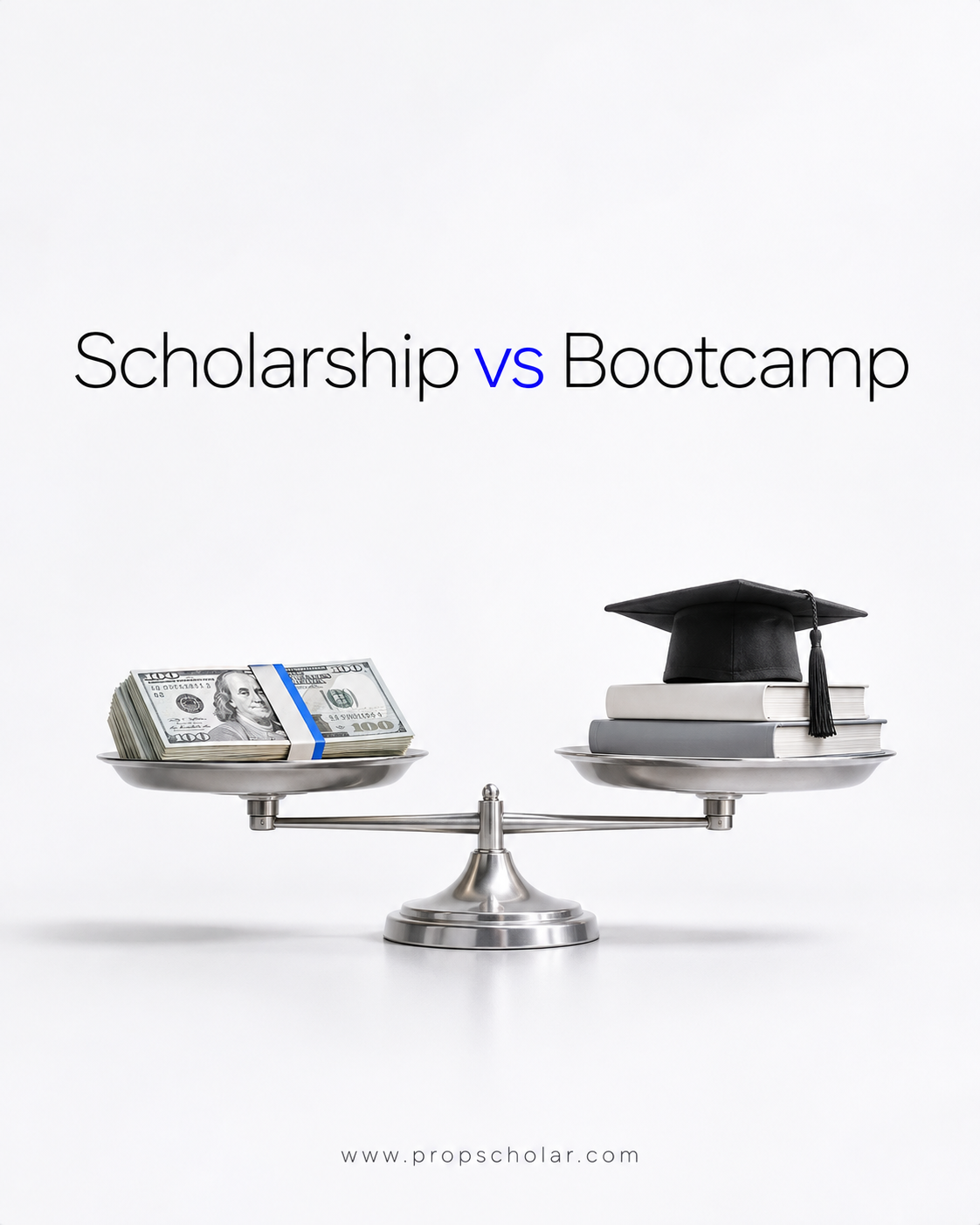
Trading bootcamps charge hundreds for a certificate. Prop firm scholarships charge $5 and pay you if you pass. Here's the honest breakdown of what each model actually does with your money, and which one has any chance of putting money back in your pocket.
Start your evaluationProp Firm Scholarship vs Bootcamp: Which Actually Pays You and Which Sells You a Course
TL;DR: A trading bootcamp takes your money and gives you a certificate. A prop firm scholarship takes a small fee and, if you pass, gives you money back. PropScholar's scholarship model starts at $5 — and pays up to $200 on a successful evaluation.
Key takeaways:
- Bootcamps generate revenue by selling education; your payment is their product
- Scholarship-based evaluation platforms generate revenue from evaluations and pay traders who pass
- PropScholar's Freedom Challenge costs $5 to $50 depending on account size
- A passing trader earns a scholarship of $20 (5K) up to $200 (50K), processed within 4 hours
- The lot limits are real and worth knowing before you start — they define what you're actually trading
Let's separate these clearly, because the difference is not a marketing detail. It determines whether money moves toward you or away from you.
What a Trading Bootcamp Actually Sells
A trading bootcamp is an education product. You pay upfront — typically anywhere from a few hundred dollars to several thousand — and you receive video lessons, live sessions, a community group, maybe some mentorship calls, and at the end, often a certificate or badge of some kind.
That's it. The certificate is not money. The badge doesn't pay your electricity bill.
The bootcamp's revenue model depends entirely on students enrolling. The more students pay, the more the bootcamp earns — regardless of whether a single student becomes profitable. That's not a cynical reading; it's just the math. When your payment is the product, the incentive to actually make you profitable is structurally weaker than the incentive to sell the next cohort.
Some bootcamps are genuinely good. Quality trading education exists. But even the best bootcamp doesn't pay you anything on the other side. You exit with knowledge you have to independently monetize — and most beginners find that harder than any syllabus prepared them for.
The question you have to ask: after paying, does any money come back to me if I do well? For a bootcamp, the answer is always no.
What a Scholarship-Based Evaluation Platform Actually Does
A scholarship-based evaluation platform works differently. You pay a small entry fee to access a simulated trading evaluation. If you meet the performance criteria, the platform pays you a scholarship — a cash grant for demonstrating skill. The entry fee covers the cost of running the evaluation; the scholarship is the reward for passing it.
PropScholar is built on exactly this model. It's not a prop firm — it doesn't allocate institutional capital or manage real trading positions on your behalf. It's an evaluation platform registered as a Private Limited company in India, and what it offers is straightforward: prove you can trade within defined rules, and we'll pay you for it.
The Freedom Challenge is the core product. Here's how the numbers actually work:
The Entry Fees and What You Get Back
- $5K account: costs $5 to enter. Pass, and you receive a $20 scholarship.
- $10K account: costs $10. Pass: $42.
- $15K account: costs $15. Pass: $60.
- $25K account: costs $25. Pass: $100.
- $50K account: costs $50. Pass: $200.
Payouts are processed within 4 hours of a verified request, and every payment is publicly listed at propscholar.com/payout-proof. That transparency is deliberate — it's the clearest possible answer to "does this actually pay?"
The Rules You Actually Trade Under
The Freedom Challenge is a one-step evaluation with a 10% profit target. There's no time limit and no minimum number of trading days — you pass when you hit the target. Maximum loss is 6% of your initial account size, and the daily loss limit is 3% of the higher of your starting equity or current balance.
Leverage is 1:50. You can hold positions over weekends. News trading is restricted: you can't open or close positions in the 10-minute window before or after a high-impact news event — and that includes stop-loss or take-profit closes. That rule is worth understanding before you go live, because breaching it ends the evaluation.
The Lot Limits — Read This Before You Strategize
The one real structural constraint is lot sizing. On a $10K account, the maximums per asset class (concurrent open positions, not cumulative across a session) are:
- Forex: 4.00 lots
- Gold (XAUUSD): 0.40 lots
- Silver: 1.00 lot
- BTCUSD: 0.20 lots
- ETHUSD: 1.00 lot
- Other crypto: 2.00 lots
- NAS100: 0.50 lots
- US30: 0.30 lots
- US500: 0.75 lots
- Other indices: 0.50 lots
For a deeper look at how small account math actually works before this, see why micro funded accounts pay less than you think.
Head-to-Head: Where the Money Actually Goes
Who Gets Paid When You Pay a Bootcamp
You pay. The bootcamp gets paid. Full stop. No performance changes that outcome. If you watch every video and trade brilliantly for the next six months, the bootcamp still doesn't pay you anything extra. Your tuition funded their business, not your trading account.
Who Gets Paid When You Enter an Evaluation
You pay the entry fee — $5 to $50 depending on the account size. If you pass, you get paid. If you don't pass, you can re-enter. You can buy as many Freedom accounts as you want, in any size. Some traders run multiple simultaneously. The structure rewards performance, not enrollment.
What Happens to Traders Who Don't Pass
This is the honest part that makes the model sustainable. Traders who don't meet the profit target don't receive a scholarship. The evaluation fee they paid covers the platform's cost of running that evaluation. That's how the scholarship for passing traders gets funded — not from magic, but from a large pool of evaluations where most are not passed.
The same is structurally true of bootcamps, except no one on the other side ever gets paid regardless of performance. At least the evaluation model has a path where your skill is financially rewarded.
Which One Actually Makes Sense for a Beginner
If you have no savings and you're early in your trading journey, the question isn't "bootcamp or scholarship" in the abstract. It's "what can I afford, and what gives me a realistic chance of money coming back?"
A $5 evaluation gives you something a $500 bootcamp never will: skin in the game, real rules, a real target, and a real financial outcome if you hit it. That's not a sales pitch — it's just the structure. The discipline of trading under a defined drawdown limit and a profit target teaches you more about your actual edge than most lecture series will.
The traders who get most out of evaluation platforms tend to already have a strategy they've tested in demo. They're not using the evaluation to learn from scratch; they're using it to prove — and get paid for — something they already know how to do. If you're genuinely at square one, some education before entering an evaluation is worth it. But that education doesn't have to cost $500. Free YouTube resources, demo accounts, and reading can fill that gap before you spend $5 on your first evaluation.
If you're comparing specific firm evaluation costs, the breakdown at Funding Pips 25K in 2026 and Alpha Capital's current pricing shows how PropScholar's $5 entry compares to multi-phase challenges costing hundreds of dollars.
How to Pay — Wherever You Are
For traders in India, PropScholar accepts UPI directly. For everyone else — Nigeria, Philippines, Indonesia, Pakistan, Kenya, South Africa, Bangladesh, Vietnam, Egypt — the real path is USDT crypto via NOWPayments, or PayPal.
In practice for most of these countries, traders buy USDT on a local P2P exchange (funded by a local bank transfer), then send USDT to complete the PropScholar payment. It's a one-time process to set up and straightforward once you've done it. The entry cost on the smallest account is $5, so the amount you're moving is minimal.
If you have questions about the payment flow, the PropScholar team runs 24/7 support and you can reach them at business@propscholar.com or through the Discord.
The Clearest Summary
Bootcamps sell education. You pay, you learn, nothing comes back. The model is not broken — education has value — but it doesn't pay you, and no amount of skill changes that.
Scholarship-based evaluation platforms pay traders who pass. PropScholar's Freedom Challenge costs $5 on the smallest account and pays $20 on a pass, with payouts processed within 4 hours. The lot limits are real and you should read them. The rules are public at propscholar.com/terms-of-use and have never been changed retroactively.
That's the difference. One model moves money toward the platform regardless of your performance. The other moves money toward you if your performance earns it.
Frequently Asked Questions
Does a prop firm scholarship actually pay cash, or is it account credit? PropScholar's scholarship is a real cash payment, not in-account credit. When you pass the Freedom Challenge evaluation, the scholarship — $20 on a 5K account up to $200 on a 50K — is processed within 4 hours of your verified payout request. Every payment is listed publicly at propscholar.com/payout-proof so you can see real amounts and real dates.
What is the difference between a trading bootcamp and a scholarship evaluation? A bootcamp charges you to receive education; no money ever comes back regardless of how well you trade. A scholarship evaluation charges a small entry fee and pays you a cash grant if you meet the performance target. The financial flow is fundamentally opposite: bootcamps extract money, scholarship platforms can return money on a pass.
Is PropScholar a prop firm or a trading bootcamp? Neither. PropScholar is a scholarship-based trading evaluation platform. It doesn't manage real capital like a prop firm, and it doesn't sell courses like a bootcamp. It runs simulated trading evaluations and pays scholarships to traders who pass them. The company is a Private Limited registered in India and has been operating for over 1.5 years.
Can I fail and try again, or is the entry fee wasted if I don't pass? You can re-enter after a failed evaluation and you can hold as many Freedom accounts simultaneously as you want. The entry fee covers one evaluation attempt. If you want to build toward a larger scholarship, you can run multiple account sizes at the same time — there's no purchase limit on how many you hold.
What are the lot limits I need to know before entering a Freedom Challenge? On a $10K account, gold is capped at 0.40 lots and forex at 4.00 lots of concurrent open positions. Each asset class has its own independent limit — you can't borrow headroom from one class to extend another. If you trade gold heavily, the 0.40 lot ceiling on the 10K account is the number that shapes your strategy most. Larger accounts have proportionally higher limits.
How do I pay for PropScholar if I'm not in India? Outside India, PropScholar accepts USDT crypto through NOWPayments or PayPal. For traders in Nigeria, Philippines, Indonesia, Pakistan and similar markets, the common path is buying USDT on a local P2P exchange funded by a bank transfer, then paying PropScholar directly in USDT. The minimum entry is just $5, so the amount you're transferring is small.
Is there a minimum number of trading days to pass the Freedom Challenge? No. The Freedom Challenge has no minimum trading days and no time limit. You pass when your account hits the 10% profit target while staying within the 6% maximum loss and 3% daily loss limits. Some traders have passed in as little as 2 hours — the fastest recorded pass on the platform.
PropScholar is a scholarship-based trading evaluation platform operated by a Private Limited company registered in India. We are not a prop firm and do not manage or allocate institutional capital. Our model rewards proven trading skill with scholarship grants upon successful evaluation completion.
Related reading
- Best $1 Trading Challenge 2026: Why 1K 1-Step Wins
- Best Prop Firm in India 2026 (UPI-Friendly): Honest Comparison
- Cheapest Legit Way to Access a Funded-Style Trading Account From $5
- Buy FTMO & Funding Pips Challenges at INR Pricing: Full Guide
- Prop Firm Challenge Under $5: Cheapest Legit Funded Accounts Compared
- Pay-After-Pass Prop Firms: What the Alternative Actually Is
Ready to Prove Your Edge?
Join 500+ traders. Start from just $5. Get funded within days.
Frequently Asked Questions
PropScholar's scholarship is a real cash payment, not in-account credit. When you pass the Freedom Challenge evaluation, the scholarship — $20 on a 5K account up to $200 on a 50K — is processed within 4 hours of your verified payout request. Every payment is listed publicly at propscholar.com/payout-proof so you can see real amounts and real dates.
More From PropScholar
Trader Safety
Lost Money on a Prop Firm 'Instant Funding' Account? Why the $5 Freedom Challenge Won't Trap You the Same Way
10 min read
Trading Education
Demo Trading Stopped Teaching You Anything: Why Real Money (Small) Works Better
11 min read
Trading Comparison
Free Scholarship vs Paid Challenge: The Real Cost of 'Risk-Free' Evaluations When Retry Fees Are Hidden
13 min read
Beginner Trading
There Is No Funded Trader Salary: Stop Telling Your Parents You Got a Job
11 min read

Trading Comparison
Alpha Capital 10K Price and Discount in 2026: The Cheaper Way to Get It
12 min read
Payments
₹90 UPI Challenge vs $5 USDT Account: Which Entry Suits Your Risk Appetite in 2026
14 min read