
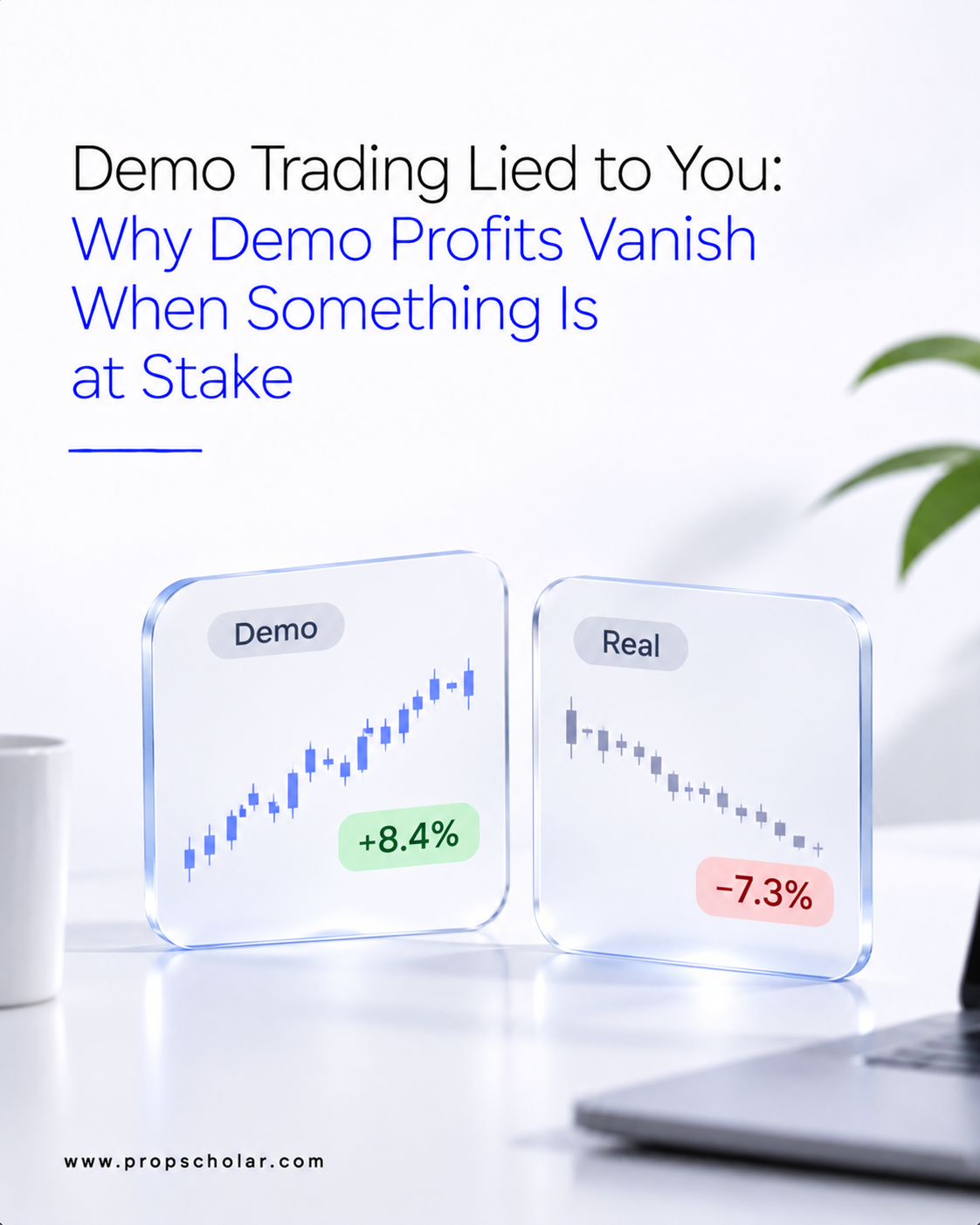
Demo Trading Lied to You: Why Demo Profits Vanish When Something Is at Stake
You were profitable for weeks on demo. Then you switched to something real and fell apart. This article explains exactly what demo hides from you, the three psychological breaks that happen on day one, and how a low-cost structured evaluation exposes them before they cost you real money.
You were profitable for weeks on demo. Then you switched to something real and fell apart. This article explains exactly what demo hides from you, the three psychological breaks that happen on day one, and how a low-cost structured evaluation exposes them before they cost you real money.
Start your evaluationDemo Trading Lied to You: Why Demo Profits Vanish When Something Is at Stake
TL;DR: Demo profits feel real until something is actually on the line. The moment a real fee, a real rule, or a real payout enters the picture, three things break almost immediately: position sizing, the response to a loss, and the ability to stop for the day. Demo never tests any of them. A structured evaluation like PropScholar's does.
Key takeaways:
- Demo is a platform tutorial, not a psychology test. It tells you nothing about how you behave under pressure.
- Three specific behaviors collapse on day one of anything real: how big you trade, what you do after a loss, and whether you can stop.
- The difference between demo and a structured evaluation is not the charts or the broker. It's the rules and what's at stake.
- PropScholar's Freedom evaluation starts at $5, runs on a demo account, and pays out within 4 hours of a pass. The demo account is the same. The conditions are completely different.
- Most traders fail evaluations, including PropScholar's. The $5 is real money you can lose. No promises here.
You spent three weeks on demo. Green days, controlled drawdowns, the occasional loss taken cleanly. You pulled up the equity curve and thought: I'm actually good at this.
Then something changed. Maybe you paid a small fee for an evaluation. Maybe a friend was watching. Maybe you just told yourself this month was for real. And within two or three sessions, you didn't recognize yourself. You sized up to make back a losing day faster. You held a position twenty minutes longer than your plan said to. You kept trading after you knew you should have closed the platform.
That's not bad luck. That's what demo hides from every single trader who uses it.
Demo is a platform tutorial, not a trading test
Demo accounts exist to teach you the mechanics. How to place an order, what a pip is, how leverage affects margin, how to set a stop. That's genuinely useful. If you've never used a trading platform, demo is exactly where you should start.
The problem comes when traders mistake platform fluency for trading skill. They're two separate things and demo only teaches one of them.
Skill on a demo account is the product of zero emotional stakes. No real fee paid. No real payout waiting. No rule that closes your account if you go past a threshold. Under those conditions, most people trade calmly, follow their plan, and book consistent green days. The plan is easy to follow when breaking it costs you nothing.
Remove those conditions and you're not the same trader. That's not a character flaw. It's how human psychology works under pressure. Demo sets you up to believe you've solved a problem you've never actually faced.
The three things that break on day one
Position size goes out the window
On demo, most traders size their trades consistently because there's no urgency. A loss is just a number. On a live account or a funded evaluation with a daily loss limit, a moderate losing streak suddenly feels like a countdown. And the natural, almost automatic response to a countdown is to try to catch up fast.
So the trader who was using 0.5 lots on demo goes to 1.5 lots on day two of their evaluation, trying to recover Tuesday's loss before the daily limit cuts them off. The logic is seductive: bigger position, faster recovery. The reality is that one more loss at the bigger size puts them in territory they never explored on demo because demo never created the urgency that caused the oversizing in the first place.
This is a loop. Demo trains the calm version of you. Real stakes reveal a different version entirely.
The revenge trade
Every trader knows what a revenge trade is. You take a loss, you feel the sting, and instead of walking away you immediately open another position, usually in the same direction, usually bigger, trying to prove the market wrong. On demo you've probably done it a few times and it resolved itself because you had nothing on the line and kept going until the chart cooperated.
On a funded evaluation, the revenge trade is often the one that ends the account. Not because the trade is always a loser, but because the sizing is off, the setup is poor, and you've broken the most fundamental rule of risk management: you're trading based on what you need to happen rather than what the market is actually doing.
Demo never punishes the revenge trade the way a real account does. So most traders arrive at their first evaluation with zero practice at the specific skill of sitting on their hands after a painful loss.
Stopping for the day
This one is the quietest of the three and it destroys more accounts than the other two combined.
On demo you can trade for eight hours if you want. No daily loss limit is bearing down on you, no fee is slipping away, no payout is at risk. If the morning session is bad you just keep going until something clicks. Demo trains you to outlast bad sessions through sheer volume of trading.
A structured evaluation with a 3% daily loss limit teaches you a completely different skill: identifying when today is not your day and closing the platform before the limit finds you. That skill does not exist in a demo trader's repertoire because demo never required them to develop it. It's learned under pressure, not from a chart.
What a structured evaluation actually tests
The PropScholar Freedom evaluation runs on a demo account. The charts are identical. The spreads are real. The platform works exactly the same way. But the conditions are radically different from pure demo practice.
There's a 10% profit target to reach. There's a 6% maximum loss limit that ends the evaluation if breached. There's a 3% daily loss limit. There are lot limits on each asset class: on the $10,000 Freedom account, for example, you can hold a maximum of 4.00 open lots in forex, 0.40 in gold, and 0.20 in BTCUSD. Each class is independent and you can't borrow headroom between them. Those lot limits are real and they matter: they are what stops a trader from doubling up on a revenge trade to chase a loss.
And there's a small fee that's already been paid. On the Freedom account, the 5K evaluation costs $5 (Rs.499 in India, paid by UPI; USDT or PayPal for traders outside India). The 10K is $10. The 50K is $50.
That fee is real money. It can be lost. That is the whole point. Something is now at stake, and that changes everything about how you trade.
If you pass, PropScholar pays out within 4 hours of your request. The 5K pays $20. The 10K pays $42. The 25K pays $100. The 50K pays $200. Every payout is publicly verifiable at propscholar.com/payout-proof. No monthly fees, no activation fee, no pay-after-pass structure.
If you don't pass, you paid $5 and you found out exactly which of the three psychological breaks got you. That information is worth significantly more than three more weeks of demo.
Demo vs the PropScholar Freedom evaluation: a direct comparison
Cost and what's at stake
Demo costs nothing. Psychologically that means nothing is at stake, which is precisely why it fails to test your real behavior. The Freedom 5K costs $5. That's enough to change how you trade. The $5 is real money you can lose, and that reality reshapes every decision you make at the chart.
Profit target and loss rules
Demo has no profit target and no loss limit. You can lose 50% of a demo balance and simply reset or keep going. The Freedom evaluation has a 10% profit target, a 6% maximum account loss limit, and a 3% daily loss limit. Those three numbers together create the conditions that reveal your true trading behavior. The 3% daily limit is particularly important: it forces you to develop the specific skill of stopping for the day before the market takes the decision out of your hands.
Minimum trading days and time limits
Most structured evaluations require a minimum number of trading days to prevent lucky one-session passes. The Freedom account has no minimum trading days and no time limit. The fastest recorded pass took 2 hours. If you trade well, you can pass quickly. If you don't, you have as long as the inactivity rule allows (14 consecutive days of no trades ends the account).
What happens on a breach vs a pass
On demo, a breach means nothing. You reset and continue. On the Freedom evaluation, breaching the max loss or daily loss closes the account. The evaluation is over. That finality is not punitive. It's the entire mechanism that makes the test meaningful and the payout real.
A pass pays out within 4 hours, verifiable publicly. Demo has no equivalent outcome. You can be profitable on demo for a year and have nothing concrete to show for it.
Lot limits
Demo typically lets you trade whatever size you want. The Freedom evaluation has specific lot limits per asset class. On the 10K: 4.00 forex, 0.40 gold, 0.20 BTCUSD, 0.50 NAS100, and so on. These limits are independent per class. They prevent the most common failure mode: oversizing on a revenge trade after a painful session.
The honest catch you should know before paying anything
Most traders fail evaluations. Most traders who fail PropScholar's Freedom evaluation also failed on demo without realizing it, because demo never showed them. The $5 is real money. It's a small amount, but it's not free and it doesn't come with a guarantee of anything.
News trading is not allowed on the Freedom account. Opening or closing a position within 10 minutes either side of a high-impact news event, including if a stop-loss or take-profit closes the position during that window, breaches the account. If your strategy relies on news, the Freedom account is not right for you.
Copy trading between two PropScholar accounts is also not permitted.
And PropScholar is a scholarship-based evaluation platform. It's not a prop firm. It does not manage or allocate institutional capital. The payout is a scholarship for demonstrated trading skill, processed within 4 hours and publicly verifiable. If you want to understand exactly what you're agreeing to, the full ruleset is at propscholar.com/terms-of-use.
Read it. Seriously. The traders who pass are the ones who actually know the rules before they start.
Who should still use demo (and when to move past it)
Demo is the right starting point if you've never placed a trade in your life. Use it to learn the platform mechanics, practice entering and exiting positions, understand how lot sizes work, and get comfortable with the interface. That's what it's for and it's genuinely good at it.
But if you can place a trade, read a chart, set a stop-loss, and explain your basic strategy, you've already taken everything useful from demo. At that point, every additional demo session is just rehearsing a performance that has nothing to do with the real show.
The move past demo doesn't require a large investment. It requires putting a small, real stake on a structured set of rules and finding out how you actually behave. That's the data demo can never give you.
The uncomfortable truth about demo confidence
Demo confidence is not fake exactly. The technical reading that made you profitable on demo is real. Your ability to identify a setup is real. What demo couldn't test is whether you execute that reading under pressure, after a loss, with a daily limit ticking down and something actually at stake.
That's the gap. And you can only close it one way: by trading with something real on the line, inside a structure that records your behavior honestly.
PropScholar's Freedom evaluation is exactly that structure at the lowest possible entry cost. $5 is not a risk-free proposition. It's a small, real stake in finding out who you actually are as a trader. That's the most useful thing you can buy for $5 in this industry.
PropScholar is a scholarship-based trading evaluation platform operated by a Private Limited company registered in India. We are not a prop firm and do not manage or allocate institutional capital. Our model rewards proven trading skill with scholarship grants upon successful evaluation completion.
Related reading
- Stop Revenge Trading: Filipino Beginner's Evaluation Guide 2026
- Revenge Trading on a $1 Challenge: Why Nigerian Traders Lose Fast
- Blown Trading Account Pakistan? 2-Week Recovery Plan
- How to Stay Disciplined During a Funded Trading Evaluation
- How to Recover Mentally After a Failed Evaluation and Pass Next Time
- Part-Time Job + Prop Trading Indonesia: Can You Pass a 10% Challenge Working 9-to-5? (USDT Method)
Ready to Prove Your Edge?
Join 500+ traders. Start from just $5. Get funded within days.
Frequently Asked Questions
Demo profits exist under conditions of zero emotional pressure. No fee paid, no loss limit, no real payout. The moment any of those things change, three behaviors shift: position sizing becomes reactive, traders revenge-trade after losses, and stopping for the day becomes nearly impossible. Demo never tested those behaviors because it never created the conditions that trigger them. The chart is the same. The trader is not.
More From PropScholar
Trading Psychology
The Mindset That Separates Funded Traders From Blown Accounts
12 min read
Evaluation Models
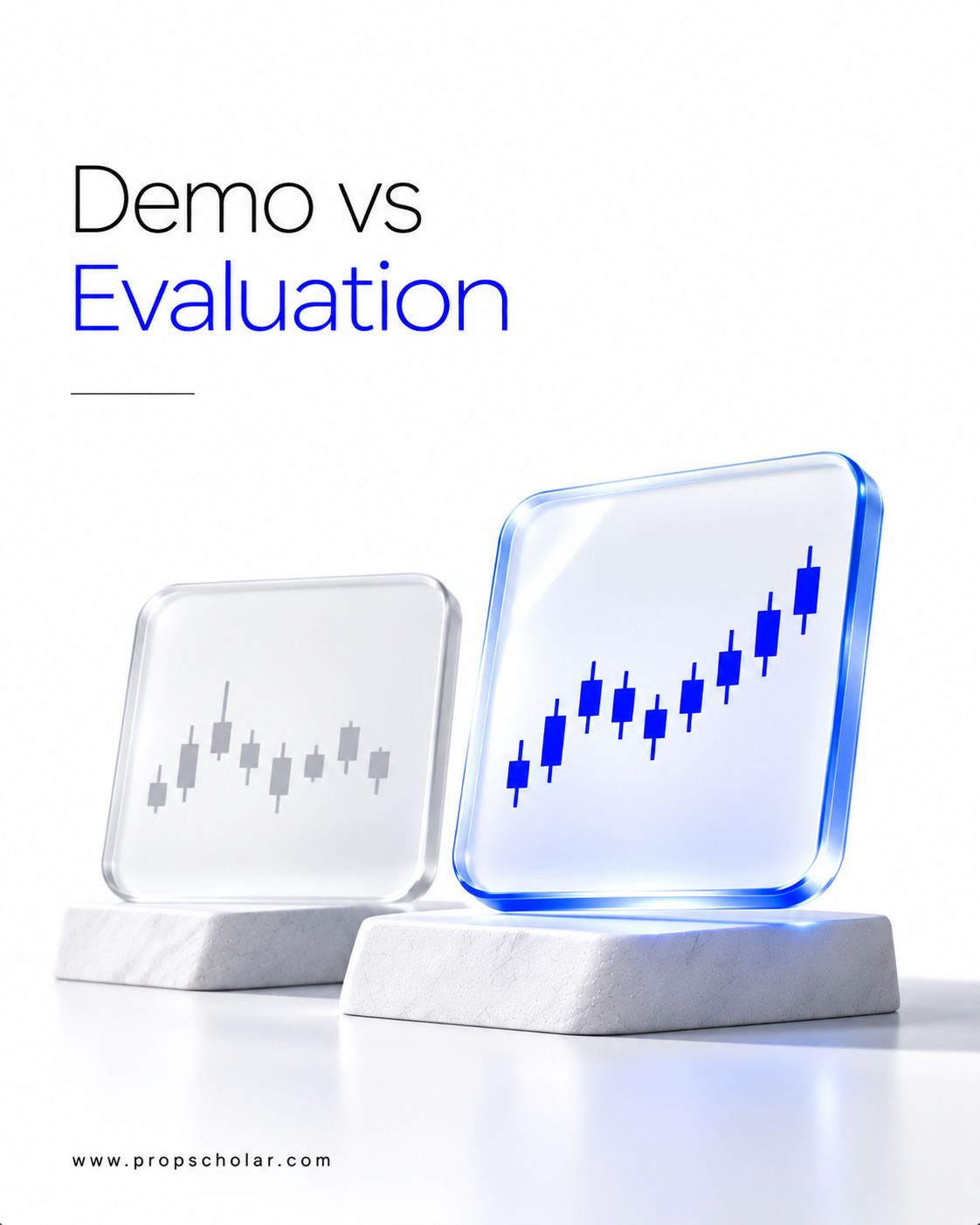
Demo Account vs PropScholar Evaluation 2026: Why Demo Can't Diagnose Your Trading
11 min read

Evaluation Models
The Rs.500 Test: Bootcamp Account, Micro Account, or Direct Payout?
14 min read
Evaluation Models
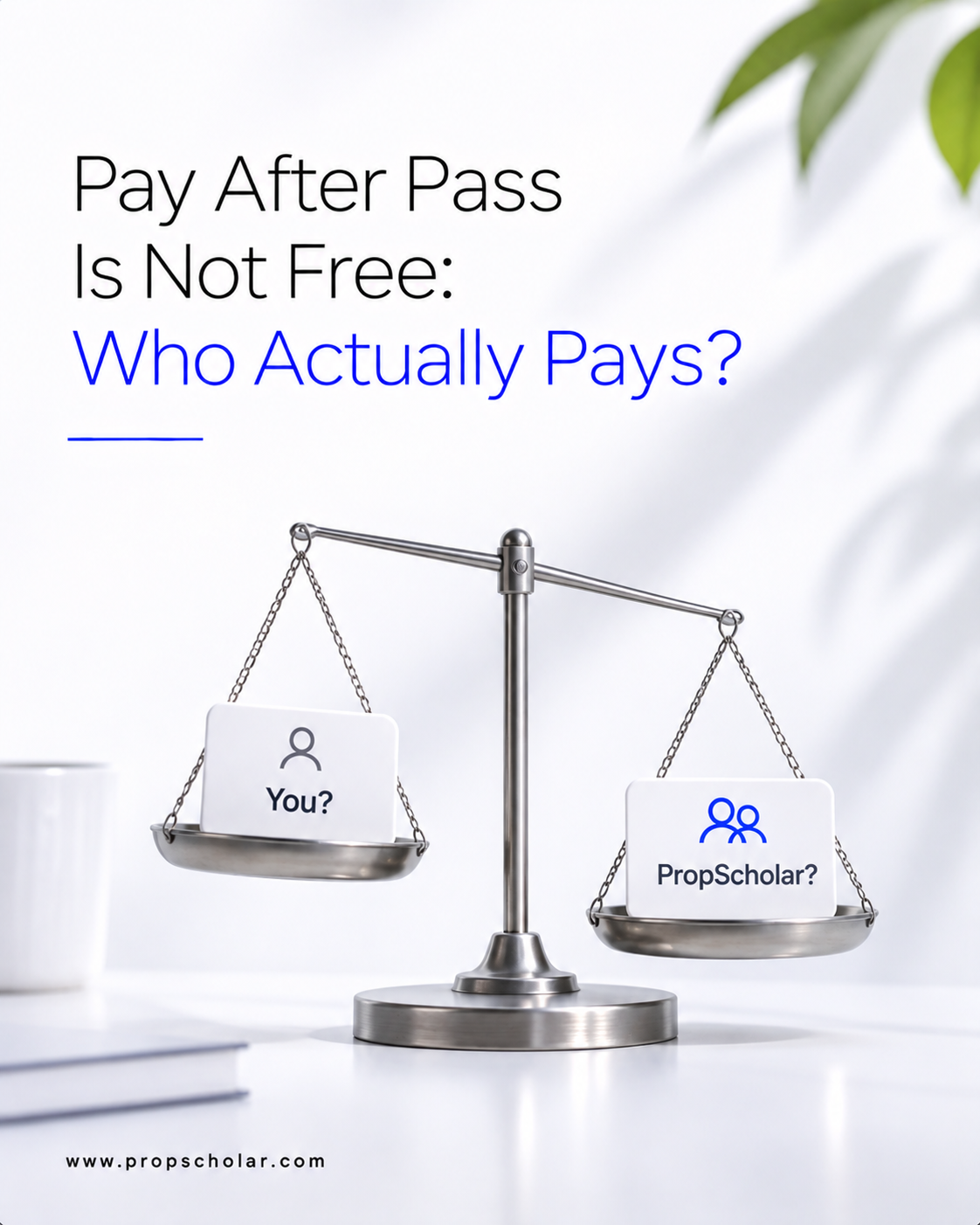
Pay After Pass Is Not Free: Who Actually Pays
13 min read

Trading Psychology
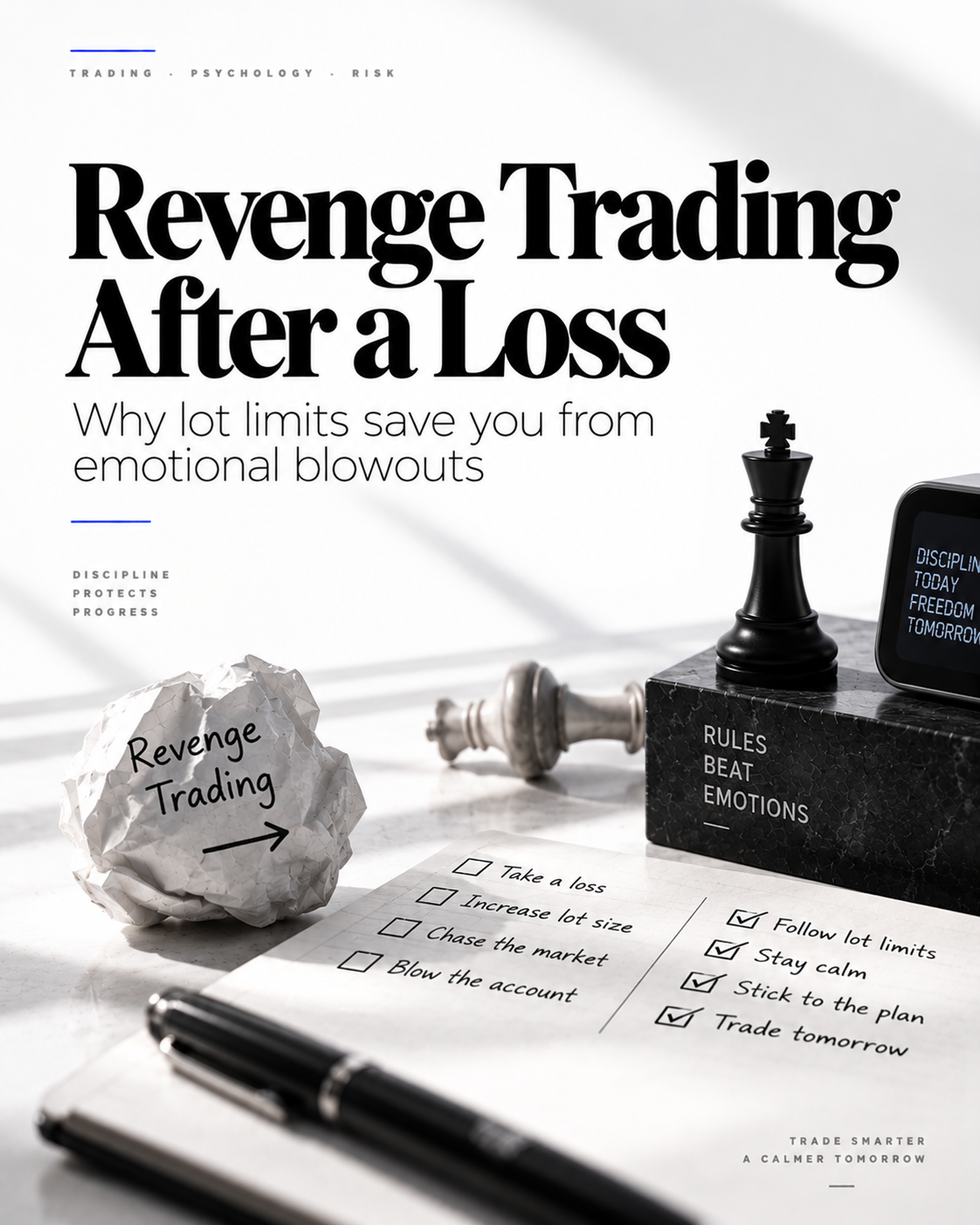
Revenge Trading After a Loss: Why PropScholar's 3% Daily Limit Stops the Tilt Cycle (Pakistan USDT 2026)
12 min read
Trading Psychology
Lot Limits Explained: Stop Emotional Oversizing on $10K Accounts
15 min read