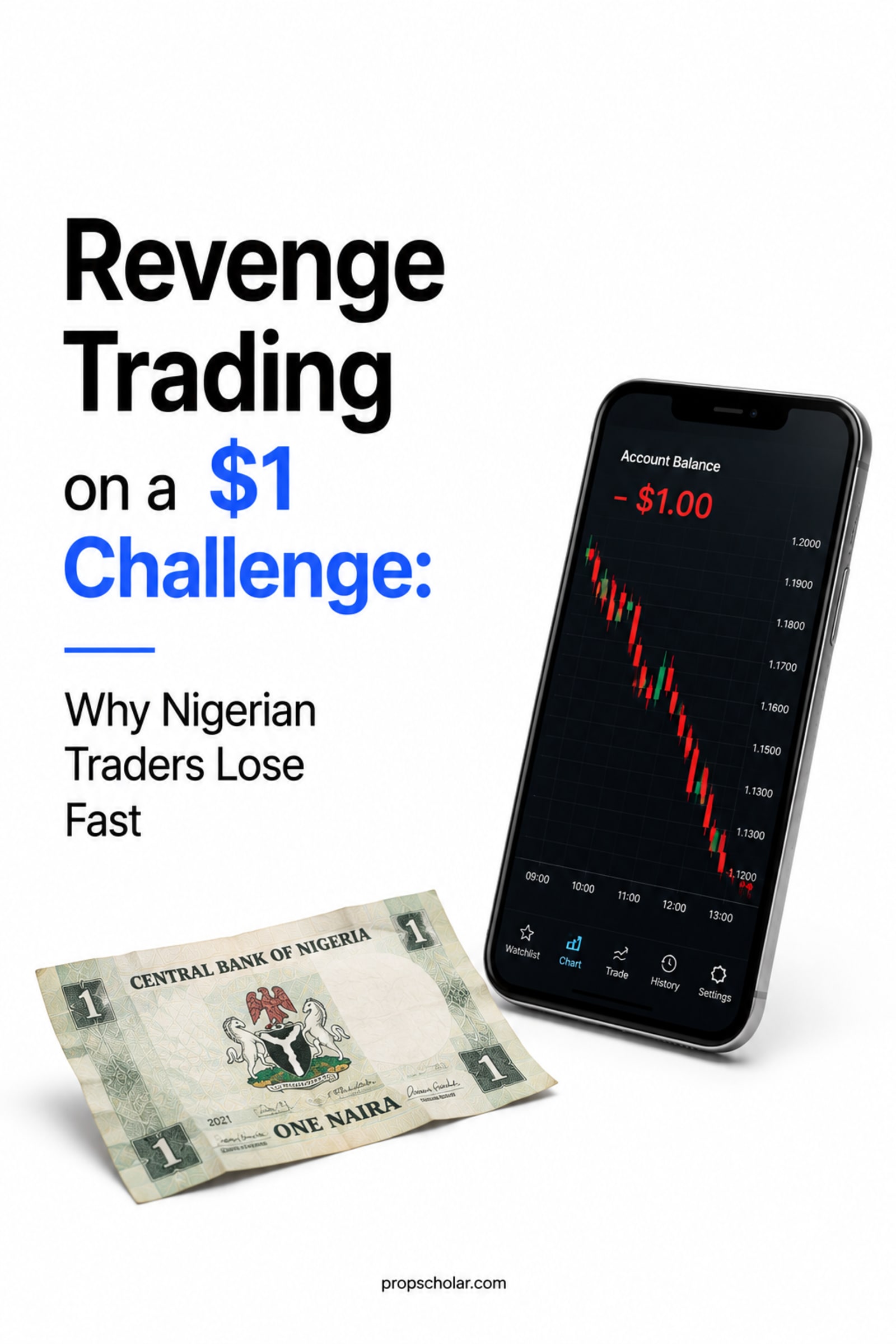
Revenge Trading on a $1 Challenge: Why Nigerian Traders Lose Fast
Revenge trading is the single fastest way to blow a trading evaluation — even a $1 one. This guide breaks down exactly why Nigerian traders fall into the trap, what the psychology behind it looks like in real time, and the specific steps to stop it before it wipes your account and your entry fee.
Revenge trading is the single fastest way to blow a trading evaluation — even a $1 one. This guide breaks down exactly why Nigerian traders fall into the trap, what the psychology behind it looks like in real time, and the specific steps to stop it before it wipes your account and your entry fee.
Start your evaluationRevenge Trading on a $1 Challenge: Why Nigerian Traders Lose Fast
TL;DR: A single bad trade triggers panic, you double your size to recover fast, and your evaluation is dead inside an hour. That cycle is revenge trading — and it's the #1 reason Nigerian traders burn through cheap evaluation fees over and over.
Key takeaways:
- Revenge trading is an emotional response, not a strategy — it almost always makes losses bigger, not smaller.
- Even a $1 evaluation has strict daily drawdown rules; one emotional spiral can breach the limit in minutes.
- The fix isn't willpower — it's a specific pre-set process that removes decisions after a loss.
- PropScholar's scholarship-based evaluations start at $5 (roughly ₦4,000–₦5,000 depending on the rate), making the cost of one failed attempt low — but the pattern of repeated failures adds up fast.
- Breaking the cycle once changes everything; traders who do it consistently reach payouts of up to 400% of their evaluation fee.
You took a setup that looked clean. Price moved two pips in your direction, then reversed hard. Stop hit. ₦4,000 entry fee on the line. Your next thought — be honest — was probably some version of "I'll get it back right now."
That thought is the trap.
Revenge trading doesn't feel like emotion in the moment. It feels like urgency, like logic, like of course you should recover a bad trade immediately. That's exactly what makes it so dangerous for anyone on a tight-budget evaluation where the daily loss limit is fixed and unforgiving.
And in Nigeria's trading community specifically — where internet costs money, data is precious, and that ₦4,000 to ₦5,000 evaluation fee was budgeted carefully — losing it in twelve minutes to an emotional spiral is a particular kind of painful.
What Revenge Trading Actually Looks Like in an Evaluation
Revenge trading is placing trades motivated by the need to recover a loss, not by a valid setup. The distinction sounds obvious. In real time, it's invisible to the trader doing it.
Here's the actual sequence:
You lose a trade. Rational brain knows to step back. But emotional brain calculates: "If I just increase my lot size, one winning trade cancels it." So you open a bigger position on the next candle — often without a proper entry signal, without checking structure, without resetting your breathing. That trade loses too. Now you're down double. The emotional pressure doubles with it. You open again, even bigger.
In a standard evaluation with a 5% daily drawdown limit on a $100 account, that's a $5 maximum loss per day. One oversized revenge trade can eat half of that ceiling. Two trades and you're out. The whole evaluation is gone before the London session closes.
This isn't a strategy failure. It's a psychology failure wearing the costume of a strategy.
Why the Low Entry Fee Makes It Worse, Not Better
Here's something counterintuitive: a cheap evaluation can actually increase revenge trading risk for some traders.
When the entry fee is $50 or $100, many traders feel the weight of it and trade more carefully — at least at first. When it's $5, the psychological barrier is lower. "I'll just re-enter if I blow it" becomes an easy thought. So the initial trade can be careless, the loss triggers shame instead of just consequence, and the revenge cycle kicks in harder.
PropScholar's evaluation entry starts at $5 — genuinely one of the lowest available globally, and payable with crypto from anywhere in Nigeria without a USD bank account. That accessibility is a real advantage. But it only works for you if you treat each attempt with the same seriousness you'd bring to a $200 challenge. The psychological contract you make with yourself matters more than the dollar amount.
We've seen traders in our Discord community go through three or four $5 attempts in a single week, each time telling themselves the next one is different, without changing a single behaviour. That's not a streak of bad luck. That's revenge trading across multiple accounts.
The Specific Rules Revenge Trading Breaks
Every evaluation — including PropScholar's — has at minimum a daily loss limit and a maximum overall drawdown. These aren't arbitrary. They're designed to measure whether your risk management holds under pressure.
Revenge trading violates both limits faster than almost any other behaviour:
Daily Loss Limit
The daily loss limit is there to protect both you and the integrity of the evaluation. When you double your position size after a loss, you're not recovering — you're compressing your remaining loss budget into a single trade. One more hit and you're done for the day. Depending on the evaluation structure, hitting the daily limit repeatedly can end your evaluation entirely.
Position Sizing Discipline
Evaluations test consistency. Jumping from 0.01 lots to 0.05 lots because you're emotional is flagged not just as a drawdown issue, but as a risk management issue. Evaluators — and the rules themselves — can see your trade history. Erratic sizing tells a clear story about who's in control: not you.
Maximum Drawdown
If your daily loss limit is breached badly enough, the cumulative drawdown can hit the maximum threshold within hours. When that happens, the evaluation ends. No appeal. The $5 is gone, and more importantly, the habit is still there for the next attempt.
Why Nigerian Traders Are Specifically Vulnerable
This isn't about capability — Nigerian traders are among the most resourceful and technically sharp in the global forex community. But there are a few structural pressures that make revenge trading more likely:
The Naira's volatility means real purchasing power pressure. When ₦4,000 to ₦5,000 represents a meaningful sacrifice and a loss feels like wasted sacrifice, the emotional pull to recover immediately is stronger than it would be in a market where that amount is trivial.
Network latency and unstable internet during peak hours also creates a specific trigger: you get stopped out on what looks like a spike — possibly a genuine spike, possibly just your connection lagging — and the frustration is compounded by the suspicion that the market got you unfairly. That mental state is revenge trading fuel.
And access to global markets through mobile-first trading setups means it's easier than ever to re-enter a trade from your phone in three taps, without the friction that might otherwise slow you down.
None of these are excuses. They're real variables that require real countermeasures.
How to Actually Stop Revenge Trading (Not Just "Be Disciplined")
Telling yourself to have more discipline after a loss is like telling yourself to be taller. The advice is useless without a mechanism. Here's what works:
Set a Hard Stop After Every Loss
Before you open your platform each session, set a rule: if I lose my first trade, I close the platform for 15 minutes. Not because 15 minutes fixes anything emotionally — it doesn't — but because it inserts physical friction between the loss and the next trade. That friction breaks the automatic revenge loop.
Write this rule down. Literally write it. It forces the prefrontal cortex — your rational brain — to be involved before the emotional state hits, not after.
Pre-Decide Your Daily Stop Loss in Dollar Terms
Don't let the evaluation's daily drawdown limit be your stop. Set your own internal limit at 50% of the maximum allowed. If the rule allows a $5 daily loss on a $100 account, you stop at $2.50 in losses. When you've used half your budget, the session is over. This buffer gives you room to make mistakes without breaching the rule.
This is one of the most underused adjustments we see from traders who pass their evaluations on the first attempt versus those who breach on day two or three.
Reduce Lot Size After Any Loss
Counterintuitive, but effective: instead of sizing up to recover, size down. Your second trade after a loss should be at half the position size of the first. This means your potential recovery is smaller — and that's fine. It also means your potential second loss is half as bad, and you've removed the revenge amplifier.
The psychology shifts from "I need to recover right now" to "I'm proving I can trade small and disciplined" — which is exactly what an evaluation is testing.
Use PropScholar's Trading Journal
PropScholar's free trading journal auto-syncs with MT5, which means your trade history, sizing pattern and loss sequences are visible to you after every session. When you look at a week of data and see three revenge trade sequences in the same 30-minute window after losses, you stop being able to pretend it isn't a pattern. Data removes the self-deception that keeps revenge trading alive.
PropScholar's Evaluation: Built for This Exact Budget
PropScholar is a scholarship-based trading evaluation platform — not a prop firm. You pay an entry fee starting at $5, you pass the evaluation by demonstrating disciplined, rule-following trading, and you claim a scholarship of up to 400% of that fee, verified and paid within 4 hours.
For Nigerian traders, crypto payment is the easiest route — USDT is accepted globally, and there's no USD bank account required. The entry cost in Naira terms is low enough to be genuinely accessible, but structured enough to mean something.
The platform also lists real prop firm challenges at INR and accessible pricing through its marketplace, giving traders who want higher-stakes evaluations a path to those too — on their timeline, with no pressure.
If you want to see what passing actually looks like before you enter, the PropScholar Discord at discord.gg/uTU85z4hft has payout proof shared publicly by community members. That's 3,000+ traders, many of them Nigerian, talking about what worked and what didn't. It's the most honest education you'll get on this topic.
The evaluations themselves are available at propscholar.com/shop. The rules are public, they've never changed retroactively, and 24/7 support is available in multiple languages.
One Honest Thing Worth Saying
The cheapness of a $5 evaluation is not the point. The point is whether you can trade the same way in session 10 as you did in session 1 — consistent, rule-bound, emotionally neutral after a loss. That's the skill being tested.
Revenge trading fails that test every single time. But it's a learnable fix. Traders who build the 15-minute pause habit, who size down after losses, who use a journal to see their own patterns — they pass. Not because they never have bad trades, but because they've made the emotional recovery process automatic instead of leaving it to willpower in the worst moments.
You already know the market is hard. Don't make it harder by fighting your last trade instead of reading the next one.
PropScholar is a scholarship-based trading evaluation platform operated by a Private Limited company registered in India. We are not a prop firm and do not manage or allocate institutional capital. Our model rewards proven trading skill with scholarship grants upon successful evaluation completion.
Related reading
- Blown Trading Account Pakistan? 2-Week Recovery Plan
- Stop Revenge Trading: Filipino Beginner's Evaluation Guide 2026
- What Does a $1 Prop Firm Account Actually Get You?
- Best $1 Trading Challenge 2026: Why 1K 1-Step Wins
- Best Prop Firm for Beginners in India 2026: Pay With UPI, Start Cheap, Trade Safe
- Cheapest Legit Way to Access a Funded-Style Trading Account From $5
Ready to Prove Your Edge?
Join 500+ traders. Start from just $5. Get funded within days.
Frequently Asked Questions
Revenge trading means opening a new position specifically to recover a recent loss, not because a valid setup exists. It fails on cheap evaluations because even a $5 evaluation has a fixed daily loss limit — often around 5% of the account size. Oversized emotional trades burn through that limit in minutes, ending the evaluation before you've had a real session.