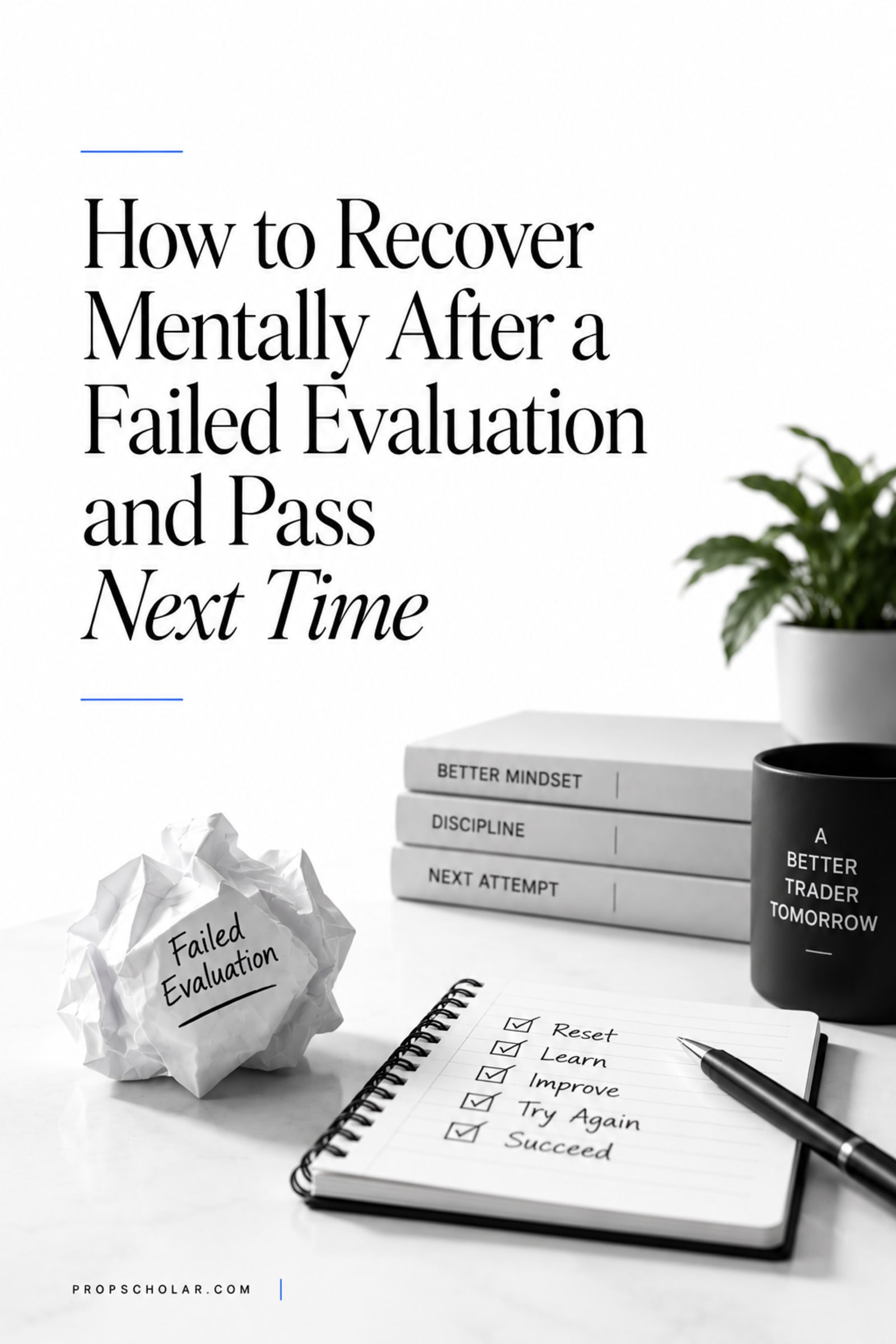
How to Recover Mentally After a Failed Evaluation and Pass Next Time
A failed trading evaluation stings — but it doesn't mean you're a bad trader. Here's how to process the loss, diagnose what actually went wrong, rebuild your mental game, and come back sharper on your next attempt.
A failed trading evaluation stings — but it doesn't mean you're a bad trader. Here's how to process the loss, diagnose what actually went wrong, rebuild your mental game, and come back sharper on your next attempt.
Start your evaluationHow to Recover Mentally After a Failed Evaluation and Pass Next Time
TL;DR: A failed evaluation hurts, but it's data, not a verdict. Diagnose the real cause, reset your mindset deliberately, and re-enter with a tighter plan — not just more determination.
Key takeaways:
- The emotional response to a failure is normal; acting on it immediately is the danger
- Most evaluations are lost to one or two repeated rule breaks, not a hundred small mistakes
- A forced break of 24-72 hours before reviewing your trade log is non-negotiable
- PropScholar evaluations start at $5, so the barrier to a retry is genuinely low — but your mental reset must come first
- Passing on the next attempt usually requires changing one specific behaviour, not overhauling your entire strategy
You checked the dashboard and the account is gone. Maybe you hit the maximum drawdown. Maybe you broke the daily loss limit on a single impulsive trade. Maybe you were actually doing fine and then one bad Friday session wiped everything out in forty minutes. Whatever the exact sequence, the feeling is the same: a tight chest, a flash of anger, and then that very quiet voice asking whether you're actually cut out for this.
You are. And I want to show you exactly how to get back on the right side of this.
Why the First 24 Hours After a Failure Are the Most Dangerous
The worst decision you can make after a failed evaluation is to open a new one immediately. That impulse — to "fix" the failure by jumping straight back in — is the same psychology that drives revenge trading. Your brain is flooded with cortisol and the need to restore what was lost. That state is genuinely incompatible with disciplined, rule-following trading.
The urge feels like confidence. It isn't. It's reactivity.
Give yourself a hard rule: no new evaluation for at least 24 hours, and ideally 48-72 hours. Use that time for something completely unrelated to charts. Walk. Sleep properly. Talk to someone. The market will still be there. PropScholar evaluations will still be there starting at $5. Nothing closes.
This isn't weakness — it's the professional approach. Even experienced funded traders treat a significant loss as a reason to step away temporarily, not push harder.
How to Actually Diagnose What Went Wrong
Once you've had genuine rest, sit down with your trade log and ask one very specific question: what was the single trade or session that made the evaluation unrecoverable?
Not "what did I do wrong in general." That question produces vague, unactionable answers like "I need to be more patient" or "I traded too emotionally." Those observations are true but useless on their own.
Find the exact moment. Was it a trade you took without a setup? A position you held through a major news event when you knew you shouldn't? Did you hit your daily loss limit and then take one more trade anyway, thinking you'd "get it back"?
In most cases, when you look honestly at the data, the evaluation wasn't lost across twenty mistakes. It was lost in one to three moments of rule-breaking. Everything else you did was actually fine.
That's important. Because it means you don't need to rebuild your entire trading approach — you need to solve one specific behavioural problem.
For more on this kind of self-diagnosis, the mindset that separates funded traders from blown accounts breaks down the patterns that repeat across failed evaluations.
The Mental Reset Process That Actually Works
Diagnosis is not the same as a mental reset. Knowing what went wrong intellectually and actually being in a different psychological state are two separate things.
Here's a simple reset process that works:
Write out what happened without judgment
Not a trade journal in the technical sense — just a paragraph or two in plain language about what you did and why. "I was up by Tuesday, I felt confident, I sized up on Wednesday, it reversed, I panicked and averaged in, the drawdown hit." Getting it out of your head and onto a page reduces its emotional weight considerably.
Identify the specific rule you'll add to your plan
Vague intention doesn't survive contact with a live market. You need a concrete, testable rule. Not "I won't overtrade" but "I will close my platform for the day the moment my daily loss reaches 1.5% of the account, no exceptions." Write it somewhere visible. Put it in your phone. Make it mechanical, not motivational.
Do a demo session before your next evaluation starts
Spend two to three days trading your exact plan in a demo environment with the same position sizing and rules you'd use in the evaluation. This isn't about practicing your strategy — you already know how to trade. It's about practicing the emotional experience of following rules under simulated pressure. If you can't follow your rules in a demo with nothing at stake, you won't follow them in an evaluation with a scholarship on the line.
Common Evaluation Killers (and Their Actual Fixes)
These are the patterns that end evaluations, seen repeatedly across traders at all levels.
Hitting the daily loss limit and continuing anyway
The fix is not willpower. The fix is removing the ability to continue. Set an alert, close the platform, log out of your broker. Make continuing genuinely inconvenient. You're trying to win against your own worst impulses, and willpower alone almost always loses.
Sizing up after a winning streak
When you're up, the brain reads risk as lower than it actually is. Consecutive wins feel like skill confirmation and they might be — but they don't change the market's next move. Lock your position size as a percentage of account at the start of the evaluation and don't touch it, regardless of how well things are going. Staying disciplined during a funded trading evaluation goes deep on exactly this.
Trading boredom, not setups
Some of the worst trades in any evaluation happen when the market is flat and a trader enters just to feel productive. The solution is a written checklist: three to five criteria that must all be true before you enter. If you can't check every box, you don't trade. That session's "doing nothing" counts as following the plan.
Revenge trading after a loss
This one is fast and brutal. One loss becomes two becomes the account gone in an afternoon. If you've experienced this, read why revenge trading on a $1 challenge kills accounts fast — it's specific and honest about the mechanics of how it happens.
How PropScholar Makes Retrying Genuinely Accessible
One of the hardest parts of a failed evaluation at a traditional funded trading platform is the financial hit. Evaluations at large global prop firms can cost anywhere from $100 to several hundred dollars, denominated in USD, with payment rails that don't work easily for traders in India, Nigeria, the Philippines, Indonesia, or most of the emerging world.
PropScholar is a scholarship-based evaluation platform that starts at $5 — or around Rs.400 for Indian traders paying via UPI through PhonePe, Razorpay or Cashfree. For traders outside India, it accepts crypto globally. That means a failed attempt doesn't have to be a month's setback. You can reset mentally, do your diagnosis, practice your adjustments, and retry without the financial stress compounding your psychological recovery.
Scholarship payouts of up to 400% are verified and paid within 4 hours of verification. The rules are public and have never changed retroactively. If you're unsure what that looks like in practice, the Discord community of 3,000+ traders is where payout screenshots and real experiences live.
That low cost of re-entry is only useful, though, if you've actually done the mental work first. A $5 retry taken in anger on the same day you failed is still a waste of $5 and another hit to your confidence.
Building the Version of You That Passes
Passing a trading evaluation isn't about being fearless or emotionally flat. It's about having a plan specific enough that emotion has less room to operate.
The traders who pass on their second or third attempt aren't necessarily better at reading charts. They've usually made one change: they defined in advance exactly what they would do at the moments when they previously broke down. The entry into a trade. The exit when wrong. The absolute stop on a bad day. These decisions made in advance, in a calm state, are more reliable than decisions made in the moment.
Trading psychology for passing your first evaluation covers how to build that pre-decision framework in detail.
You don't need a personality transplant. You need a tighter plan and the self-knowledge to know exactly where your discipline breaks.
A Note on Realistic Timelines
Give yourself permission to take more than one attempt. There's no rule that says success has to come on the next try, and the expectation that it must creates pressure that works against you. Some traders pass on the second attempt, some on the fourth. What changes between attempts is the specificity of the lesson applied.
If you're on your third or fourth retry and the same pattern keeps ending it, that's telling you something important: the pattern requires external accountability, not just internal resolve. That's what the PropScholar Discord is genuinely useful for — not just motivation, but having other traders ask you hard questions about your plan before you trade it.
The goal isn't to grind until you get lucky. It's to understand yourself well enough that the next evaluation feels different from the inside, because your behaviour actually is different.
PropScholar is a scholarship-based trading evaluation platform operated by a Private Limited company registered in India. We are not a prop firm and do not manage or allocate institutional capital. Our model rewards proven trading skill with scholarship grants upon successful evaluation completion.
Related reading
- Blown Trading Account Pakistan? 2-Week Recovery Plan
- Stop Revenge Trading: Filipino Beginner's Evaluation Guide 2026
- Revenge Trading on a $1 Challenge: Why Nigerian Traders Lose Fast
- How to Stay Disciplined During a Funded Trading Evaluation
- Trading Psychology for Passing Your First Evaluation
- The Mindset That Separates Funded Traders From Blown Accounts
Ready to Prove Your Edge?
Join 500+ traders. Start from just $5. Get funded within days.
Frequently Asked Questions
Take a mandatory break of at least 24-72 hours before reviewing anything. Don't open a new evaluation immediately — that impulse is reactive, not strategic. Once rested, go back to your trade log and identify the one to three specific moments that made the account unrecoverable. Most evaluations are lost in a handful of rule breaks, not across hundreds of mistakes. Diagnose precisely, then build one concrete rule to address it.