
Funded Is Not Paid: The Payout You Wait For vs the Payout You Get
Getting funded and getting paid are two completely different events. Most traders don't realize there's a gap between them until they're inside it. This article explains what that gap looks like, why it carries real risk, and what a direct payout actually means in practice.
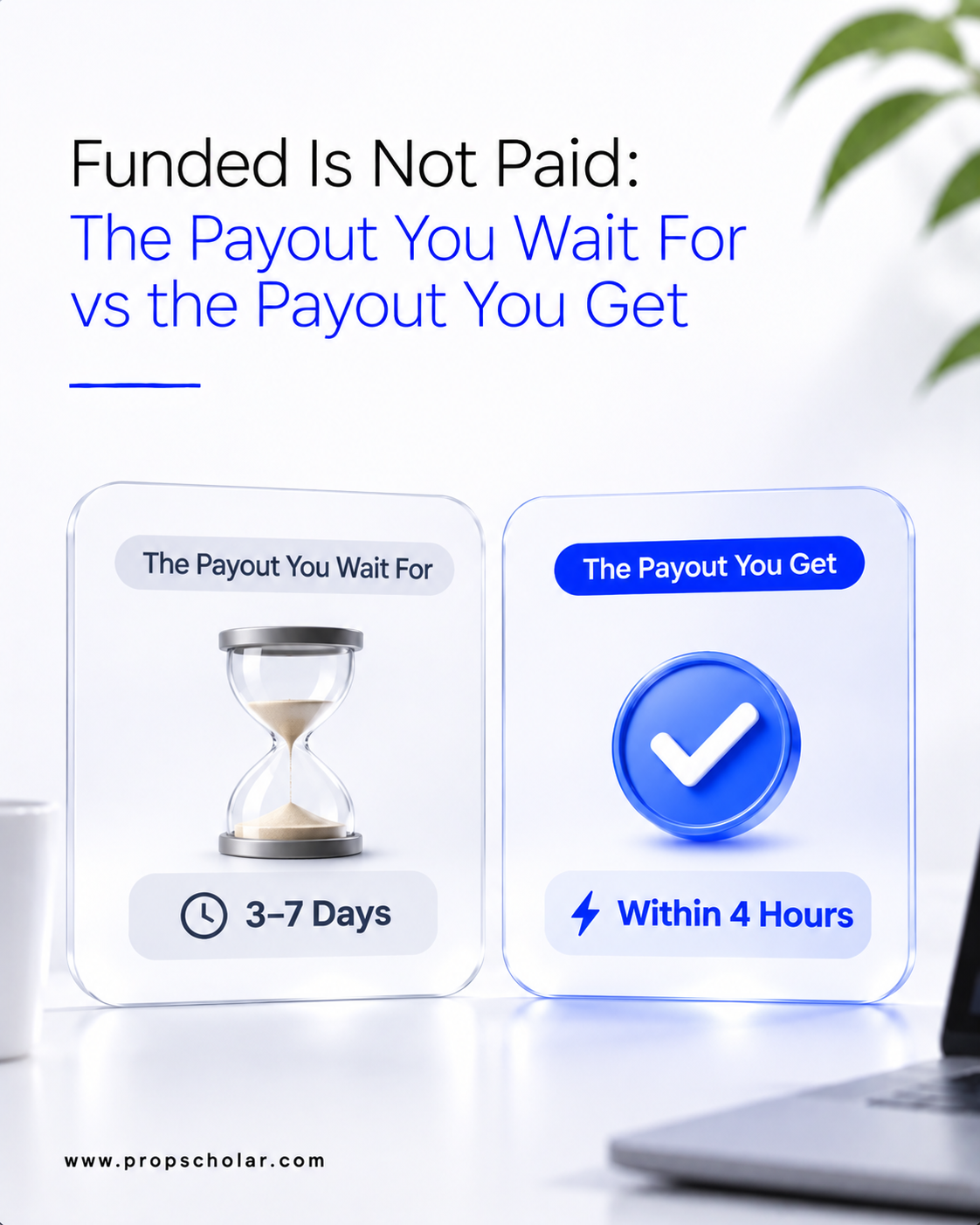
Getting funded and getting paid are two completely different events. Most traders don't realize there's a gap between them until they're inside it. This article explains what that gap looks like, why it carries real risk, and what a direct payout actually means in practice.
Start your evaluationFunded Is Not Paid: The Payout You Wait For vs the Payout You Get
TL;DR: Getting a funded account and receiving actual money are two separate events, often weeks apart, with real risk sitting between them. PropScholar's Freedom Account collapses that gap: pass the evaluation, request a payout, and it's processed within 4 hours.
Key takeaways:
- "Funded" means you now have access to a live account under a firm's rules. It does not mean money has moved anywhere yet.
- The wait between funding and your first payout carries genuine risk: you can still breach the account before you ever collect.
- Minimum trading days, consistency rules, and funded-phase drawdown limits all exist between you and that first withdrawal.
- PropScholar's model is different: the payout is a fixed scholarship paid to you after passing an evaluation on a demo account, processed within 4 hours.
- The Freedom 5K costs $5 (Rs.499) and pays a $20 scholarship. That gap and that timeline are publicly verifiable.
You passed. You got the email saying your account is live. You've been telling yourself for three months that if you could just get funded, you'd finally be able to make real money from trading. And now you're funded.
So where's the money?
This is the conversation nobody has clearly before you sign up. Getting a funded account and getting paid are not the same thing. There's a gap between them, and that gap has rules, timelines, and risk inside it. A lot of traders find out about that gap only after they're already in it.
Let's work through exactly what that gap looks like, why it matters, and what the alternative is.
What "Funded" Actually Means
When a prop firm or evaluation platform says you're funded, it means you passed the challenge phase and you now have access to a funded trading account. That account operates under a fresh set of rules, often stricter than the challenge rules in some ways, and you need to generate a certain amount of profit before you can request your first withdrawal.
Most funded programs have a minimum number of trading days before you can request a payout. Some require a minimum number of profitable days. Some apply a consistency rule, which means no single day's profit can represent more than a fixed percentage of your total gains, or your payout request gets blocked or reduced. And throughout all of this, you're still subject to drawdown limits. If you breach those limits in the funded phase, the account is closed and you receive nothing.
So the timeline looks something like this: pass the challenge, wait for the account to be provisioned, complete the minimum trading days, hit the profit target or threshold, avoid any rules breach, then request the payout, then wait for the firm to review and process it. That can easily stretch to several weeks, and during every day of that stretch, the account can still go wrong.
The wait is not just inconvenient. It is a period of active exposure.
Why the Wait Carries Real Risk
There's a version of this story that gets told during the marketing phase: pass the challenge, get funded, make money. The funded phase gets presented as a reward. But functionally, the funded phase is a second evaluation with real consequences.
You're trading under drawdown limits. The daily loss limit on many funded programs is calculated from your starting equity or your current balance, whichever is higher. If you've built up gains during the funded phase and then have a losing day that breaches the daily limit calculated from your elevated balance, the account closes. You don't get to withdraw the profits you'd already accumulated.
Consistency rules add another layer. Some programs require that no single day accounts for more than a set percentage of your total profit, so a great single day early in the funded phase can actually create a cap on your overall payout if the rest of your trading doesn't match it. Miss that detail and your payout gets blocked or reduced at the review stage, not at the trading stage, so you won't even know until you try to withdraw.
And then there's the activation fee that some models charge after passing. You pass the challenge, pay the activation, then start the funded phase. That's two fees before you've seen a single dollar.
None of this means funded programs are worthless. But there's a meaningful difference between understanding this structure going in and being surprised by it after you've already paid.
What the Direct Payout Model Looks Like Instead
PropScholar is a scholarship-based trading evaluation platform, not a prop firm. It does not allocate institutional capital or sell access to live firm accounts. What it does is evaluate your trading on a demo account and pay you a direct, fixed scholarship when you pass.
The Freedom Account is the core product. The Freedom 5K costs $5 (Rs.499 in India). Pass the 10% profit target within the rules, request the payout, and it's processed within 4 hours. The scholarship amount is fixed at $20. It doesn't depend on how many days you traded, how consistent your day-to-day returns were, or whether a reviewer decided your trading pattern met some unstated standard.
The Freedom 10K costs $10 and pays $42. The 15K costs $15 and pays $60. The 25K costs $25 and pays $100. The 50K costs $50 and pays $200. Every one of those payout amounts is published, fixed, and you can see PropScholar's public payout proofs at PropScholar's public payout proofs before you spend anything.
That's the structural difference. In the conventional funded model, the payout you're promised at the start is the payout you're chasing through a funded phase that could last weeks and still end in nothing. In PropScholar's model, the payout is defined up front, it triggers when you pass the evaluation, and it clears within 4 hours.
The Rules You're Trading Under on the Freedom Account
Being honest here matters. The Freedom Account has its own rules and you should know them before you start.
The profit target is 10% of the account size. The maximum loss limit is 6% of the initial account size. The daily loss limit is 3% of the higher of your starting equity or your current balance, so if you've built up gains, the daily limit scales with that. There are lot limits per asset class: on the Freedom 10K, for example, you're capped at 4.00 lots open in forex, 0.40 in gold, 0.20 in BTCUSD, 0.50 for US30, and so on. Each class is independent; you can't borrow headroom from one to use in another.
News trading isn't allowed. You can't open or close positions from 10 minutes before to 10 minutes after a high-impact news event, and that includes positions being closed by a stop-loss or take-profit during that window. The inactivity rule is 14 days, meaning you need to have placed at least one trade within any 14-day window to keep the account active.
There is no minimum trading days requirement. No minimum profitable days. No time limit. You could pass in a single session if your trading delivers the target within the rules. The fastest recorded pass on a PropScholar evaluation is 2 hours.
So the account is not without constraints. The lot limits in particular are real and they're there for a reason. But there's no funded phase sitting on the other side of the pass. You pass, you request, you get paid.
Comparing the Two Structures Honestly
What you're paying and when
In a conventional evaluation model, you pay the challenge fee upfront. Some models also charge an activation fee after you pass, before the funded phase begins. In PropScholar's model, you pay one entry fee, nothing more. No activation fee, no monthly fee, no pay-after-pass charge.
When money actually reaches you
In a funded model, money reaches you after the funded phase: minimum days completed, profit target hit, consistency rules satisfied, payout reviewed and processed. The timeline varies by firm and by how your trading goes. In PropScholar's model, money reaches you within 4 hours of a verified pass. That's the design, and PropScholar's payout records are public.
What you're risking in the gap
In a funded model, the risk in the gap is real: a single bad day in the funded phase can wipe out everything you've built since the challenge pass. In PropScholar's evaluation, there is no funded phase. The gap between passing and getting paid is 4 hours, not 4 to 8 weeks.
The honest catch
Most traders don't pass on the first attempt. That's true of PropScholar evaluations and it's true of every other evaluation out there. The entry fee for a Freedom 5K is $5, which is real money even if it's small. If you breach the account before hitting the target, you've lost that $5. If you want to try again, you pay again. The evaluation model doesn't guarantee income; it rewards trading that meets a defined standard. If your trading doesn't meet that standard yet, the right response is to work on it, not to assume the platform is at fault.
PropScholar's evaluation runs on a demo account with real rules and a real financial outcome at stake. That is what creates the useful signal: not fake trading, not live capital at risk, but a structured test where something meaningful is on the line.
Payment for Traders Outside India
PropScholar accepts UPI in India. For traders everywhere else, including Nigeria, the Philippines, Indonesia, South Africa, Pakistan, Bangladesh, Kenya, Egypt, and Vietnam, the payment path is USDT or PayPal. The practical route most international traders use is to buy USDT on a local P2P exchange funded by a local bank transfer, then pay at checkout. No bank wire, no foreign exchange account, no waiting days for a card to process. You pay in USDT and the payout, if you pass, is processed within 4 hours.
For questions about checkout or payment, you can reach the team at business@propscholar.com or through the PropScholar Discord, which runs 24/7 support in Hindi and multiple languages.
The Bottom Line
The funded account model has genuine value for some traders. But the gap between getting funded and getting paid is real, it has rules inside it, and it carries risk that doesn't get described clearly enough during the sales process. If you breach in the funded phase, you walked through the entire evaluation and came out with nothing.
PropScholar's Freedom Account is built around a different idea: a fixed, published payout that clears within 4 hours of a verified pass, starting from $5 for the 5K evaluation. The lot limits and news trading rules are real and you need to respect them. But there is no funded phase, no minimum days, no consistency rule blocking your withdrawal.
Funded is not the same as paid. PropScholar skips the gap entirely.
PropScholar is a scholarship-based trading evaluation platform operated by a Private Limited company registered in India. We are not a prop firm and do not manage or allocate institutional capital. Our model rewards proven trading skill with scholarship grants upon successful evaluation completion.
Related reading
- Free Funded Account Nigeria 2026: Qualify Without Paying Upfront
- How PropScholar Scholarship Payouts of Up to 400% Actually Work
- Trading Scholarship for Students in India 2026: How It Works and Who It Is For
- How to Get Paid Quickly After Passing a Trading Evaluation
- $1 Evaluation vs Free Trial: Which Model Suits Vietnamese Beginners
- How to Get a Direct Payout From a Trading Evaluation in Hours, Not Weeks
Ready to Prove Your Edge?
Join 500+ traders. Start from just $5. Get funded within days.
Frequently Asked Questions
In the conventional funded model, passing the challenge only grants access to a funded phase. You then need to complete minimum trading days, hit profit thresholds, and satisfy consistency rules before requesting a withdrawal. The firm also takes time to review and process the request. That entire period, often several weeks, sits between the word 'funded' and actual money in your account.
More From PropScholar
Scholarship Model
After You Pass the $1 Challenge: Your $6 Payout Within 4 Hours
11 min read

Evaluation Models
The Rs.500 Test: Bootcamp Account, Micro Account, or Direct Payout?
14 min read

Scholarship Model
Scholarship Evaluation vs Prop Firm: Key Legal Differences
14 min read
Evaluation Models
Trading Competitions Reward Reckless Risk: The Disciplined Alternative
10 min read
Beginner Trading
Every Way to Start Trading With Little Money, Ranked Honestly (2026)
15 min read
Scholarship Model
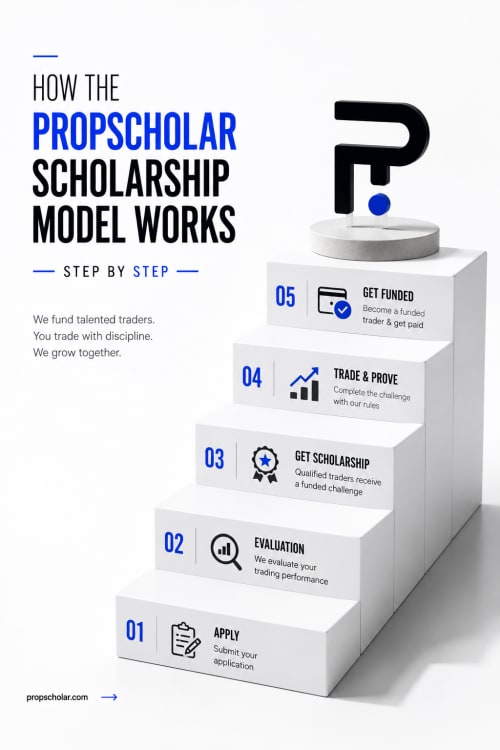
How the PropScholar Scholarship Model Works Step by Step
12 min read