
Every Way to Start Trading With Little Money, Ranked Honestly (2026)
Seven real routes to start trading when your budget is small, ranked by what they actually cost, what stands between you and money, and what a win pays. Demo accounts, micro accounts, bootcamp accounts, broker incubation, pay-after-pass, trading competitions, and the PropScholar direct payout evaluation — compared honestly, with no guaranteed-income claims and no invented numbers.
Seven real routes to start trading when your budget is small, ranked by what they actually cost, what stands between you and money, and what a win pays. Demo accounts, micro accounts, bootcamp accounts, broker incubation, pay-after-pass, trading competitions, and the PropScholar direct payout evaluation — compared honestly, with no guaranteed-income claims and no invented numbers.
Start your evaluationEvery Way to Start Trading With Little Money, Ranked Honestly (2026)
TL;DR: There are seven real routes to start trading when you have almost no capital. They are not equal. This article ranks them by what they actually cost, what stands between you and real money, and what a win pays out — so you can pick the right one for your situation right now.
Key takeaways:
- Demo trading costs nothing but pays nothing and proves nothing that a broker or evaluator will pay for.
- Micro accounts and bootcamp accounts cost a few dollars but bury the upside in monthly fees or tiny profit shares.
- Pay-after-pass sounds free but the deferred fee is often larger than a small upfront cost.
- Broker incubation programs typically require $100 or more in live capital before they will match you.
- PropScholar's Freedom evaluation starts at $5, pays out within 4 hours of a pass, and the payout is publicly verifiable.
- Every method on this list carries real risk. None guarantees income. Most evaluation attempts fail.
- The right choice depends on three things: your starting budget, your willingness to lose the entry cost, and how fast you need an answer about your trading.
You want to start trading. You have maybe five dollars, maybe fifty, maybe nothing you can afford to lose. Every guide you have read either tells you to open a live brokerage account with $100 you do not have, or waves you toward demo trading as if paper profits will pay your phone bill.
Neither of those answers is good enough. So here is an honest ranking of every real route available in 2026, in order from least to most likely to actually put money in your hands.
Route 1: Pure Demo Trading
Cost to start: Zero. What stands between you and money: Everything. What a win pays: Nothing.
Demo accounts are free and infinite. You can open one in ten minutes on almost any broker and trade a fake million dollars with zero consequences. That is also the problem.
Demo trading is genuinely useful for one narrow purpose: learning how the platform works before you risk anything. It is not useful for proving that you can trade under pressure, because there is no pressure. The moment a real fee or a real payout is at stake, your psychology changes. Demo profits are not transferable to any funded program, any competition prize pool, or any broker incubation scheme. You are essentially practicing cooking on a stove that is not plugged in.
Use demo accounts. Just do not mistake them for progress toward actual income.
Route 2: Free Trading Competitions
Cost to start: Usually zero. What stands between you and money: Thousands of other participants and pure luck at the top. What a win pays: Varies; often small cash or broker credit.
Many brokers run monthly or quarterly competitions where you trade a demo account and the top finishers win a prize. Entry is free, which is genuinely attractive.
The catch is the structure. The winner of a free competition is almost always the person who took the most reckless position and happened to be right that week — not the most disciplined trader. If you trade responsibly, you will likely finish in the middle of the pack, unpaid. And most prizes are broker account credits, not withdrawable cash.
If competitions are free and convenient, there is no harm in entering one while you pursue a more structured route. But they should not be your plan.
Route 3: Micro Accounts With a Live Broker
Cost to start: Typically $10 to $50 in real deposited capital. What stands between you and money: A losing trade you funded yourself. What a win pays: Whatever you trade, but tiny at micro lot sizes.
Some brokers allow you to open a live account with as little as $10 and trade micro lots of 0.01. The risk is real, the losses are real, and the profits — while also real — are very small at that account size.
This is a legitimate path if you want skin in the game immediately and you understand that $10 to $50 of live capital will not generate meaningful income at micro lot sizes. It is practice that costs real money but pays very little. The value is psychological: you discover quickly whether you can manage a drawdown when it is your own money on the line.
The limitation is ceiling. Micro accounts at a retail broker do not scale to anything significant unless you fund up significantly, which circles back to the original problem of not having capital.
Route 4: Bootcamp and Low-Cost Evaluation Accounts at Some Firms
Cost to start: Often $3 to $20 upfront. What stands between you and money: A set of rules, then a funded account stage that often carries monthly fees. What a win pays: A share of profits from a small funded account, sometimes after ongoing subscription costs.
Some evaluation platforms advertise entry fees under $10 or $20. The entry price is real. What they sometimes do not headline is what comes after: a monthly platform fee once you are funded, a profit split that starts low and builds slowly, or account sizes so small that even a 70% profit share on a $500 account per month is not meaningful money.
This is not automatically dishonest — it depends entirely on the specific program's published terms. The point is that a low entry fee does not automatically mean low total cost. Read every post-pass term before you buy, specifically: monthly fees, minimum trading day requirements, and the actual profit split on the smallest funded tier.
Route 5: Pay-After-Pass Programs
Cost to start: Zero upfront. What stands between you and money: Passing the evaluation, then paying a fee that may be larger than the upfront alternative. What a win pays: A funded account, after you pay.
Pay-after-pass sounds like the perfect beginner solution: you only pay if you succeed, so there is no risk. That framing is not entirely accurate.
The fee you pay after passing is typically equal to or higher than the upfront fee for the equivalent evaluation. You are not saving money; you are deferring it. And you are deferring it to a moment when you are excited and committed — which is not the best headspace for evaluating whether the program is worth the cost. You can explore a full breakdown of this model in a detailed article on the PropScholar blog.
Pay-after-pass is not a scam as a practice. It is a real payment structure. Just do the math before you celebrate the pass.
Route 6: Broker Incubation Programs
Cost to start: Often $100 or more in live capital. What stands between you and money: Hitting the broker's performance targets with your own real money. What a win pays: Access to a larger allocation, sometimes with a profit split.
Some retail brokers run incubation programs where you fund a live account, hit certain performance milestones, and they scale your account or offer better terms. The appeal is obvious: a path from your own capital to a larger allocation.
The barrier is the starting capital requirement. These programs typically require at least $100, sometimes $500 or more, in live deposited funds. For the trader who has $5 or $20 to test their skills, this route is simply not accessible yet. It may be worth returning to once you have proven your edge elsewhere.
Route 7: A PropScholar Scholarship Evaluation
Cost to start: $5 (or Rs.499 in India) for the Freedom 5K. What stands between you and money: Passing a one-step trading evaluation with a 10% profit target on a demo account. What a win pays: A direct cash payout, processed within 4 hours of verification.
This is the route I want to explain in the most detail, because it is the one that is genuinely different from everything above.
PropScholar is a scholarship-based trading evaluation platform, not a prop firm. You pick an account size, pay a small one-time entry fee, and trade a demo account to a 10% profit target. If you pass, PropScholar pays you a scholarship — real money, processed within 4 hours, publicly verifiable at propscholar.com/payout-proof. There is no funded account to manage afterward, no monthly fee, no activation charge, no pay-after-pass bill.
the Freedom 5K costs $5 and pays $20 on a pass. The 10K costs $10 and pays $42. The 25K costs $25 and pays $100. The 50K costs $50 and pays $200. The entry fee is literally one dollar per thousand dollars of simulated account size.
The rules are real. You need a 10% profit target. Maximum loss is 6% of the initial account size. Daily loss is capped at 3% of the higher of your starting equity or current balance. Lot limits apply by asset class — on the $10,000 account, that is 4.00 lots for forex, 0.40 for gold, 0.20 for BTCUSD. No news trading within 10 minutes either side of a high-impact event, including stop-loss or take-profit closes. Breach that and the account is voided. These are the real trade-offs, and you should know them before you pay.
There is no minimum trading day requirement and no time limit. The fastest recorded pass is 2 hours. You can hold over the weekend. You can buy as many Freedom accounts in as many sizes as you want simultaneously.
Payment is UPI in India. Outside India, PropScholar accepts USDT via NOWPayments or PayPal. For traders in Nigeria, the Philippines, Indonesia, Kenya, Pakistan, Bangladesh, South Africa or Egypt, the practical path is buying USDT on a P2P exchange funded by a local bank transfer, then paying PropScholar directly in USDT at checkout. That is a real, working process today.
Which Route Is Right for You?
If you have zero dollars and no plan yet
Use a demo account to learn the platform. Enter a free competition if one is available. But move to a paid evaluation as soon as you can put $5 together, because only real stakes reveal real trading.
If you have $5 to $20 and want the fastest honest answer about your trading
The PropScholar Freedom evaluation is built for this. The entry cost is small enough that losing it is not a financial crisis, but real enough that it creates genuine focus. A pass within the rules pays cash within 4 hours.
If you have $20 to $50 and want to try multiple routes at once
You can run a Freedom evaluation and open a micro broker account simultaneously. The micro account gives you live market experience. The evaluation gives you a structured target and a real payout if you hit it.
If you have $100 or more and six months of trading history
Broker incubation programs become worth exploring alongside an evaluation. At that budget you have enough to do both. PropScholar's larger Freedom accounts (25K at $25, 50K at $50) also make sense at this level.
The Honest Catch Section
Most traders fail their first evaluation. That is true for PropScholar evaluations, for every other platform's evaluations, and for first attempts at almost any skilled activity. The entry fee is real money you can lose. A $5 or $10 fee will not break anyone's finances, but five or ten failures at $5 each is $25 to $50 — which is not nothing if you are on a genuinely tight budget.
The right mindset is not "I cannot afford to fail." It is "what does this result tell me about my trading, and what do I fix before the next attempt?" That is the only way any of these routes leads somewhere useful.
PropScholar publishes every payout publicly at propscholar.com/payout-proof. The rules have never been changed retroactively. The company is registered in India (CIN U85499JH2026PTC027330). None of that removes the risk of failing the evaluation — it just means the platform itself is not the risk.
A Summary Comparison
Demo Trading
Cost: zero. Payout: zero. Useful for learning platform mechanics only. No path to real money from here alone.Free Competitions
Cost: zero. Payout: small and unreliable, often broker credit not cash. Best outcome requires luck at the top, not skill.Micro Broker Accounts
Cost: $10 to $50 of real deposited capital. Payout: whatever micro lot size earns you, which is small. Good for psychological conditioning, poor for income.Bootcamp or Low-Fee Evaluations
Cost: $3 to $20 upfront. Payout: varies; check monthly fees and profit split after pass carefully before you buy.Pay-After-Pass Programs
Cost: zero upfront, then equal or higher fee on pass. Payout: funded account access, after payment. Not cheaper overall.Broker Incubation
Cost: $100 or more in live capital. Payout: larger allocation and profit split if targets are hit. Not accessible on a very small budget.PropScholar Freedom Evaluation
Cost: $5 to $50 one-time. Payout: $20 to $200 direct cash within 4 hours of a verified pass. Lot limits and no-news-trading rule are the real constraints. Every payout is public.Questions from Real Traders
Can a beginner with no track record enter a PropScholar evaluation? Yes. There is no experience requirement, no employment check, no minimum account history. You pay the entry fee, receive your demo account credentials, and trade. Whether you pass depends on your trading, not your resume. PropScholar has seen traders pass within 2 hours and others take multiple attempts.
What happens if I fail the evaluation? Do I lose everything? You lose the entry fee — $5 on the Freedom 5K, up to $50 on the Freedom 50K. That is the total loss. The demo account closes, your capital is not at risk, and you can purchase again immediately. There is no cooldown period and no limit on how many times you can re-enter.
How do traders outside India pay for a PropScholar evaluation? PropScholar accepts USDT via NOWPayments and PayPal for all non-Indian traders. The practical route in Nigeria, the Philippines, Indonesia, Kenya and similar markets is buying USDT on a P2P exchange funded by a local bank transfer, then paying PropScholar in USDT at checkout. It works today and no special bank arrangement is needed.
Is a 10% profit target realistic on a demo account with a 6% max loss? It is achievable but not easy. The 6% maximum loss is tight enough that reckless trading will breach it before you reach 10% profit. That is deliberate — the rules reward controlled, consistent trading over gambling for a quick target. A 3% daily loss limit applies on top, calculated on the higher of your starting equity or current balance.
What is the difference between a PropScholar evaluation and a traditional prop firm challenge? A traditional prop firm challenge costs $80 to $500 or more, and a pass gives you access to a funded live account where you trade a share of real or notional capital. PropScholar is a scholarship-based evaluation platform: you trade a demo account, and a pass pays you a direct cash scholarship within 4 hours. PropScholar does not manage or allocate institutional capital. The scholarship amount is fixed by account size — $20 for the 5K up to $200 for the 50K.
Are there lot limits on the Freedom Account? Yes, and this is the most important restriction to understand before you buy. On the $10,000 Freedom Account, maximum open lots are 4.00 for forex, 0.40 for gold, 0.20 for BTCUSD, and 1.00 for ETHUSD, among others. Each asset class is independent — you cannot borrow headroom from one class to use in another. The limits scale with account size.
PropScholar is a scholarship-based trading evaluation platform operated by a Private Limited company registered in India. We are not a prop firm and do not manage or allocate institutional capital. Our model rewards proven trading skill with scholarship grants upon successful evaluation completion.
Related reading
- What Does a $1 Prop Firm Account Actually Get You?
- Best Prop Firm for Beginners in India 2026: Pay With UPI, Start Cheap, Trade Safe
- Nigerian Traders: Start Prop Trading for Just $1 in USDT
- UPI Prop Firm India: $10 Entry on $10K Account — Real Cost Breakdown for Job-Holding Traders
- I Want to Start Trading But Don't Know Where to Begin: A Step-by-Step Roadmap
- Prop Trading for Students and College Traders: How to Start a Real Trading Career From Pocket Money Using PropScholar
Ready to Prove Your Edge?
Join 500+ traders. Start from just $5. Get funded within days.
Frequently Asked Questions
Yes. There is no experience requirement, employment check, or minimum account history. You pay the entry fee, receive demo account credentials, and trade. Whether you pass depends entirely on your trading, not your background. PropScholar has recorded passes as fast as 2 hours and has traders who take multiple attempts before succeeding.
More From PropScholar
Trading Psychology
Demo Trading Lied to You: Why Demo Profits Vanish When Something Is at Stake
12 min read
Trading Comparison
Maven 2K Account: The Cheapest Way to Get It Paid For
9 min read
Beginner Trading
How to Start Trading With $5: A Realistic Global Roadmap
15 min read
Evaluation Models
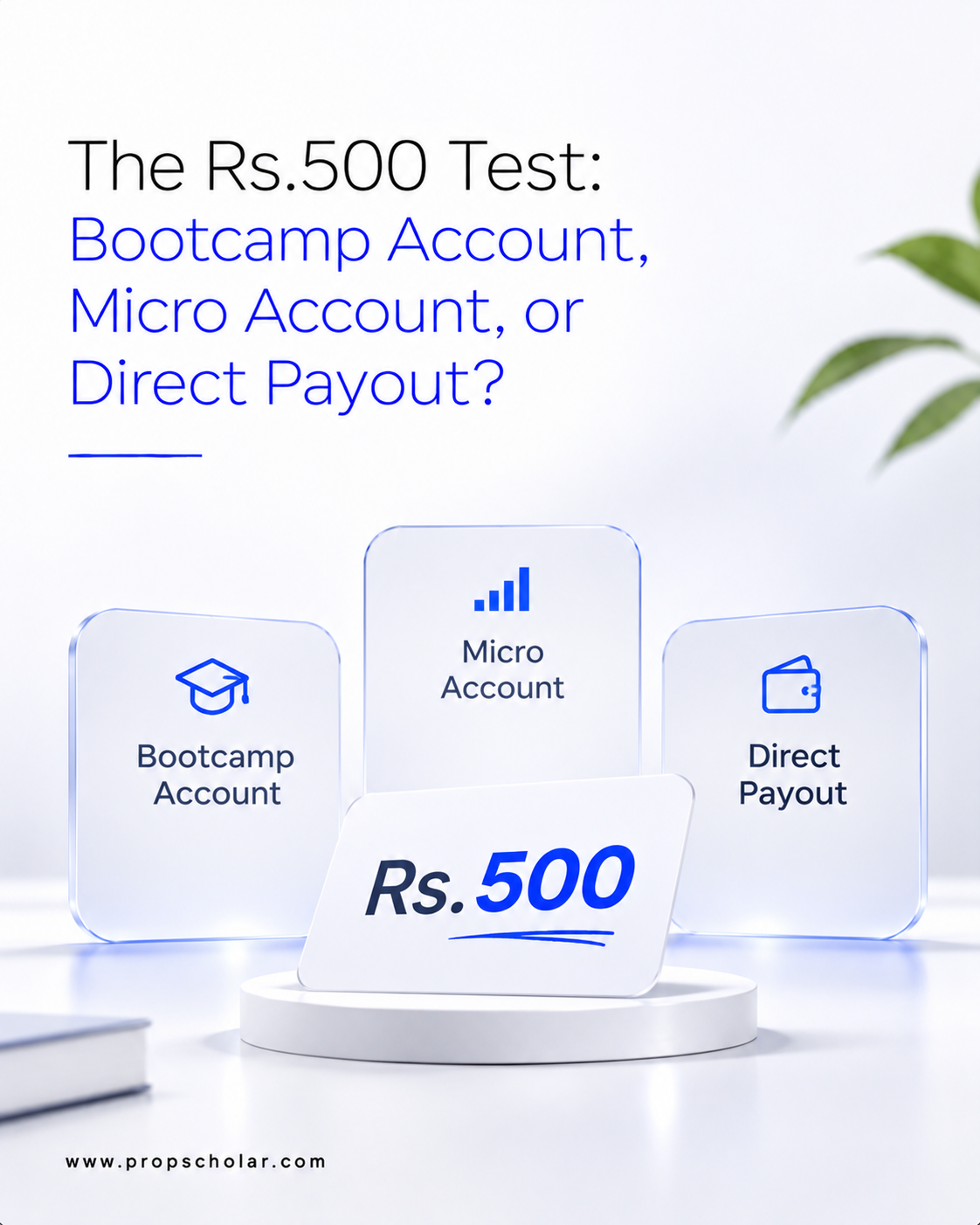
The Rs.500 Test: Bootcamp Account, Micro Account, or Direct Payout?
14 min read

Beginner Trading
Student Trading Fund: Get Trading Capital Without Savings or a Loan
13 min read
Beginner Trading
Crypto-Funded Trading in Indonesia: Start from $5
13 min read