
Bolt Mobile Money Prop Firm Payouts Kenya: 5 Hidden Fees
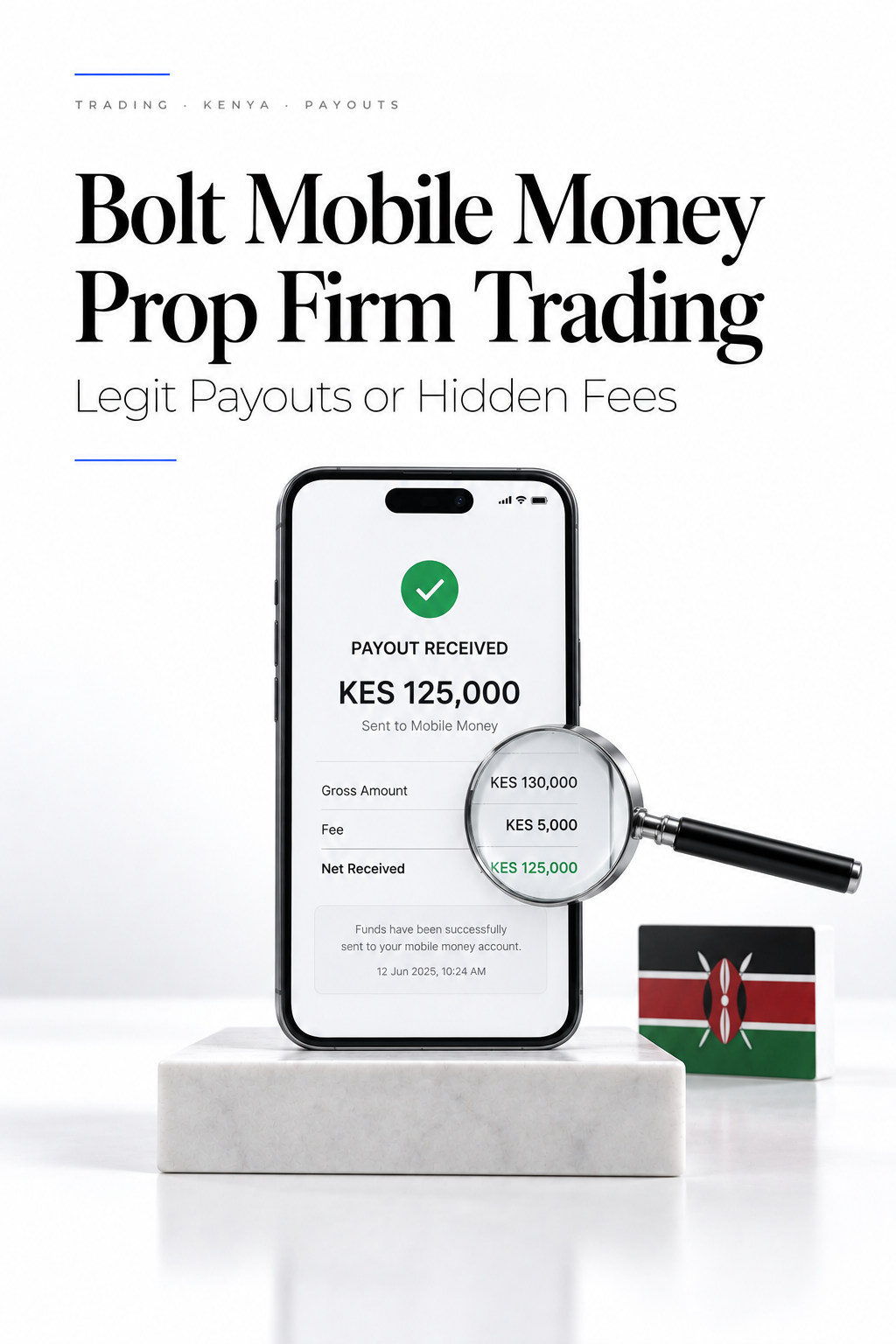
Bolt Mobile Money rarely works for prop firm payouts in Kenya. Here are the hidden fees Kenyan traders miss before funding an evaluation account.
Bolt Mobile Money rarely works for prop firm payouts in Kenya. Here are the hidden fees Kenyan traders miss before funding an evaluation account.
Start your evaluationBolt Mobile Money Prop Firm Trading in Kenya: Legit Payouts or Hidden Fees
TL;DR: Bolt Mobile Money isn't widely supported by prop firm evaluation platforms, and Kenyan traders who assume it is often get burned by fee structures they didn't read carefully. Here's what you actually need to know before you put money in.
Key takeaways:
- Bolt Money is a digital wallet operating in Kenya, but most prop firms and evaluation platforms don't list it as a supported deposit or payout method
- Hidden fees in funded trading often live in the payout terms, not the entry fee — always read the profit split and withdrawal conditions before signing up
- Crypto is the most reliable global payment method for Kenyan traders accessing international evaluation platforms
- PropScholar, a scholarship-based evaluation platform, accepts crypto globally and starts at $5 — no UPI required, no geographic lock-out
- If a platform has denied your withdrawal, the problem is almost never the payment method — it's usually the fine print you weren't shown
You searched this because something felt off. Maybe you saw an ad for a prop firm accepting Bolt Mobile Money payments in Kenya, or maybe someone in a WhatsApp group mentioned it and you wanted to verify before spending your money. Either way, that instinct to check first is exactly right.
The funded trading space in Kenya is growing fast, and so are the number of platforms trying to capture Kenyan traders before they know what questions to ask. Payment methods are where a lot of the confusion — and the hidden costs — actually live.
Does Bolt Mobile Money Actually Work for Prop Firm Payments?
Bolt Money (the financial services arm of Bolt, separate from the ride-hailing app in some markets) operates as a digital wallet in select East African markets. But here's the reality: almost no established prop firm evaluation platform officially supports Bolt Money as a deposit or withdrawal method. If you've seen a platform claiming to accept it, you need to ask for that in writing, verify their company registration, and check whether their payout terms even mention it.
What sometimes happens is that middlemen or aggregators accept mobile money from Kenyan traders and then process the payment on their behalf. That adds a layer of fees and a layer of risk. Your payment might arrive, but when it's time to withdraw profits, the same method may not be available — and you could be stuck choosing between an unfavorable bank wire and waiting weeks.
The safest assumption: if a platform doesn't list Bolt Money explicitly in their FAQ or terms, it's not supported. Don't rely on a screenshot from Telegram.
Where Kenyan Traders Actually Get Caught by Hidden Fees
The entry fee is rarely the problem. The problem is everything that comes after.
Here's where the fees tend to hide in prop firm evaluations targeted at Kenyan traders:
Payout processing fees disguised as "platform charges"
Some platforms advertise an 80% or 90% profit split, but then deduct a processing fee from your withdrawal. That fee can be a flat amount or a percentage. On a small payout, it can eat 15-25% of what you actually earned. Read the withdrawal section of the terms, not just the headline split percentage.
Currency conversion markups
If the platform pays in USD and you're withdrawing to a Kenyan account, whoever converts that money takes a spread. Banks do it. Mobile wallets do it. Even some crypto platforms do it if you're converting to KES before withdrawal. A 2-3% conversion markup on every payout adds up fast over time.
Refund-only models that don't pay in cash
Some platforms offer to "refund" your evaluation fee if you pass, which sounds like a payout. But that refund goes back to your account as trading credit, not actual money. You can't withdraw it. Always ask: does passing give me real money, or account credit?
Reset fees and re-evaluation costs that aren't upfront
You blow the evaluation. You want to try again. Suddenly there's a reset fee — sometimes nearly as much as the original entry — that wasn't mentioned on the landing page. Check the pricing page for reset and retry fees before you register.
For a deeper look at what to do if a platform actually refuses your withdrawal, the guide on prop firm withdrawal denial and how to respond is worth reading before you're in that situation rather than after.
What Payment Methods Actually Work for Kenyan Traders?
Crypto is the most practical answer right now, and that's not a promotional statement — it's just the reality of cross-border payments for retail traders in East Africa.
USDT (TRC-20) and other stablecoin options let you deposit without going through a bank that might flag an international transaction, and they let platforms pay you out without the friction of SWIFT wires. The on-ramp and off-ramp (converting KES to USDT and back) is the part that costs money, but you control when and where that happens — you're not at the mercy of a platform's undisclosed conversion rate.
M-Pesa is the dominant mobile money network in Kenya, and a handful of platforms have experimented with M-Pesa integrations — but most international prop firm evaluations don't support it directly. You'd still be going through a third party.
Bank transfers in KES to international platforms work, but the correspondent banking fees and conversion costs usually make them less efficient than crypto for amounts under $200.
PropScholar's Approach: Crypto Global, Transparent Rules
PropScholar is a scholarship-based evaluation platform — not a prop firm, not a capital allocator. The model is straightforward: you pay an entry fee starting at $5, complete a trading evaluation following published rules, and if you pass, you claim a scholarship of up to 400%, paid within 4 hours of verification.
For Kenyan traders specifically, what matters is this: PropScholar accepts crypto globally. You don't need UPI, you don't need a specific mobile money provider, and you don't need to be based in India to participate. The $5 entry point exists because the platform was built with traders in emerging markets in mind — people who can't drop $200 on a challenge that might reset them twice before they even understand the rules.
The rules are public and have never been changed retroactively. That matters more than people realize. A lot of hidden fees complaints from traders in Kenya and across Africa stem from platforms that update their terms after you've already paid — and you'd never know unless you saved a copy of the original.
Spotting a Legitimate Platform vs a Fee Trap: Practical Checklist
Before you pay anything to any funded trading platform as a Kenyan trader, run through these quickly:
Is the company registered somewhere verifiable?
A company registration number you can look up in a public database is a basic signal of legitimacy. PropScholar, for instance, is a Private Limited company registered in India under MCA — a public record. If a platform's "About" page has no legal entity information, that's a red flag.
Are the payout terms written in plain language?
If you need to read a sentence three times to understand whether you get paid in real money or credit, assume it's credit until proven otherwise. Legitimate platforms write payout conditions clearly because they want you to understand what you're signing up for.
Is there a community with independent voices?
Not a Telegram group with only success stories — an open community where people post losses, ask questions, and occasionally complain. PropScholar's Discord has 3,000+ traders and functions as a real, mixed-voice community. That's where you can check whether payouts are actually happening before you commit.
Does support actually respond?
Send a question before you pay. Ask something specific — like what the exact withdrawal method is for Kenya, and what the processing time is. If the answer is vague or delayed, that tells you something important.
For comparison of how this plays out in other African markets, the breakdown of OPay vs bank transfer for prop firm payouts in Nigeria and the Vodafone Cash vs bank transfer comparison in Egypt both show the same pattern: the payment method you use matters less than the platform's withdrawal terms.
The Honest Verdict on Bolt Mobile Money and Prop Firm Trading in Kenya
Bolt Mobile Money isn't a scam. It's a payment tool. But it's not a supported method on most international trading evaluation platforms, and any platform that claims otherwise should be asked to prove it with written documentation before you send a shilling.
The real issue for Kenyan traders isn't the payment method — it's the opacity of the platforms themselves. Entry fees are visible. Everything else often isn't.
The traders who avoid fee traps consistently do two things: they read terms in full (especially the withdrawal section), and they start with the smallest possible entry to test whether the payout process actually works before committing more. That's why a $5 entry matters. It's not just affordable — it's a test you can afford to run.
PropScholar's evaluation platform is built for exactly this kind of cautious, budget-aware trader. Crypto-accessible, transparent rules, payouts within 4 hours of verification, and a real community you can check before you commit.
PropScholar is a scholarship-based trading evaluation platform operated by a Private Limited company registered in India. We are not a prop firm and do not manage or allocate institutional capital. Our model rewards proven trading skill with scholarship grants upon successful evaluation completion.
Related reading
- Best Prop Firm You Can Pay With UPI in 2026
- Cheap Prop Firm You Can Pay With UPI in India (2026)
- Best Prop Firm You Can Pay With PayPal (No Crypto Needed)
- Crypto USDT vs Card Payment: Which Payout Route Is Actually Faster in 2026
- Best UPI-Friendly Trading Evaluation for Indian Beginners 2026
- Can You Pay for a Trading Evaluation With Crypto? A Global Guide
Ready to Prove Your Edge?
Join 500+ traders. Start from just $5. Get funded within days.
Frequently Asked Questions
Bolt Mobile Money is not officially supported by most international prop firm evaluation platforms as a deposit or withdrawal method. If a platform claims to accept it, ask for written confirmation in their terms of service. Most Kenya-based traders use crypto (USDT) for reliable cross-border payments to evaluation platforms, since it avoids third-party conversion fees and processing delays.
More From PropScholar

Beginner Trading
Teacher in Kenya on 40K Salary: Trade USDT Funded Accounts in Lunch Breaks (2026)
12 min read
Beginner Trading
Prop Trading Evaluations Explained: What Beginners Actually Pay to Start
14 min read

Prop Trading Education
Best Pay After Pass Prop Firm 2026 — And Why You Should Skip Them
11 min read

Payments
How to Access Top-Tier Prop Firm Accounts Without Paying in USD
8 min read
Payments
USDT vs Local Wallet: Your Real Payment Path in Nigeria, Kenya, and Bangladesh (2026)
11 min read
Payments
Why USDT Beats Local Payment Apps for Traders in Nigeria, Ghana, and Egypt
13 min read