
Prop Trading Evaluations Explained: What Beginners Actually Pay to Start
Most beginners think prop trading starts at $100 or more. It doesn't. In 2026, the smartest first step is a $1 evaluation that pays a $6 scholarship if you pass, then a clear path to the $5,000 Freedom Account. Here is the honest comparison of every starting route, including the one that costs almost nothing and still teaches you everything that matters.
Most beginners think prop trading starts at $100 or more. It doesn't. In 2026, the smartest first step is a $1 evaluation that pays a $6 scholarship if you pass, then a clear path to the $5,000 Freedom Account. Here is the honest comparison of every starting route, including the one that costs almost nothing and still teaches you everything that matters.
Start your evaluationBest Way for Beginners to Start Prop Trading in 2026 (It Starts at $1, Not $100)
TL;DR: The best first step for a beginner in 2026 is PropScholar's $1 trial evaluation, which pays a $6 scholarship if you pass and costs about Rs.90 in India via UPI. Once you can pass that, the $10 Freedom Account is the clear next move.
Key takeaways:
- Prop trading in 2026 does not require $100 or more to begin. The entry point is $1.
- PropScholar is a scholarship-based trading evaluation platform, not a prop firm managing institutional capital.
- The $1 Trial 1K evaluation pays a $6 scholarship on a pass, six times the entry fee.
- Every payout is processed within 4 hours of request and is publicly verifiable at propscholar.com/payout-proof.
- The smartest path: pass the $1 trial, build confidence, then move to the $10 Freedom Account.
- Trading is genuinely risky. No evaluation platform can guarantee income. What a low-cost entry does is limit how much you lose while you learn.
Most people who want to start prop trading in 2026 get stuck at the same point. They look at the entry fees on popular evaluation platforms, see $100, $150, sometimes $300, and decide they need more capital first. So they go back to demo trading. Months pass. Nothing changes.
That stuck feeling is the problem this article solves. Because the actual starting point today is not $100. It is $1, or about Rs.90 if you're paying by UPI in India. That number is real, not a teaser. Let's work through exactly what that gets you, what the alternatives actually look like, and what the honest path forward is once you've taken that first step.
What Prop Trading Actually Means for a Beginner in 2026
Prop trading, in the context most beginners encounter it, means paying a small fee to take a trading evaluation. If you pass, you receive a scholarship payout. You trade on a simulated account against clear, published rules. You don't need to deposit trading capital of your own. The platform is judging your skill, not your savings.
PropScholar is a scholarship-based trading evaluation platform, which means the reward for passing an evaluation is a scholarship grant, not a seat at an investment firm. That distinction matters because it keeps the model honest: PropScholar Private Limited (CIN U85499JH2026PTC027330) is a registered Indian company, the rules are public and never changed retroactively after you start an evaluation, and every payout comes with a scannable certificate and a unique verification code at propscholar.com/payout-proof. You're not trusting a brand on Instagram. You're trusting a published, verifiable record.
For a beginner, that structure removes the biggest early fear: what if I pay and the platform disappears or changes the rules? The short answer at PropScholar is that neither has happened in over 1.5 years of operation, and the rules are designed to prevent both.
The Four Real Starting Routes for a Beginner in 2026
Before we get to PropScholar specifically, here is an honest look at the options a beginner actually has. Each one has a real cost, a real learning outcome, and a real failure mode.
Route 1: Demo Trading Indefinitely
Demo trading is free, unlimited, and teaches almost nothing about managing a real situation under pressure. When there's no financial consequence for a mistake, most traders either take massive risks they'd never take with real stakes, or they trade in a way so cautious that the demo account becomes irrelevant practice. The feedback loop is broken. Traders who stay on demo for six months often perform worse in their first real evaluation than traders who started with a $1 entry on day one, because the $1 entry created a reason to care.
Demo has a place: learning a platform's interface, understanding how to place a trade, checking execution. It should last two weeks, not two years.
Route 2: A $100 to $300 Evaluation from a Major Platform
This is where most people assume prop trading begins. The fees are high enough that losing the entry fee genuinely stings. Some platforms charge this much for a $10,000 or $25,000 evaluation, which sounds impressive until you realise the entry cost eats into any scholarship before you've placed a single trade.
For a beginner in Nigeria, the Philippines, Bangladesh, or India, a $150 entry fee is a serious commitment. Losing it on your first evaluation because you didn't understand the rules is demoralizing, and it happens constantly. The expensive entry is not a badge of seriousness. It's a barrier with no educational advantage.
Route 3: Pay After Pass Offers
Pay after pass sounds perfect. No upfront cost, pass the evaluation, then pay. In practice, many of these structures involve monthly fees that continue whether you trade or not, activation charges when you go to claim your payout, or rules that are opaque until after you've passed. We've covered the honest mechanics of this model in detail elsewhere. The summary: read every line of the terms before signing up for anything that sounds free. Nothing in this industry is actually free.
Route 4: A $1 Evaluation Entry
This is where PropScholar's Trial 1K sits. One dollar. About Rs.90 at checkout in India via UPI. Everywhere else, you pay in crypto (USDT is the practical choice for traders in Nigeria, Kenya, Indonesia, Pakistan, the Philippines, Bangladesh, Egypt, South Africa and Vietnam) or PayPal. You get a $1,000 one-step evaluation on standard PropScholar rules. Pass it, and you receive a $6 scholarship payout. That's six times your entry fee.
The $1 trial is not designed to make PropScholar money. It is designed to get you inside the platform with the lowest possible barrier, so you can see how an evaluation works, use Scholaris (PropScholar's AI assistant), sync your MT5 trades to the trading journal, explore Trade Map and analytics, and connect with a 3,000+ trader community on Discord. All of that unlocks at $1. One per user. It's the entry ticket, not a product you buy repeatedly.
What the $1 Trial Teaches That Demo Never Does
When there is an actual financial stake, even $1, your brain processes a losing trade differently. You check the rules before you open a position. You think about position sizing. You don't revenge trade after a loss, because you understand the evaluation has a maximum loss rule and that breaching it ends the account.
That's the real education. Not the $6 you might earn. Not the $1 you risk. It's what happens to your decision-making when something is actually on the line.
From our experience running this platform and watching thousands of traders go through evaluations, the traders who start with the $1 trial and treat it seriously arrive at the Freedom Account with clearer habits than traders who skipped straight to the $10 or $25 challenge. They've already had one real conversation with their own risk tolerance. That's worth more than any demo equity curve.
If you're a smartphone-only trader in India, you might also find this useful: the UPI Rs.400 entry position sizing guide for smartphone traders covers the mechanics of sizing trades on a mobile screen without overcomplicating anything.
After the $1 Trial: The Freedom Account Path
Passing the $1 trial and collecting the $6 scholarship is step one. Step two is the Freedom Account, PropScholar's flagship evaluation. Here's what you need to know before you get there.
Sizing and Cost
The Freedom Account comes in three sizes: $5,000, $10,000, and $25,000. Entry starts at $5 for the $5,000 account and $10 for the $10,000 account. The scholarship on a pass is $20 for the $5,000, $42 for the $10,000, and $100 for the $25,000 account.
You can hold one Freedom Account at a time. That limit is enforced server-side, not just in the terms.
The Rules (Honest Version)
The Freedom Account is a one-step evaluation with a 10% profit target. Maximum loss is 6% of the initial account size. Daily loss is 3% of the higher of your starting equity or current balance. There's no time limit and no minimum trading days, which means you can take your time or move fast depending on how your trading is going.
The fastest recorded pass on the Freedom Account is 2 hours. That's the ceiling of what's possible, not the expectation. Most beginners should expect to need more time than that.
News trading is the rule that catches the most people off guard: you cannot open or close positions from 10 minutes before to 10 minutes after a high-impact news event. That includes stop-loss and take-profit closes. Breaching this rule ends the account. Check an economic calendar before every session.
Weekend holding is allowed. Copy trading is not allowed between two PropScholar accounts.
Inactivity for 14 consecutive days without placing a trade closes the account.
Lot Limits on the $10,000 Account
This is the one real restriction that deserves to be stated plainly. On the $10,000 Freedom Account, the maximum open lots per asset class are: 4.00 on forex, 0.40 on gold, 1.00 on silver, 0.20 on BTCUSD, 1.00 on ETHUSD, 0.50 on NAS100, 0.30 on US30, and 0.75 on US500. Each class is independent. You cannot borrow headroom from one to use in another.
If you trade gold specifically, 0.40 lots is the ceiling. That's a real limit, and knowing it before you fund is the entire point of transparency. A platform that hides lot limits until after you pay is one you should avoid. PropScholar publishes them before checkout.
For traders who want to understand why these limits exist and how to size trades around them, the gold lot limit guide for Nigerian USDT traders is a practical walkthrough.
How Payment Works in 2026 (By Region)
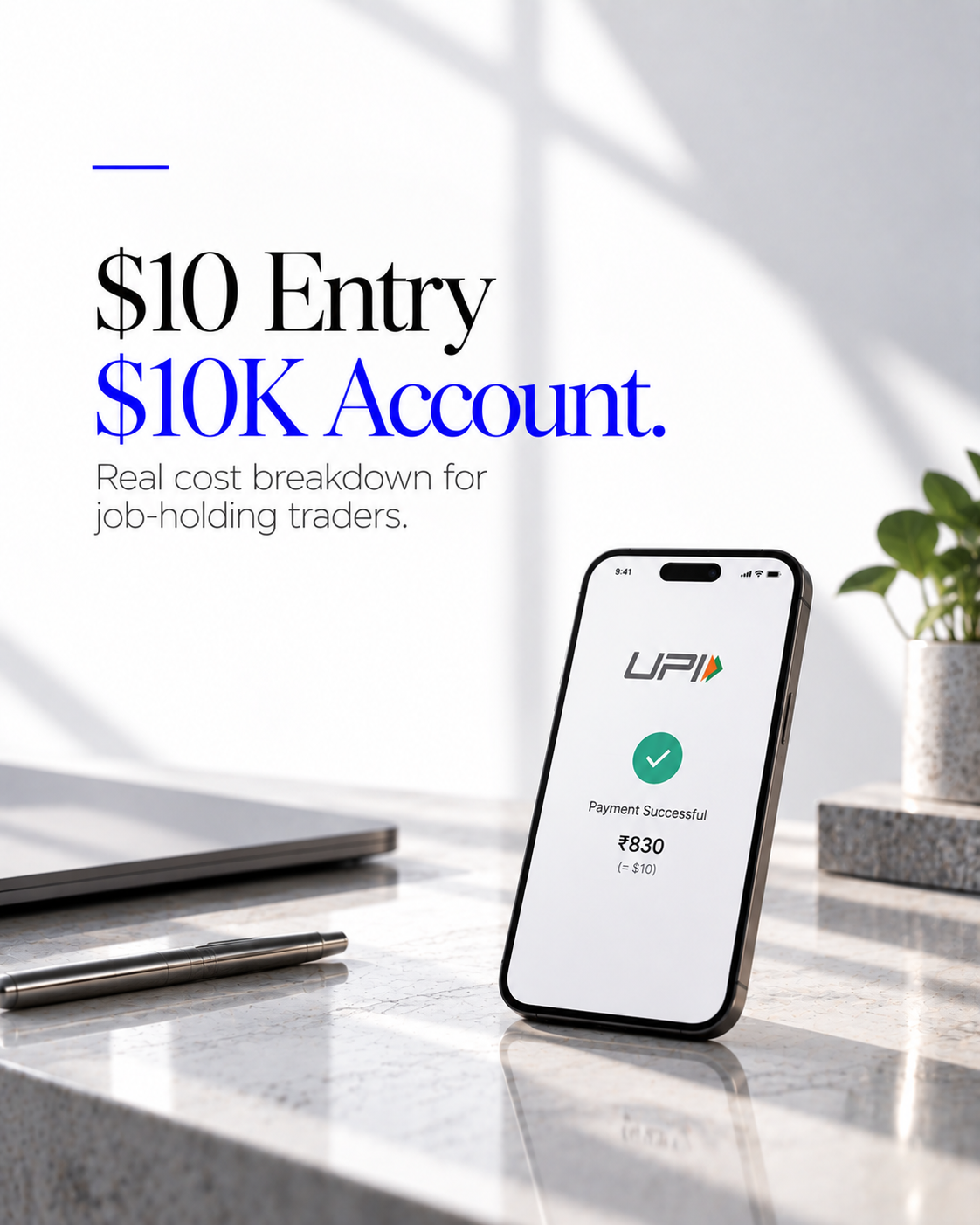
In India, you pay by UPI in rupees. The $1 trial is about Rs.90 at checkout. The $10 Freedom Account is around Rs.850 depending on the exchange rate shown at checkout. No card needed, no conversion confusion.
Everywhere else, crypto or PayPal. USDT is what traders in Nigeria, Ghana, Kenya, South Africa, Pakistan, Bangladesh, Indonesia, the Philippines, Vietnam and Egypt actually use in practice. The real path is: buy USDT on a P2P exchange using your local bank transfer or mobile wallet, then pay PropScholar directly in USDT through NOWPayments at checkout. You're not wiring money internationally. You're just sending USDT. Most traders who've done it once say it takes less than 10 minutes from start to finish.
If you want to see how a working trader in Kenya manages the USDT payment path alongside a full-time salary, this article is the clearest guide: teacher in Kenya trading USDT funded accounts on a 40K salary.
For the Philippines, this is also a solved problem. The part-time trader in the Philippines guide covers how to fit evaluations around a day job with limited trading hours.
What You Should Not Expect from a $1 Entry
A $1 evaluation is a first step, not an income. The $6 scholarship on a pass is six times your entry, which is a strong return on a training exercise, but it's not a salary. The point of the $1 trial is to learn how evaluations work, test your strategy against real rules, and decide whether the Freedom Account is the right next move.
Trading is risky. That applies inside an evaluation platform the same as anywhere else. You can lose the $1 entry fee by breaching the maximum loss rule before you hit the profit target. That loss is small by design, but it's real, and it should prompt you to look at what went wrong before you try again.
No evaluation platform, including PropScholar, can guarantee that you will pass, earn a scholarship, or develop a profitable trading career. Anyone telling you otherwise is selling something much more dangerous than a $1 evaluation fee.
What PropScholar does guarantee, in writing, is that if you pass, your payout is processed within 4 hours of your request, and that payout has a publicly verifiable certificate with a unique code. That's the honest promise: we pay fast, we publish the proof, and the rules don't change after you start.
How PropScholar Compares to the Alternatives
On Entry Cost
No other platform in this category currently offers a one-step evaluation that starts at $1. The market standard for a beginner-friendly funded evaluation is $40 to $80 for a small account. PropScholar's trial is two orders of magnitude cheaper. That difference removes the main reason beginners delay.
On Transparency
PropScholar publishes lot limits, news trading rules, inactivity rules, and payout records before you buy. The complete ruleset is at propscholar.com/terms-of-use. Many platforms bury these details in PDFs linked from a footer. The transparency test is simple: can you find every rule before you pay? At PropScholar, yes.
On Payout Speed
Four hours from request to processed is among the fastest in the industry. The public payout proof page means you don't have to take that claim on faith. Look at the timestamps on recent payouts yourself.
On What It Is
PropScholar is a scholarship-based trading evaluation platform. It does not manage institutional capital. It does not place your trades in real markets. If that distinction matters to you, which it should, then you want a platform that is honest about what it is. PropScholar is.
The Honest Starting Plan for a Beginner in 2026
Here is what the path actually looks like, step by step, without the marketing.
Spend one week on demo to learn your platform's interface. Not to develop a strategy. Just to understand how to place a trade, set a stop loss, and read a chart without panicking. One week.
Then buy the $1 trial at propscholar.com/trial. Trade it carefully. Read the rules at propscholar.com/terms-of-use before you open your first position, not after. Use the Scholaris AI assistant if you have questions. Connect to the Discord. Watch what other traders are doing.
If you pass, collect the $6 scholarship. If you don't pass, pay $1 again and figure out what went wrong. The cost of two attempts is still less than a coffee.
Once you can pass the $1 trial consistently, move to the $10 Freedom Account. The rules are structurally similar. The stakes are higher and the scholarship is real money: $42 on the $10,000 account, $100 on the $25,000.
That's the path. It's not glamorous. It's just the one that works.
PropScholar is a scholarship-based trading evaluation platform operated by a Private Limited company registered in India. We are not a prop firm and do not manage or allocate institutional capital. Our model rewards proven trading skill with scholarship grants upon successful evaluation completion.
Related reading
- What Does a $1 Prop Firm Account Actually Get You?
- Best Prop Firm for Beginners in India 2026: Pay With UPI, Start Cheap, Trade Safe
- Nigerian Traders: Start Prop Trading for Just $1 in USDT
- I Want to Start Trading But Don't Know Where to Begin: A Step-by-Step Roadmap
- Prop Trading for Beginners with Low Budget: Why Cheap Prop Firms Are a Trap and What to Do Instead
- How to Start Forex Trading as a Complete Beginner in 2026
Ready to Prove Your Edge?
Join 500+ traders. Start from just $5. Get funded within days.
Frequently Asked Questions
The best first step is PropScholar's $1 Trial 1K evaluation, which costs about Rs.90 in India via UPI, or $1 in USDT or PayPal everywhere else. Pass it and you receive a $6 scholarship payout. It's the lowest-cost way to experience a real evaluation, learn the rules, and decide whether the $10 Freedom Account is your next move.
More From PropScholar
Beginner Trading Guides
How a $1 Account Starts Your Prop Trading Journey
11 min read

Scholarship Model
Is There a Scholarship for Traders Who Failed Retail? Evaluation Accounts vs Demo (India UPI 2026)
13 min read
Trader Safety
Is Pay After Pass Legit or Not? The Honest Answer for 2026
11 min read

Beginner Trading
How to Become a Trading Scholar in India: Start from ₹90, Get Paid in 4 Hours
14 min read
Beginner Trading
PropScholar $1 Challenge: Cheapest Beginner-Friendly Prop Access in 2026
11 min read
Beginner Trading
UPI Prop Firm India: $10 Entry on $10K Account — Real Cost Breakdown for Job-Holding Traders
13 min read