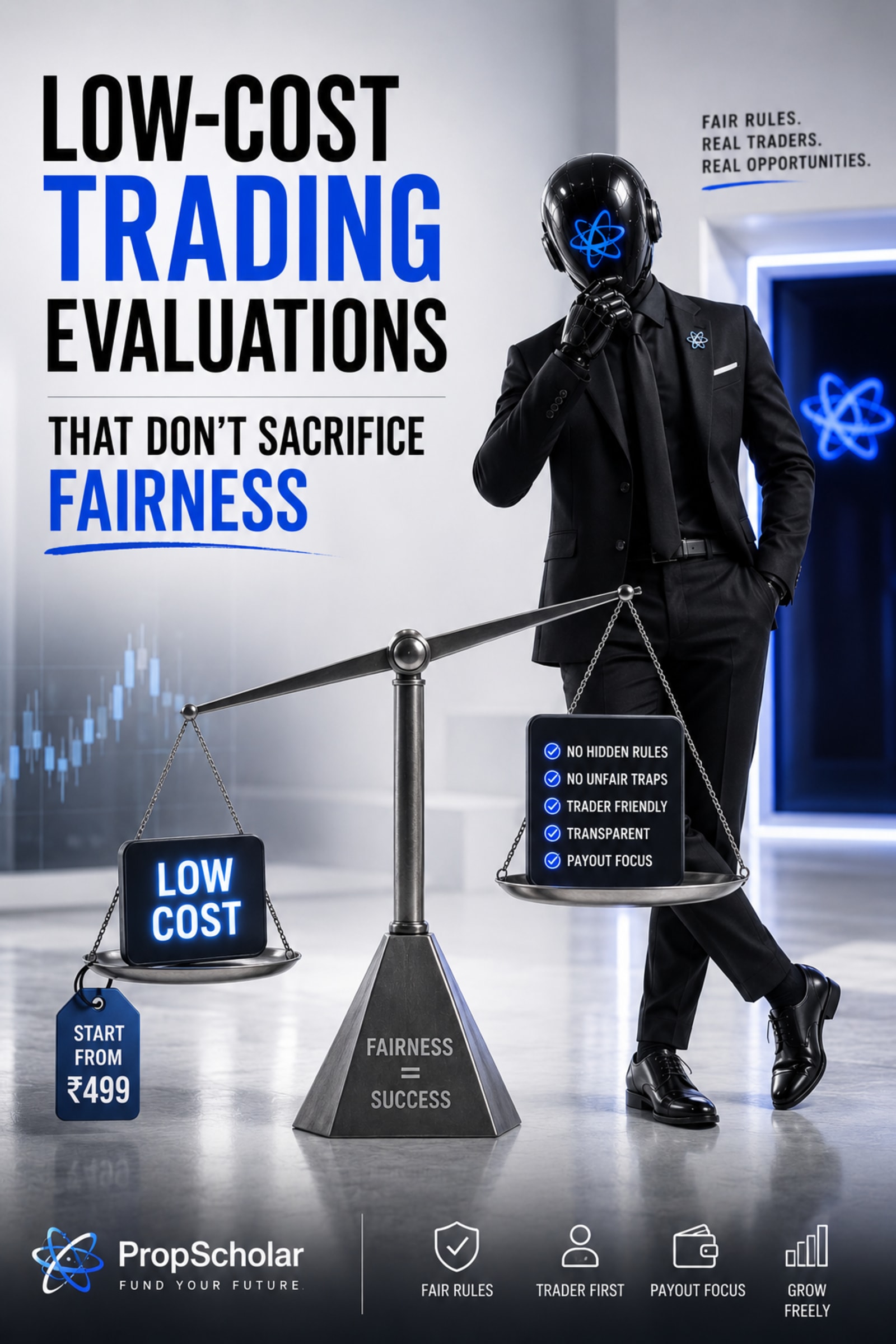
Low-Cost Trading Evaluations That Don't Sacrifice Fairness
Cheap entry fees don't have to mean rigged rules. Here's how to tell a genuinely fair low-cost trading evaluation from one designed to fail you — and where PropScholar fits into that picture.
Cheap entry fees don't have to mean rigged rules. Here's how to tell a genuinely fair low-cost trading evaluation from one designed to fail you — and where PropScholar fits into that picture.
Start your evaluationLow-Cost Trading Evaluations That Don't Sacrifice Fairness
TL;DR: A cheap entry fee is meaningless if the rules are designed to trip you up. The real question is whether a low-cost evaluation gives you a genuine shot — and several do, including PropScholar, which starts at $5.
Key takeaways:
- Low cost and fair rules are not mutually exclusive — but you have to know what to look for.
- The most dangerous rules aren't the expensive ones; they're the hidden or retroactively changed ones.
- Fixed drawdown limits are almost always fairer than trailing drawdown for newer traders.
- PropScholar is a scholarship-based evaluation platform starting at $5 (around Rs.400), paying scholarships within 4 hours of verification.
- Public, unchanging rules are a non-negotiable signal of a trustworthy platform.
You're probably here because you want to test yourself against real market conditions without betting rent money on the entry fee. That's completely reasonable. The good news is that affordable, genuinely fair evaluations exist. The challenge is learning to tell them apart.
What Actually Makes a Trading Evaluation "Fair"?
Fairness in a trading evaluation comes down to one thing: do the rules give a competent trader a realistic chance to pass, or are they structured so that even good traders fail on technicalities?
Three areas are where fairness either lives or dies.
Clear, public rules that never change retroactively
If you can't read the complete ruleset before you pay, that's a red flag. If those rules can be changed after you've bought your evaluation — without your consent — that's worse. The platforms worth your time publish every rule publicly and commit to never applying new rules to evaluations already in progress. PropScholar does exactly this; the rules are public and have never been changed retroactively in its 1.5+ years of operation.
Fixed drawdown over trailing drawdown
This one matters more than most beginners realise. A trailing drawdown follows your peak equity upward and locks in a new, tighter floor every time your account grows. That sounds fine until you hit a small pullback after a good run — and suddenly you're out, even though you're still up overall. Fixed drawdown limits stay constant relative to your starting balance. For newer traders especially, fixed limits give you room to actually trade rather than constantly managing an ever-shrinking safety margin. If you want the full breakdown, the article on trailing drawdown and why fixed limits are fairer covers the mechanics in detail.
No vague or unpublished restrictions
News trading bans, lot size restrictions, mandatory stop-loss rules, minimum trading day requirements — none of these are inherently unfair, but they need to be stated clearly upfront. An evaluation that disqualifies you for something that wasn't explicitly forbidden is not a fair evaluation. It's a revenue model.
Why Low Cost and Fair Rules Aren't Contradictory
The idea that you have to pay more to get treated fairly is a myth the expensive platforms benefit from. The cost of running an evaluation platform has dropped substantially with modern infrastructure — automated rule monitoring, instant data feeds, real-time dashboards. A platform that charges $100 for an evaluation isn't necessarily spending more on fairness than one charging $5. They might just be charging more because they can.
PropScholar is a good example of this. Entry fees start at $5 (around Rs.400 in India), and the evaluation mechanics are identical whether you pay that or more. You're not getting a watered-down experience at the lower tier. The scholarship payout — up to 400% of your entry fee — is verified and paid within 4 hours. That's the same standard at every level.
For traders in Nigeria, the Philippines, Indonesia, South Africa, or anywhere that major prop firm fees feel genuinely out of reach, the math here is different from what it is for someone in London or New York. A $149 evaluation fee can represent a week's income. A $5 entry point changes who can participate at all.
The Warning Signs of a "Cheap" Evaluation That Isn't Actually Fair
Not every low-cost evaluation deserves your trust. Here's what to watch for.
Trailing drawdown on a small account. At a $5 or $10 entry level, trailing drawdown is particularly brutal. One good trade followed by a slight pullback and you're out — not because you traded badly, but because the mechanic punishes normal volatility. Look for fixed drawdown limits.
Unclear payout timelines. "We pay fast" is not a promise. "We pay within 4 hours of verification" is. If a platform won't give you a specific number, treat that as a warning.
Rules that reference other documents. If the main ruleset says "see our terms of service" for key definitions, go read those terms before you pay. Hidden disqualification triggers often live there.
No public community or payout proof. A genuine platform has traders talking about it. PropScholar has a Discord community of 3,000+ traders where payout screenshots get posted regularly. If you can't find any real human discussion about a platform, that absence tells you something.
The article on how to get a cheap funded account without falling for traps goes deeper on specific patterns to avoid — worth reading before you commit to anything.
How PropScholar Balances Low Cost With Real Standards
PropScholar is a scholarship-based trading evaluation platform, not a prop firm. The distinction matters: you pay an entry fee, trade through an evaluation under published rules, and if you pass, you receive a scholarship grant — up to 400% of your entry fee — paid within 4 hours of verification.
The cost structure
Evaluations start at $5, or around Rs.400 for Indian traders via UPI through PhonePe, Razorpay, or Cashfree. For traders outside India, PropScholar accepts crypto globally, which means currency conversion barriers and international payment friction aren't your problem. You don't need a dollar account or a credit card that works internationally.
The rule structure
All rules are published publicly. None have been changed retroactively. The drawdown limits are fixed, not trailing. There are no secret restrictions waiting to disqualify you after the fact.
The support structure
PropScholar offers 24/7 support in Hindi and multiple other languages — which isn't standard in this space. For a beginner in an emerging market whose first language isn't English, that's a concrete practical advantage, not a marketing line.
PropScholar also operates a marketplace where you can buy top prop firm challenges at INR/UPI pricing, making internationally priced evaluations accessible locally. That breadth is worth noting if you eventually want to try larger evaluations elsewhere.
What Fair Rules Look Like in Practice: A Quick Checklist
Before you pay for any evaluation, run through these questions. They take five minutes and can save you a real mistake.
Can you read the complete ruleset before purchasing? Are the drawdown limits fixed (not trailing)? Is the payout timeline stated as a specific number of hours, not just "fast"? Has the platform ever changed rules on active evaluations? Is there a real community — Discord, Telegram, forum — where traders post results?
If you can answer yes to the first four and find a genuine community for the fifth, you're looking at a platform worth considering. If any answer is no or unclear, keep looking. There are enough honest options in 2026 that you don't need to take a risk on murky terms.
For a deeper look at getting started with minimal capital, the guide on starting a trading evaluation for under Rs.500 or under $10 walks through exactly that process step by step.
One More Thing Worth Knowing
Right now, PropScholar is running a FIFA World Cup 2026 Penalty Game at app.propscholar.com/fifa. Score one goal in five attempts and you get a mystery discount code — anywhere from 22% to 25% off an evaluation, or up to 15% extra on a scholarship payout. You can retry every four hours. It's a free shot at reducing your entry cost further, and on a $5 evaluation, even a small discount makes a real difference.
The Bottom Line
Low cost and fair rules are not in conflict. The evaluations that fail traders aren't the cheap ones — they're the ones with hidden mechanics, retroactive rule changes, and vague payout promises. PropScholar starts at $5, keeps its rules public and fixed, and pays scholarships within 4 hours. That's the standard worth measuring other platforms against.
If you're ready to start, the PropScholar shop has every evaluation option listed with fees and rules visible before you commit to anything.
PropScholar is a scholarship-based trading evaluation platform operated by a Private Limited company registered in India. We are not a prop firm and do not manage or allocate institutional capital. Our model rewards proven trading skill with scholarship grants upon successful evaluation completion.
Related reading
- Cheapest Prop Firm in 2026: The Complete Price Comparison Guide (From ₹300 With FIFA Discount)
- Cheapest Prop Trading Evaluation in 2026 Ranked by Real Total Cost
- How to Get a Cheap Funded Trading Account Without Falling for Traps
- Best Way for Beginners to Get Trading Capital Without Big Upfront Cost
- Cheapest Legit Way to Access a Funded-Style Trading Account From $5
- Cheap Prop Firms: Why the Lowest Fee Often Costs the Most
Ready to Prove Your Edge?
Join 500+ traders. Start from just $5. Get funded within days.
Frequently Asked Questions
A low-cost trading evaluation is a challenge where you pay a small entry fee — sometimes as little as $5 — and trade a demo account under published rules around profit targets and drawdown limits. If you pass, you receive a payout or scholarship. The key is whether the rules are genuinely fair, not just whether the entry fee is cheap.