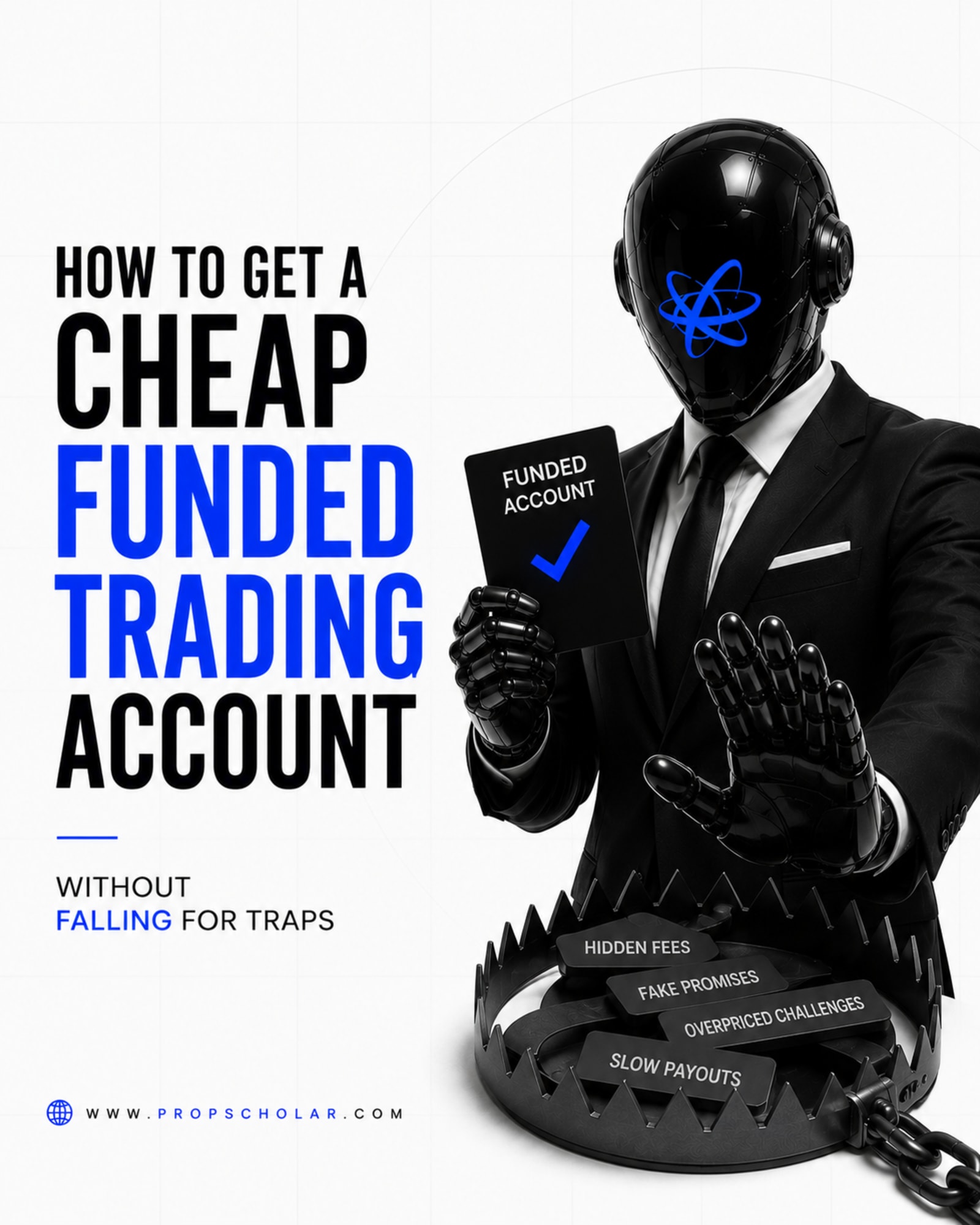
How to Get a Cheap Funded Trading Account Without Falling for Traps
Cheap funded trading accounts sound great until you discover the hidden rules, reset fees, and withdrawal tricks that drain traders who don't know what to look for. This guide walks you through exactly what separates a genuine low-cost evaluation from a money-collecting trap — and shows you how to get started for as little as $5 without losing your shirt.
Cheap funded trading accounts sound great until you discover the hidden rules, reset fees, and withdrawal tricks that drain traders who don't know what to look for. This guide walks you through exactly what separates a genuine low-cost evaluation from a money-collecting trap — and shows you how to get started for as little as $5 without losing your shirt.
Start your evaluationHow to Get a Cheap Funded Trading Account Without Falling for Traps
TL;DR: A genuinely cheap funded trading account costs you less upfront AND doesn't steal your profits through hidden rules. Most don't pass that second test. This guide shows you exactly what to check before paying a single dollar.
Key takeaways:
- Entry price is not the same as total cost — reset fees, add-ons, and hidden rules can multiply what you actually pay.
- Seven specific traps appear over and over in low-cost evaluations; knowing them ahead of time takes away their power.
- Legitimate evaluation platforms publish all rules publicly and never change them retroactively.
- PropScholar's scholarship-based evaluation platform starts from $5 (around Rs.400) and pays verified scholars up to 400% within 4 hours of verification.
- You can cut costs further right now using PropScholar's FIFA World Cup 2026 penalty game at app.propscholar.com/fifa — score one goal in five chances for a mystery code worth 22–25% off or up to 15% extra payout, retryable every 4 hours.
You've probably done the math. A $50,000 funded account at one of the well-known evaluation platforms costs you somewhere between $300 and $500 just to take the challenge — and that's before you factor in what happens if you fail once and need to reset. For a trader in Lagos, Manila, Jakarta, Nairobi, or Karachi, that's not pocket change. That's weeks of savings.
So you go looking for something cheaper. And the cheaper you go, the more dangerous it gets. Not because cheap is always bad, but because a lot of platforms specifically price low to attract people who are too excited to read the fine print.
The good news: cheap and legitimate can absolutely coexist. You just need to know what questions to ask before you pay.
What a Funded Trading Account Actually Is (And What It Isn't)
A funded trading account is one where a platform or firm gives you simulated or real capital to trade after you've demonstrated skill through an evaluation. You keep a percentage of the profits you generate.
The word "funded" gets used loosely, though. Some platforms are genuine prop firms allocating institutional capital. Others — like PropScholar — are scholarship-based evaluation platforms: you pay a small entry fee, complete the evaluation, and if you pass, you receive a scholarship grant of up to 400% of your entry fee paid directly to you within 4 hours of verification. The distinction matters because it changes what you're actually buying. You're not buying trading capital. You're paying a relatively small fee for the opportunity to prove your skill and earn a scholarship.
Why does that distinction matter for finding something cheap? Because once you understand you're paying an evaluation fee — not a deposit — the game changes. A $5 evaluation fee where you can earn $20 back as a scholarship is a fundamentally different proposition from a $400 "funded account" where the platform claws back profit through a dozen invisible rules.
See our breakdown of the cheapest prop trading evaluations in 2026 ranked by real total cost to understand how dramatically costs vary when you count everything.
The Seven Traps That Make "Cheap" Evaluations Expensive
These aren't hypothetical. They show up in real platforms, real terms and conditions, real trader complaints on forums and Discord servers. Go through each one carefully.
Trap 1: The Reset Fee Loop
This is the oldest trick. You fail the evaluation — maybe by one bad trade on day three — and you're offered a discounted reset. Pay 40% of the original fee and start over. Sound reasonable? It is, until you fail three or four times and realize you've paid 160% of the original cost across resets, with nothing to show for it.
Some platforms structure their pricing specifically around this model. The entry price is low because the real revenue comes from repeated resets by traders who are committed but haven't yet passed.
The question to ask before joining: what is the reset fee, and is there a cap on how many you can buy?
Trap 2: Trailing Drawdown That Snapshots Your Peak
Trailing drawdown sounds simple: your maximum allowed loss follows your highest account value, keeping you disciplined. In practice, some platforms set it to trail from your peak equity, not your starting balance, and they calculate it tick by tick — meaning a temporary spike in open profits can permanently tighten your allowed drawdown even if that trade closes lower.
Example: you start with a $10,000 simulated account. Your open profit reaches $500 intraday, so your trailing stop snaps to $10,300. You then give back $250 on that trade and close at $250 profit. Your drawdown limit is now tighter than when you started — permanently. This catches traders who think they're comfortable and aren't.
The question to ask: does trailing drawdown update from closed balance or from peak floating equity?
Trap 3: The Consistency Rule You Weren't Told About
Some evaluations have a rule that says no single trading day can account for more than 30% (or 40%, or 50%) of your total profit. The idea is to prevent one lucky day carrying a mediocre week.
The trap? It's often not mentioned prominently. You trade well, hit your profit target, apply for your scholarship or payout — and get rejected because 35% of your profit came on one Tuesday. The evaluation fee is gone.
The question to ask: is there a daily profit consistency rule? What percentage is the threshold?
Trap 4: News Trading Bans With No Clear Definition
Many platforms ban trading within a window around major news events. Fine — that's a legitimate risk management choice. The trap is when the window is vague ("around major news" — how major? how wide?) or when the list of banned events changes without notice.
If you trade macroeconomic events as part of your strategy, a broad news trading ban can make the evaluation effectively untradeable for your style. And if you accidentally trade through a news window you didn't know was banned, you lose the account.
The question to ask: show me the exact news trading policy in writing. What events, what window in minutes, where is it documented?
Trap 5: Withdrawal Thresholds That Keep Moving
Some platforms set minimum payout thresholds and then quietly raise them, or add processing delays that stretch weeks into months. You pass the evaluation, you generate profit, and then you discover that payouts are processed "at the end of each quarter" or require a minimum that your account hasn't reached yet.
This is where you want to see real proof — not marketing copy. Look for actual payout screenshots in a community, with timestamps. On PropScholar's Discord server (3,000+ active traders), payout proof is shared regularly and is publicly visible before you pay a cent.
The question to ask: what is the exact payout timeline, and can I see verified community proof of it?
Trap 6: Add-Ons That Inflate the "Cheap" Price
A $19 evaluation sounds incredible until you see the checkout. Dashboard access: $5/month. MetaTrader 5 connection fee: $10. Profit split upgrade from 50% to 80%: $25. Suddenly your $19 evaluation is $59 before you've placed a single trade.
Always price at the checkout level, not the advertised level. And check whether fees are one-time or recurring.
The question to ask: what is the all-in cost at checkout, including any required add-ons?
Trap 7: Rules That Change After You Pay
This one is the most insidious. You pay, you start trading under a set of rules, and mid-evaluation the platform updates their terms. New leverage limit. New drawdown rule. New instrument restriction. Your strategy that was compliant yesterday isn't today.
Legitimate platforms lock in the rules at the point of purchase for that evaluation. Rules apply to new accounts going forward, never retroactively to accounts already in progress.
The question to ask: do rule changes apply to active accounts or only to new signups?
How to Actually Verify a Platform Before Paying
Reading terms and conditions matters, but not everyone speaks legal-document English fluently. Here's a faster verification checklist that works for any platform.
Check the community first. A real Discord or Telegram with thousands of members who regularly post payout screenshots and talk openly about their experience is a strong signal. A community that deletes critical questions or has zero payout screenshots is a red flag.
Google the platform name plus "not paid" and "scam" and "withdrawal rejected". You'll surface real complaints if they exist. Every legitimate platform will have some unhappy traders — that's normal. Look for patterns, not isolated incidents.
Read the rules document, not the marketing page. They should link directly to a rules PDF or page from the checkout flow. If the rules aren't publicly accessible before you pay, that's a problem.
Check company registration. Is the platform registered as a legal entity? PropScholar, for instance, is a Private Limited company registered in India under the MCA. That's verifiable. Platforms that operate with no disclosed legal entity are harder to hold accountable.
Test customer support before buying. Send a question through their chat or email. If response is slow, vague, or non-existent before you're a customer, imagine how it'll be after you've paid.
What Cheap Actually Looks Like When It's Legitimate
Genuinely affordable evaluations share a few characteristics: transparent total cost, rules that don't move, and a track record of actual payouts.
PropScholar's scholarship-based trading evaluation starts from $5, which is roughly Rs.400 in Indian Rupees, around 4,000 Naira in Nigeria, or 200 Philippine Peso equivalent. That's not just a low number — it's genuinely accessible for a trader who can't risk $200 on something unproven.
The scholarship works proportionally: your entry fee unlocks an evaluation, you pass it, and you receive a scholarship of up to 400% of your entry fee paid within 4 hours of verification. The rules are public, have never been changed retroactively in the platform's 1.5+ years of operation, and the Discord community has thousands of traders who talk openly about their experience — including failures and successes.
Payments happen via UPI (PhonePe/Razorpay/Cashfree) for Indian traders and crypto for global traders. If you're in Nigeria, South Africa, the Philippines, Indonesia, Kenya, Egypt, Vietnam, or anywhere else — the crypto route is available. There's 24/7 support in Hindi and multiple languages.
For a deeper comparison of how the costs stack up against major alternatives, the cheapest prop firm in 2026 complete price comparison guide walks through the numbers line by line.
PropScholar vs. Typical Low-Cost Platforms: The Real Comparison
Entry Cost and What You Actually Pay
Typical low-cost evaluation platforms advertise $19–$49 entry fees but require add-ons at checkout, optional reset purchases, and recurring dashboard fees. By the time you've gone through two evaluation attempts, you've often spent $80–$150.
PropScholar's evaluation starts at $5 all-in. There are no recurring monthly fees on evaluation accounts. If you want to go for a higher scholarship tier, you pay a higher entry fee — but the structure is transparent and the ratio stays proportional. The best way for beginners to get trading capital without big upfront cost explains how this compares to trying to save up for a traditional prop challenge.
Payout Speed
Many platforms list "2–5 business days" or "processed on the 1st and 15th of the month" as payout timelines. Traders in emerging markets often wait longer because of international wire delays or platform-side verification backlogs.
PropScholar's scholarship is paid within 4 hours of verification completing. That's a specific number, not a range. And the Discord server has timestamped payout screenshots going back through the platform's history — you can verify it yourself before signing up.
Rules Transparency
Platforms that change rules midway through active evaluations are a well-documented complaint across trader communities. It's not always malicious — sometimes platforms update rules for new signups but apply them to existing accounts by mistake. Either way, the result for the trader is the same: the rules they agreed to changed under them.
PropScholar's rules are public and have never been applied retroactively in over 1.5 years of operation. When rules update, they apply to new accounts only. That's the standard you should demand from any platform.
Payment Methods for Global Traders
This matters more than it sounds. If you're in a country where your bank doesn't easily support international wire transfers, and the platform only accepts card payments that your bank declines, the "cheap" evaluation becomes inaccessible in practice.
PropScholar accepts UPI (via PhonePe, Razorpay, and Cashfree) for India, and crypto globally. That covers the vast majority of the emerging-market traders who are actually the target audience for low-cost evaluations. No fighting with international card declines at checkout.
Cutting Your Entry Cost Even Further
Right now, PropScholar is running a FIFA World Cup 2026 promotion at app.propscholar.com/fifa. You play a free penalty shootout — score one goal in five chances — and receive a mystery discount code. Codes are worth between 22% and 25% off your evaluation entry fee, or alternatively up to 15% extra on your scholarship payout. You can retry every 4 hours.
On a $5 entry fee, even a 22% discount saves you over a dollar — but on a higher tier evaluation, the savings compound meaningfully. It's worth playing before you buy any evaluation level.
Red Flags Checklist: Run Through This Before Paying Anything
Print this out or save it somewhere. Before paying any evaluation platform, you should be able to answer all of these with confidence.
Is the company registered as a legal entity, and can you verify it independently? Are the full rules publicly accessible before payment, without requiring you to create an account first? Is the reset fee structure clearly documented? Does trailing drawdown calculate from closed balance or floating equity? Is there a consistency rule, and what is the threshold? Is the news trading policy specific about events, windows, and documentation? What is the exact payout timeline, and is there community proof with timestamps? Are checkout add-ons optional or effectively required? Do rule changes apply only to new accounts or to active ones too? Is there an active, genuine community with real trader discussions — not just marketing testimonials?
If any platform you're evaluating can't answer all ten cleanly, that's your answer.
The Mindset Shift That Saves Most Beginners Money
Here's something that doesn't get said often enough: the goal isn't to find the cheapest evaluation. The goal is to find the evaluation with the lowest total cost relative to what you actually get out of it.
A $5 evaluation where you realistically have a chance of earning a 400% scholarship — with clear rules, fast payouts, and a community you can learn from — is worth more than a free trial that never actually pays anyone, or a $99 "lifetime" membership to a platform that disappears after six months.
We've been operating for over 1.5 years. We have 3,000+ traders on Discord. We have payout proof you can scroll through before you ever pay. None of that proves we're perfect — every platform has traders who fail evaluations and are frustrated. But it does prove we're real, functional, and consistent.
That's actually the bar. Not "perfect," just real and consistent. It's a bar that more platforms fail than you'd expect.
If you're still figuring out whether an evaluation model is right for you at all, check the broader beginner context in our guide on the best way for beginners to get trading capital without big upfront cost.
Frequently Asked Questions
What is the cheapest way to get a funded trading account? The cheapest legitimate path is through a scholarship-based evaluation platform like PropScholar, where you can start for $5 (around Rs.400). You pay an entry fee, pass the trading evaluation, and receive a scholarship of up to 400% of your entry fee within 4 hours of verification. Avoid platforms that look cheap upfront but charge reset fees, add-ons, or have opaque withdrawal rules that eat your earnings after the fact.
Are cheap funded trading accounts a scam? Not automatically — but many are structured in ways that make losing money almost inevitable. The traps to watch for include trailing drawdown calculated from peak floating equity, hidden consistency rules, reset fee loops, and withdrawal thresholds that keep moving. A genuinely affordable platform publishes all rules publicly, never changes them retroactively, and has verifiable payout proof in an active community. Those platforms exist, but you have to verify before paying.
How much should a beginner pay for a trading evaluation? As little as possible while still accessing a legitimate platform with real payout history. PropScholar starts at $5, which is an appropriate starting point for a complete beginner. You get to prove your skill without risking significant savings. As you pass evaluations and build confidence, higher tiers become worth considering. Starting at $300–$500 as a beginner, before you've proven you can pass consistently, is unnecessary risk.
What is a trailing drawdown and why does it trap traders? Trailing drawdown is a rule where your maximum allowed loss rises as your account balance grows. The trap version calculates from your peak floating equity — meaning even a temporary spike in open profits permanently tightens your allowed loss. A trader can do everything right and still fail because an intraday profit high shifted their drawdown limit without them realizing. Always ask whether trailing drawdown tracks closed balance or peak floating equity before joining any evaluation.
Is PropScholar a prop firm? No. PropScholar is a scholarship-based trading evaluation platform, not a prop firm. It doesn't manage or allocate institutional capital. The model is: you pay an entry fee, complete the evaluation, and if you pass, you receive a scholarship grant of up to 400% of that entry fee within 4 hours of verification. It's registered as a Private Limited company in India under the MCA and has been operating for over 1.5 years.
How does PropScholar pay out, and how fast? PropScholar pays verified scholars within 4 hours of verification completing. Indian traders receive payment via UPI (PhonePe, Razorpay, or Cashfree). Global traders receive payment via crypto. Payout proof with timestamps is publicly visible in the PropScholar Discord server — you can check it before paying anything.
Can I get a funded trading account outside India? Yes. PropScholar serves traders globally, not just in India. If you're in Nigeria, the Philippines, Indonesia, South Africa, Kenya, Egypt, Vietnam, Pakistan, Bangladesh, or anywhere else, you can access evaluations and receive payouts via crypto. The entry fee from $5 makes it accessible across most emerging markets without requiring international wire transfers or card payments that local banks often decline.
What is the consistency rule in prop firm evaluations? The consistency rule is a restriction that prevents any single trading day from contributing more than a set percentage (often 30–50%) of your total evaluation profit. It's designed to filter out traders who got lucky once. The trap is when this rule isn't disclosed prominently — a trader hits their profit target, applies for their scholarship or payout, and gets rejected because too much profit came from one day. Always ask about consistency rules before paying.
What does a 400% scholarship mean at PropScholar? If you pay a $5 entry fee and pass the evaluation at the maximum scholarship tier, you receive $20 back as a scholarship grant — that's 400% of your entry fee. Higher entry fees unlock higher scholarship amounts proportionally. The scholarship is paid to you directly within 4 hours of verification, via UPI or crypto depending on your location. It's not trading profit; it's a grant for demonstrating verified trading skill.
Can I reduce my evaluation fee at PropScholar? Yes. During the FIFA World Cup 2026 promotion at app.propscholar.com/fifa, you can play a free penalty shootout — score one goal in five attempts and receive a mystery discount code. Codes are worth 22–25% off your evaluation entry fee or up to 15% extra on your scholarship payout. You can retry every 4 hours at no cost, so there's no reason not to play before purchasing any evaluation level.
What questions should I ask before joining any trading evaluation platform? The ten most important: Is the company legally registered and verifiable? Are rules public before signup? What is the reset fee? Does trailing drawdown track closed balance or floating equity? Is there a consistency rule and what's the threshold? What exactly is banned around news events? What is the exact payout timeline with community proof? What add-ons are required at checkout? Do rule changes apply to active accounts? Is there a genuine community with real discussions? If a platform can't answer all ten clearly, don't pay.
How do I check if a trading evaluation platform is legitimate? Start with the community: look for a Discord or Telegram with active members posting timestamped payout screenshots. Then Google the platform name alongside "not paid," "scam," and "withdrawal rejected" to surface real complaints. Check company registration — PropScholar is MCA-registered in India and verifiable. Read the actual rules document, not just the marketing page. Test support with a question before you pay. Legitimate platforms are transparent, fast to respond, and have verifiable payout histories.
What is the difference between a prop firm and a scholarship-based evaluation platform? A traditional prop firm allocates real or institutional trading capital and keeps a percentage of live trading profits. A scholarship-based evaluation platform like PropScholar charges an entry fee for a simulated trading evaluation and pays a scholarship grant upon successful completion — it doesn't manage institutional capital. The scholarship model tends to have lower entry costs and clearer, simpler rules, making it more accessible for beginner traders in emerging markets who can't afford $300–$500 for a traditional prop firm challenge.
Why do so many cheap funded account offers turn out to be expensive? Because the entry price is only one part of the total cost. Platforms make money through reset fees (charged every time you fail and restart), required add-ons at checkout, recurring dashboard subscriptions, and by setting withdrawal thresholds or timelines that prevent many traders from ever actually receiving a payout. A $19 evaluation that requires three resets and a monthly dashboard fee has already cost $80+ before you've passed anything. Always calculate total cost across a realistic number of attempts, not just the headline price.
PropScholar is a scholarship-based trading evaluation platform operated by a Private Limited company registered in India. We are not a prop firm and do not manage or allocate institutional capital. Our model rewards proven trading skill with scholarship grants upon successful evaluation completion.
Ready to Prove Your Edge?
Join 500+ traders. Start from just $5. Get funded within days.
Frequently Asked Questions
The cheapest legitimate path is through a scholarship-based evaluation platform like PropScholar, where you can start for $5 (around Rs.400). You pay an entry fee, pass the trading evaluation, and receive a scholarship of up to 400% of your entry fee within 4 hours of verification. Avoid platforms that look cheap upfront but charge reset fees, add-ons, or have opaque withdrawal rules that eat your earnings after the fact.