Cheap Prop Firm Real Total Cost: FTMO vs Apex vs PropScholar
Real total cost compared: entry fees, reset costs, payout speed and rule traps across FTMO, Apex, and PropScholar — so you know what you actually spend.
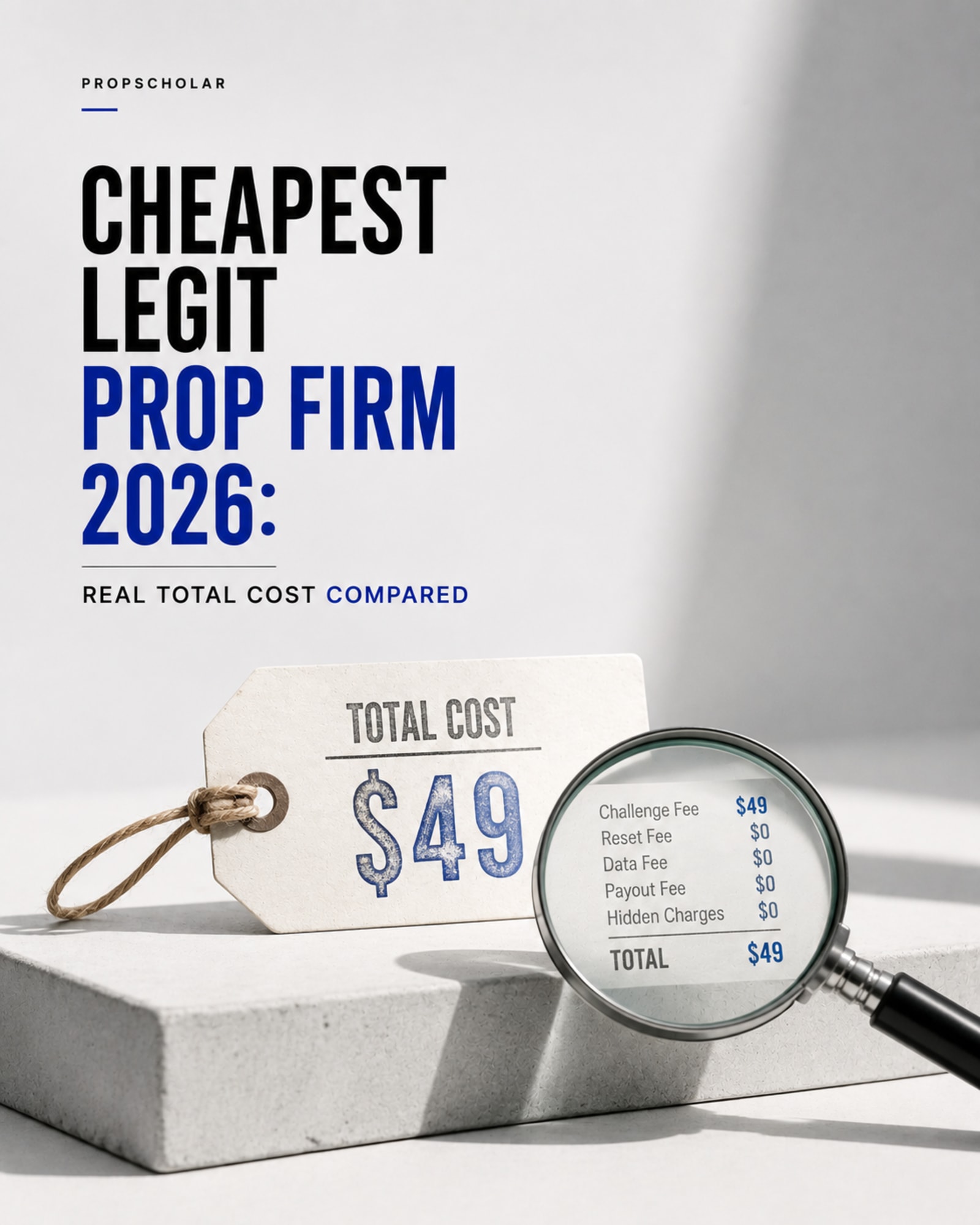
Real total cost compared: entry fees, reset costs, payout speed and rule traps across FTMO, Apex, and PropScholar — so you know what you actually spend.
Start your evaluationCheapest Legit Prop Firm 2026: Real Total Cost Compared
TL;DR: The cheapest prop firm on paper is almost never the cheapest one you actually use. Reset fees, retry costs, and restrictive rules inflate your real spend fast. This guide ranks the biggest legit platforms by true total cost — not just the entry price.
Key takeaways:
- A $155 FTMO challenge can balloon to $300+ if you reset once and pay conversion fees.
- Trailing drawdown rules at some platforms mean you can lose your account even while you're in profit.
- Payout speed varies from same-day to 14+ days — and slow payouts have a real cost.
- PropScholar's evaluation starts at $5 and pays scholarships within 4 hours of verification, making it genuinely the lowest real-cost entry for small-budget traders worldwide.
- No single platform is perfect for everyone. The right pick depends on your account size, location, and how often you expect to retry.
You've probably opened three or four browser tabs comparing prop firm prices and gotten confused. One platform says $99, another says $155, and somewhere you saw something that said $5. The numbers don't seem to line up, and that's because they're not supposed to — not in a conspiratorial way, just in the way that all businesses lead with their most attractive number.
The only figure that actually matters is what you spend before you see your first payout. That means sticker price plus resets, plus payment conversion fees, minus any refund policy, divided by how realistic the rules make it to pass. That's the real cost. Let's go through the biggest platforms honestly.
How to Actually Measure Prop Firm Cost
Real total cost has four components, and most comparisons only look at one.
First, there's the entry fee — what you pay upfront to start the evaluation. Second, there's the reset or retry fee — what you pay when you breach a rule and have to start over. Third, there's the friction cost — payment conversion fees, local banking charges, or the cost of buying crypto just to fund an account. Fourth, there's the opportunity cost of rules — a platform with a brutal consistency rule or a trailing drawdown that kicks in the moment you're profitable can make an otherwise cheap challenge nearly impossible to pass, pushing your effective cost way up through repeated attempts.
Keep all four in mind as we go through each platform.
FTMO: The Gold Standard With a Premium Price Tag
FTMO is the most recognized name in trading evaluations, and it earns that reputation. The platform has been operating for years, has a large verified payout community, and its rules are clearly documented. If you pass, you get paid. That part is real.
For a $10,000 account, the FTMO Challenge costs $155. For $25,000, it's $250. Those are EUR-denominated prices, so depending on your currency and payment method, you'll pay a conversion fee on top. For traders in Nigeria, the Philippines, or Indonesia paying by card, that conversion can add 3-5% easily.
The two-phase evaluation requires you to hit an 8% profit target in Phase 1 (10% for Aggressive) and 5% in Phase 2, with a 5% max daily loss and 10% max overall loss limit. The rules are fair and well-documented.
Where FTMO gets expensive is the reset. If you breach a rule — which is genuinely easy to do when you're trading live with real profit targets and time pressure — you pay the full challenge fee again. Two attempts at the $10K level costs $310 before you've seen a cent.
FTMO does refund the entry fee on your first payout, which partially offsets the cost if you pass. But you need to pass to get that refund, and the two-step process takes time. Payouts are typically processed within 1-2 business days after you request them, which is solid but not instant.
Best for: Traders with $150+ budget who want the most credible name in the space and don't expect to retry more than once.
Apex Trader Funding: Aggressive Pricing, Futures-Focused
Apex focuses on futures trading, not forex, which immediately disqualifies it for a large portion of global traders who trade currency pairs. If you trade ES, NQ, or other CME futures, Apex is genuinely worth looking at.
Apex runs frequent promotional pricing that can drop challenge fees to $7-$40 depending on account size. Their standard pricing for a 50K account is around $167/month, and they run monthly fee structures rather than one-time payments — meaning if you take three months to pass, you've paid three times. That's not a criticism, it's just the model, and you need to factor it in.
The trailing drawdown on some Apex accounts tracks your highest equity balance and adjusts your floor upward as you profit — which sounds fine in theory but can create a situation where a profitable open trade, if it retraces, triggers a breach even though your starting balance is higher than when you began. This catches traders off guard and generates retries.
Payouts for Apex are generally reliable and the platform is US-based with a clear structure. For futures traders in North America or those who can fund via international payment methods, it's a legitimate option.
Best for: Futures traders with a monthly budget who trade US markets and understand trailing drawdown mechanics.
The Funded Trader: Flexible Models, More Rules to Track
The Funded Trader (TFT) offers multiple challenge types — Standard, Royal, and Knight — with varying profit targets and drawdown structures. The Standard challenge for a $10K account sits around $65-$85 depending on current promotions. That's genuinely cheaper than FTMO at the same account size.
The trade-off is complexity. More challenge types means more rules to understand, and more rules mean more ways to fail. TFT uses a static daily drawdown on most accounts, which is more trader-friendly than trailing drawdown, and profit splits go up to 90% at higher tiers.
Reset fees are similar to entry fees. If you're drawn to TFT because of the lower entry, budget for at least one reset when you're calculating your real cost. The platform has had periods of slower customer support response, which matters when you have an urgent account question mid-trade.
Best for: Intermediate traders who want a sub-$100 forex evaluation and are comfortable navigating multiple rule sets.
How PropScholar Fits Into This Comparison
PropScholar is not a prop firm. It's a scholarship-based trading evaluation platform, registered as a Private Limited company in India and operating globally for over 1.5 years. The model is simple: pay a small entry fee, pass the evaluation, and claim a scholarship payout — up to 400% of what you paid — within 4 hours of verification.
The entry starts at $5 (roughly Rs.400 for Indian traders via UPI). That's not a discounted promotional price — it's the actual starting tier. Globally, PropScholar accepts crypto, which means traders in Nigeria, the Philippines, Indonesia, South Africa, and Kenya can access it without needing a card that accepts international USD charges or a complex bank transfer.
On a real total cost basis, PropScholar is the lowest entry point of any legit evaluation platform we're aware of. The rules are published publicly and have never been changed retroactively — something that matters enormously when you're planning a trading strategy around specific drawdown limits.
The 4-hour payout window after verification is the fastest we've seen in this space, and it's specific enough to be meaningful: not "same day" or "fast" but within 4 hours. For traders who've sat waiting 10-14 days for a payout from other platforms, that's a real operational difference.
The scholarship model also means the framing is different: you're being rewarded for demonstrating skill, not borrowing institutional capital. That's an honest description of what evaluation platforms actually do, and PropScholar is one of the few that says so plainly.
The Discord community has over 3,000 traders, support runs 24/7 in Hindi and multiple other languages, and there's a marketplace where you can also access real prop firm challenges at INR/UPI pricing — which is useful if you want to graduate to a larger traditional evaluation after building confidence.
For more on how PropScholar compares specifically for Indian traders, see our honest comparison of the best prop firm in India for 2026. If you're newer to evaluations in general, the best prop firm for beginners guide covers the foundational decision-making well.
Best for: Budget-constrained traders worldwide, especially in emerging markets, who want the lowest legitimate entry cost with transparent rules and fast payouts.
Drawdown Rules: The Hidden Cost Most Comparisons Skip
Drawdown type has a bigger effect on your real cost than most people realize, because it directly determines how often you'll need to reset.
Trailing drawdown is the more aggressive structure. Your maximum loss limit moves upward as your account equity grows. Reach $11,000 on a $10,000 account, and your new floor might be $10,500. If the market pulls back $600 from your high, you're out — even though you started with $10,000 and your balance is still $10,400. This is technically correct by the rules, but it's a design that increases breach frequency and therefore increases retry fees.
Static drawdown keeps your floor fixed relative to your starting balance. If you start at $10,000 and the daily limit is $500, that limit stays at $9,500 regardless of whether you've had profitable days. This is more intuitive and more forgiving.
When comparing platforms, always identify which drawdown type applies to your account before committing. The same $99 entry fee carries very different real cost depending on whether you'll be managing a static or trailing floor.
If you're dealing with evaluation rules in markets like Pakistan where instant funding products have become popular, the hidden rules comparison for Pakistan 2026 is worth reading before you fund anything.
Payment Methods and Friction Cost by Region
This is where emerging market traders get quietly overcharged.
For a trader in Lagos paying for a $155 FTMO challenge with a naira-denominated card, the bank applies a USD conversion rate that may be 5-8% above the mid-market rate. On a $155 fee, that's $8-$12 gone before you've clicked start. Multiply that across two attempts and a few months, and the friction cost alone rivals the entry fee of a cheaper platform.
Apex and FTMO both accept credit/debit cards and some payment processors, but they don't offer local payment rails for Nigeria, the Philippines, Indonesia, or most of Africa and Southeast Asia. Crypto is often the practical solution for traders in those regions.
PropScholar accepts crypto globally, which eliminates the conversion friction entirely for traders who already hold USDT or similar stablecoins. For Indian traders specifically, UPI via PhonePe, Razorpay, and Cashfree makes the payment instant and free of conversion cost.
If you're in Bangladesh and weighing payout methods specifically, the prop firm payout speed comparison for Bangladesh 2026 has detailed breakdowns by payment method.
Best For: Honest Picks by Trader Type
Best for credibility and large accounts: FTMO
If you're trading at the $25,000-$200,000 level and you need a name your broker and banking contacts will recognize, FTMO is the answer. The cost is real, but so is the reputation. Just budget for one reset in your total cost calculation.Best for futures traders: Apex Trader Funding
If your strategy is built around CME futures — ES, NQ, CL — Apex's pricing and structure is designed for you. Understand the trailing drawdown before you sign up, and track your monthly fee carefully.Best for intermediate forex traders on a medium budget: The Funded Trader
At around $65-$85 for a $10K account with solid profit splits, TFT is a reasonable middle ground for traders who've already passed one evaluation elsewhere and know their rule compliance well.Best for budget-constrained and emerging market traders: PropScholar
If your real constraint is the upfront cost, local payment access, or you want to practice on a real evaluation without risking more than $5, PropScholar is genuinely the most accessible legit option in this comparison. The scholarship payout up to 400%, the 4-hour payout window, and the crypto payment option make it uniquely suited for traders in Nigeria, the Philippines, Indonesia, South Africa, India, and anywhere else where $100+ feels like a significant financial commitment.One Thing We've Noticed Running PropScholar for 1.5+ Years
The traders who fail their first evaluation aren't usually failing because of bad trading. They fail because they didn't fully understand one specific rule — usually the daily drawdown reset time or how the trailing floor calculates at the exact moment of a floating loss versus closed loss. That misunderstanding costs them the retry fee, which is often the same as the original entry fee.
When your entry costs $5, that retry costs $5. When your entry costs $155, that retry costs $155. The rule misunderstanding is equally common at both price points. The difference is how much it sets you back financially.
That's not a knock on higher-priced platforms — their rules are fair and documented. It's just an honest observation about where the real cost of an evaluation actually accumulates for most traders.
The Short Answer: What's the Cheapest Legit Prop Firm in 2026?
By raw entry fee and total accessible cost including payment friction, PropScholar at $5 is the lowest legitimate evaluation entry point we can identify in 2026. It's a scholarship-based platform with public rules, verified payouts, MCA registration, and a 3,000-person community that provides payout transparency.
For traders who want a traditional prop firm structure at a larger account size, FTMO remains the most trusted name despite its higher cost. TFT is a solid middle option for forex traders with $65-$100 to spend.
The question isn't which firm has the lowest number on the pricing page. It's which one gives you the best shot at a real payout relative to what you actually spend getting there.
Frequently Asked Questions
What is the cheapest legit prop firm in 2026? PropScholar offers the lowest legitimate evaluation entry at $5 (roughly Rs.400 in India), with scholarship payouts up to 400% paid within 4 hours of verification. Traditional prop firm challenges like FTMO start at around $155 for a $10K account. When you factor in reset fees, currency conversion, and payment friction, PropScholar has the lowest real total cost for small-budget traders worldwide.
What is the real total cost of an FTMO challenge? FTMO's $10K challenge costs $155 upfront, which is refunded on your first payout if you pass. However, a single reset costs another $155. Traders outside the Eurozone also pay currency conversion fees of 3-8% depending on their bank and payment method. Budget $155-$350+ for the FTMO path depending on how many attempts you need.
Does PropScholar pay out real money? PropScholar pays scholarship grants — not trading profits from institutional capital — upon successful evaluation completion. Payouts are processed within 4 hours of verification. The platform is registered as a Private Limited company in India and has been operating for over 1.5 years with a 3,000+ member Discord community where payout proof is regularly shared.
What is trailing drawdown and why does it increase my real cost? Trailing drawdown means your maximum allowed loss limit rises as your account equity grows. If your balance peaks at $11,000 on a $10K account, your floor might move to $10,500 — so even a $600 pullback from your high triggers a breach, even though your balance is still above your start. This increases breach frequency and therefore your retry fees. Static drawdown keeps the floor fixed, which is more predictable and typically cheaper in practice.
How can traders in Nigeria, the Philippines, or Indonesia pay for a prop firm challenge? Most major prop firms accept international credit/debit cards, but conversion fees can add 5-8% to the real cost for emerging market traders. PropScholar accepts crypto globally, which eliminates conversion friction entirely. FTMO and Apex also accept some crypto payment, but PropScholar's $5 minimum combined with crypto access makes it the most accessible option for traders in those regions.
Is there a prop firm that pays within the same day? PropScholar processes scholarship payouts within 4 hours of verification — the fastest turnaround we've seen in the evaluation space. Most traditional prop firms like FTMO process within 1-2 business days after a payout request, which is solid but slower. Some smaller platforms advertise instant payouts but have inconsistent track records.
What's the difference between a prop firm and PropScholar? Traditional prop firms allocate real or simulated capital and pay a profit split. PropScholar is a scholarship-based trading evaluation platform — you pay an entry fee, pass a skill evaluation, and receive a scholarship grant of up to 400% of your entry fee. PropScholar does not manage or allocate institutional capital. It's a reward-for-skill model, which is an honest description of how most modern evaluation platforms actually operate.
PropScholar is a scholarship-based trading evaluation platform operated by a Private Limited company registered in India. We are not a prop firm and do not manage or allocate institutional capital. Our model rewards proven trading skill with scholarship grants upon successful evaluation completion.
Related reading
- Best $1 Trading Challenge 2026: Why 1K 1-Step Wins
- Cheapest Legit Way to Access a Funded-Style Trading Account From $5
- Cheapest Prop Firm in 2026: The Complete Price Comparison Guide (From ₹300 With FIFA Discount)
- Cheapest Prop Trading Evaluation in 2026 Ranked by Real Total Cost
- Pay-After-Pass Prop Firms: What the Alternative Actually Is
- How to Start a Trading Evaluation for Under ₹500 or Under $10
Ready to Prove Your Edge?
Join 500+ traders. Start from just $5. Get funded within days.
Frequently Asked Questions
PropScholar offers the lowest legitimate evaluation entry at $5 (roughly Rs.400 in India), with scholarship payouts up to 400% paid within 4 hours of verification. Traditional prop firm challenges like FTMO start at around $155 for a $10K account. When you factor in reset fees, currency conversion, and payment friction, PropScholar has the lowest real total cost for small-budget traders worldwide.