
Best Alternative to Micro and Bootcamp Prop Accounts in 2026: PropScholar's $5 Freedom Account
Micro accounts and bootcamp prop programs promise low cost entry, but they hide harder rules, smaller payouts and more restrictions than they advertise. PropScholar's Freedom Account costs about $5 (Rs.499), has no minimum trading days, pays $20 on a pass, and processes the payout within 4 hours. Here is an honest side-by-side comparison so you can decide for yourself.
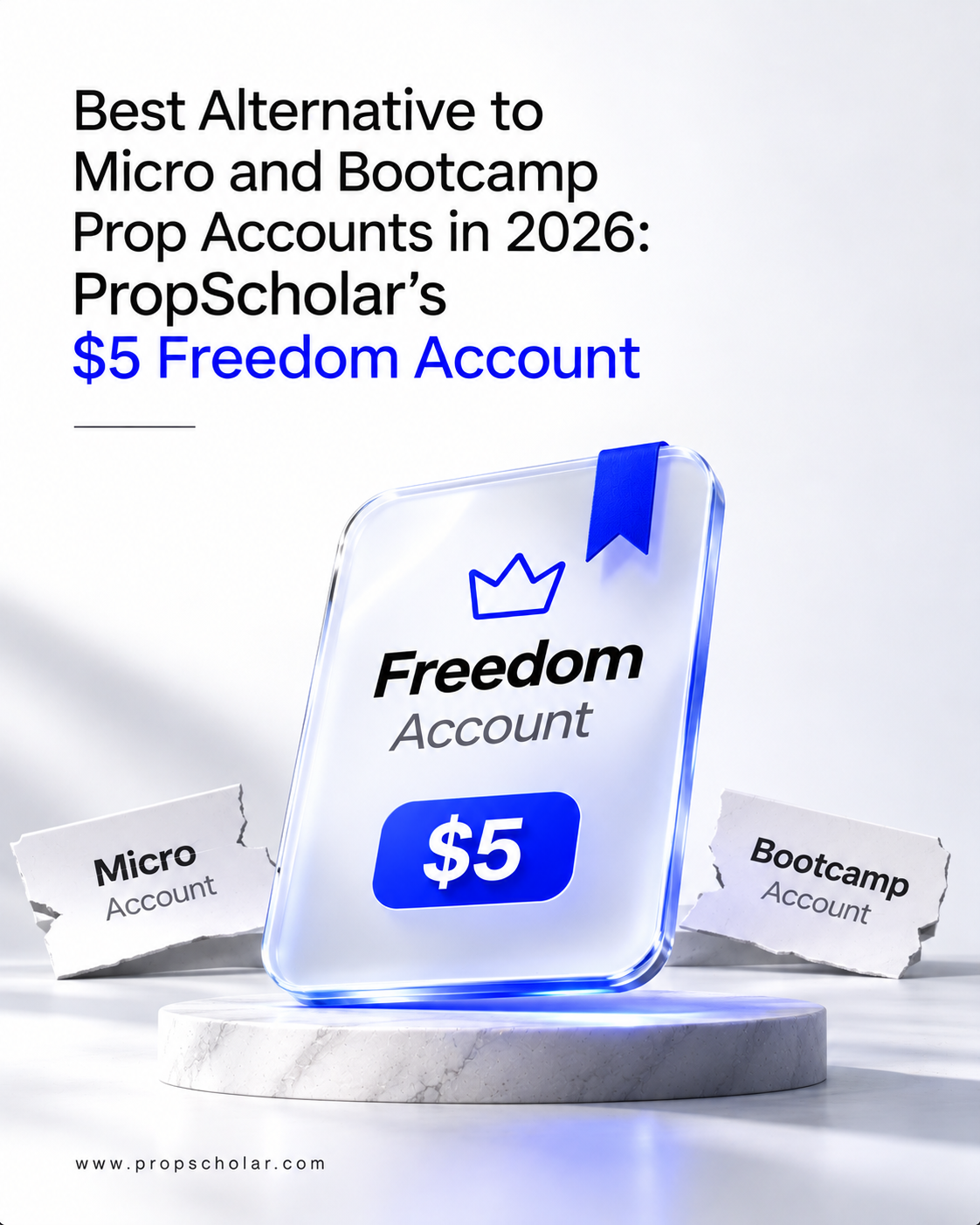
Micro accounts and bootcamp prop programs promise low cost entry, but they hide harder rules, smaller payouts and more restrictions than they advertise. PropScholar's Freedom Account costs about $5 (Rs.499), has no minimum trading days, pays $20 on a pass, and processes the payout within 4 hours. Here is an honest side-by-side comparison so you can decide for yourself.
Start your evaluationBest Alternative to Micro and Bootcamp Prop Accounts in 2026: PropScholar's $5 Freedom Account
TL;DR: PropScholar's Freedom 5K costs about $5 (Rs.499), has no minimum trading days so you can pass it in a single session, pays $20 directly to you within 4 hours of passing, and every payout is publicly listed at public payout proofs. It is the most honest low-cost evaluation on the market right now.
Key takeaways:
- Micro and bootcamp prop programs lower the entry fee by tightening the rules, not by being more trader-friendly.
- PropScholar is a scholarship-based evaluation platform, not a prop firm. You pay a small one-time fee, pass a demo evaluation, and receive a direct payout.
- The Freedom 5K is the entry point: $5 / Rs.499, 10% target, no minimum trading days, payout within 4 hours.
- Freedom has real restrictions you should know before you buy: 6% max loss, 3% daily loss, lot limits per asset class, and no news trading.
- You can hold positions over the weekend and buy as many Freedom accounts as you want.
If you have spent any time searching for a cheap way into funded trading in 2026, you have probably run into three categories of product: micro accounts (tiny funded balances, usually under $5,000), bootcamp programs (phased coaching plus evaluation rolled together), and low-cost diagnostic challenges that claim to be the affordable on-ramp the industry was missing. They all pitch the same thing: big names, small fees, real capital.
The problem is that the fees are small because something else is expensive. The profit target is steeper. The daily loss rule is tighter. The minimum trading days stretch the evaluation out for weeks. Or the payout after passing comes with conditions nobody mentioned on the sales page.
PropScholar's approach is different, and I want to show you exactly why, with real numbers you can check.
What micro and bootcamp accounts actually offer in 2026
Micro funded accounts and bootcamp programs have a genuine use case: they let a beginner enter the market at a price that does not destroy a month's savings. That is a real benefit and worth acknowledging. Where they fall short is in what the low price buys you.
A program that charges $10 to $30 for a micro evaluation is not doing that out of generosity. The economics require a specific trade-off, and it usually shows up in one or more of these places:
Higher profit targets. If the standard industry target is 8 to 10 percent, a micro program may push that to 12 or 15 percent to keep the failure rate high enough that the fee income covers payouts.
More restrictive drawdown rules. A 2 or 3 percent daily loss limit on a small account punishes normal volatility. A single bad morning can end the evaluation before you have had a chance to recover.
Mandatory minimum trading days. Some programs require 10, 15 or even 20 trading days to count a pass. If you hit the profit target in 5 days, you still wait. That is not a skill filter. It is a time filter.
Coaching or bootcamp attachments. Some products bundle a structured course into the fee. That is fine if the course is genuinely useful, but if passing the evaluation also depends on completing the course in a set sequence, you are paying for a schedule, not a skill test.
None of this makes those programs scams. It makes them a specific product with specific trade-offs. The question is whether those trade-offs suit you, and for most beginners I talk to in our Discord community, they do not.
Why demo accounts and free trials do not solve the problem
The most common advice a new trader gets is to practice on a demo account first. It is not wrong advice. But a demo account with no evaluation attached and no money at stake tells you almost nothing about how you actually trade under pressure. You will hold losing positions longer than you should because there is no real consequence. You will risk more than you mean to because the loss is not real. The psychological feedback loop that makes trading hard simply does not exist.
Free trials offered by some programs are demo-only too. They give you a taste of the platform and the rules, but you are not being evaluated in a meaningful way, and there is nothing on the other side of the pass.
Monthly trading competitions are the same story told differently. The winners are almost always traders who swung for extreme returns, not beginners trading sensibly with controlled risk. Winning a competition by posting a 40 percent month does not mean you can trade consistently. It usually means you got lucky once.
The honest answer for a beginner who wants to prove skill and receive a tangible reward for it is an evaluation with real stakes, a transparent ruleset, and a payout that is processed quickly and publicly verifiable.
That is what PropScholar's Freedom Account is built to be.
How the Freedom Account actually works
PropScholar is a scholarship-based trading evaluation platform, not a prop firm. The distinction matters. You are not being allocated real institutional capital. You pay a one-time entry fee, trade a demo evaluation, and when you pass, PropScholar pays you a scholarship grant directly, processed within 4 hours of your request.
The Freedom Account is PropScholar's own one-step evaluation. Here is the full structure:
The profit target and loss rules
The target is 10 percent of the starting account balance. On the Freedom 5K that means reaching $5,500 on a $5,000 demo account. The maximum loss is 6 percent of the initial account, which is $300 on the 5K. The daily loss limit is 3 percent of the higher of your starting equity or current balance, calculated fresh each day.
Those numbers are tighter than some programs and looser than others. I will not pretend otherwise. The daily loss rule in particular means a 3 percent down day ends your evaluation, so position sizing matters from session one.
No minimum trading days
This is the rule that genuinely separates Freedom from most micro and bootcamp alternatives. There is no minimum. If your strategy hits 10 percent profit on day one, you pass on day one. The fastest recorded pass at PropScholar is 2 hours. That is not a marketing figure: it reflects traders who ran a controlled, high-conviction setup and hit the target cleanly.
Most micro programs cannot say this. Minimum day requirements are a deliberate friction mechanism, and Freedom does not have one.
Weekend holding and inactivity
You can hold positions over the weekend. That flexibility matters for swing traders who do not want to be forced out of a good trade just because Friday's close is approaching. The one rule on the other end is a 14-day inactivity window: if you go 14 calendar days without placing a trade, the account closes. That is a reasonable rule. Just trade.
Lot limits: the real restriction
Freedom does have lot limits, and I want to be clear about them because some platforms bury this. These are limits on maximum concurrent open lots per asset class, not cumulative position counts. On the Freedom 10K as a reference point: 4.00 lots for forex, 0.40 for gold, 1.00 for silver, 0.20 for BTCUSD, 1.00 for ETHUSD, 2.00 for other crypto, 0.50 for NAS100, 0.30 for US30, 0.75 for US500, and 0.50 for other indices. Each asset class is independent. You cannot borrow headroom from one class to top up another.
On the Freedom 5K the limits scale down proportionally. If your strategy runs large gold positions, plan around the 0.40 limit on the 10K and adjust down from there on the 5K. Most beginners trading at sensible risk per trade will not hit these ceilings in normal conditions.
No news trading
You cannot open or close positions from 10 minutes before to 10 minutes after a high-impact news event. This includes stop-loss or take-profit closes triggered in that window. Breaching the news rule ends the account. This is a firm line, not a soft guideline.
If your entire edge depends on trading the NFP spike or the Fed announcement in real time, Freedom is not the right product for you. If you trade technically or hold positions through news rather than targeting the spike itself, you will be fine.
The Freedom Account ladder from $5 to $50
The entry point is the Freedom 5K at roughly $5 (Rs.499 for Indian traders paying by UPI, USDT or PayPal for everyone else). That pays a $20 scholarship on a pass.
The full ladder:
Freedom 5K
Entry: about $5 / Rs.499. Pass pays $20. Demo account size: $5,000.Freedom 10K
Entry: about $10 / Rs.999. Pass pays $42. Demo account size: $10,000.Freedom 15K
Entry: about $15 / Rs.1,499. Pass pays $60. Demo account size: $15,000.Freedom 25K
Entry: about $25 / Rs.2,499. Pass pays $100. Demo account size: $25,000.Freedom 50K
Entry: about $50 / Rs.4,999. Pass pays $200. Demo account size: $50,000.There is no purchase limit. You can buy as many Freedom accounts as you want across any combination of sizes. Traders who run multiple accounts simultaneously use that flexibility to scale their scholarship income without needing to wait for a single evaluation to close before starting the next one. For a deeper look at how the payout model works, the blog on direct payout after passing a trading evaluation covers the mechanics clearly.
How PropScholar compares to common alternatives
PropScholar Freedom 5K vs a typical micro bootcamp program
A typical micro bootcamp might charge $15 to $30 for a structured evaluation with coaching modules attached. The profit target is often 12 percent or higher. Minimum trading days commonly run to 10 or 15. Payout timelines vary and are not always public. PropScholar's Freedom 5K costs less than any of those at about $5, targets 10 percent, has no minimum trading days, and processes the payout within 4 hours of your request. Every processed payout is publicly verifiable. The coaching is not bundled, which means you are not paying for something you may not need.
PropScholar Freedom 5K vs a low-cost diagnostic challenge
Diagnostic programs frame their evaluation as a personality assessment or trading style test rather than a funded account challenge. The appeal is psychological: it feels lower stakes. But if there is no payout attached to passing, the diagnostic framing is marketing, not a product feature. Freedom is explicit: pass the evaluation, receive $20 within 4 hours. That is a concrete outcome, not a certificate.
PropScholar Freedom 5K vs broker incubation programs
Broker incubation programs require you to deposit real money with the broker, usually a minimum of $100 or more, trade under their rules for a defined period, and qualify for a top-up of some kind. You are risking your own capital from day one. PropScholar's evaluation uses a demo account throughout. You do not risk trade capital, and the entry cost is the flat one-time fee.
For a broader look at what the micro and bootcamp model looks like across the industry in 2026, the post on prop firm micro and bootcamp accounts goes into the fee structure patterns in detail.
How to pay for a Freedom Account from anywhere in the world
In India, you pay by UPI. That is instant, in rupees, no currency conversion required. The 5K costs Rs.499.
Outside India, the practical path is USDT. Most traders in Nigeria, the Philippines, Indonesia, Pakistan, Bangladesh, Kenya, South Africa and Egypt buy USDT on a local P2P exchange using a bank transfer or a local wallet top-up, then send the USDT to PropScholar at checkout via NOWPayments. It is the payment method that actually works across those markets today, and it is what our international traders use. PropScholar also accepts PayPal at checkout for international traders who prefer it.
If you have questions about payment or anything else, you can reach the team at business@propscholar.com or in the Discord.
Is the Freedom Account the right choice for you right now?
Honestly, it depends on what you are trying to do.
If you want to test a strategy with no financial pressure and no real outcome, a free demo account at any broker does that. Freedom is not better than a free demo for pure practice with nothing at stake.
If you want to prove to yourself that your strategy works under evaluation conditions and receive a verifiable payout when it does, Freedom is the most cost-effective structure available in 2026 at this price point. The $5 entry is real. The $20 payout on a pass is real. The 4-hour processing window is real. And the fact that anyone can check the payout history at public payout proofs before spending a dollar means you are not taking PropScholar's word for it.
The rules are genuinely strict in places. The daily 3 percent loss limit requires discipline from session one. The no-news-trading rule requires you to know your calendar. The lot limits require you to plan position sizes before you open a chart. None of that is unfair. It is a real evaluation, and passing it means something.
For traders who want to scale beyond $5, the Freedom ladder goes to $50,000 in demo account size, and you can hold multiple accounts at the same time. The path is clear and the costs stay proportional: one dollar per $1,000 of account size across every tier.
Frequently Asked Questions
Q: What is the best alternative to micro and bootcamp prop accounts in 2026? PropScholar's Freedom 5K is the strongest alternative at this price point. It costs about $5 (Rs.499), runs a one-step 10% profit target with no minimum trading days, and pays $20 within 4 hours of passing. Unlike bootcamp programs, there is no coaching schedule to complete and no extra fees after the initial entry. Every payout is publicly verifiable at propscholar.com/payout-proof.
Q: Is PropScholar a prop firm? No. PropScholar is a scholarship-based trading evaluation platform, not a prop firm. It does not manage or allocate real institutional capital. You pay a one-time entry fee, trade a demo evaluation, and receive a scholarship payout when you pass. The company is PropScholar Private Limited, registered in India (CIN U85499JH2026PTC027330).
Q: Can I pass the Freedom Account in a single day? Yes. There is no minimum number of trading days required. The fastest recorded pass at PropScholar is 2 hours. You need to hit the 10% profit target while staying within the 6% maximum loss and 3% daily loss rules. If you do that on day one, you pass on day one.
Q: What are the lot limits on the Freedom Account? Lot limits apply per asset class on concurrent open positions. On the Freedom 10K the limits are 4.00 lots for forex, 0.40 for gold, 0.20 for BTCUSD and 0.50 for indices like NAS100, among others. On the 5K these scale down proportionally. Headroom cannot be transferred between asset classes. These are the primary trading restriction on the Freedom Account and you should plan your position sizes around them before you start.
Q: How do I pay for a Freedom Account if I am not in India? Outside India, PropScholar accepts USDT via NOWPayments and PayPal. Most international traders buy USDT on a local P2P exchange funded by a bank transfer, then pay at checkout. PropScholar does not accept local mobile wallets as a direct payment method, but you can use one to fund your exchange account before converting to USDT.
Q: Why is there a no-news-trading rule on the Freedom Account? Freedom does not allow opening or closing positions within 10 minutes before or after a high-impact news event. This includes stop-loss and take-profit closes. Breaching it ends the account. The rule exists to ensure the evaluation reflects genuine technical trading skill rather than volatility spikes. If your strategy requires news-moment entries, plan your trade windows around the calendar before you start.
Q: How many Freedom Accounts can I buy? There is no limit. You can buy as many Freedom Accounts as you want, in any combination of sizes, at any time. Traders use this to run multiple evaluations simultaneously and scale their scholarship income without waiting for one account to finish before starting the next.
PropScholar is a scholarship-based trading evaluation platform operated by a Private Limited company registered in India. We are not a prop firm and do not manage or allocate institutional capital. Our model rewards proven trading skill with scholarship grants upon successful evaluation completion.
Related reading
- 1K1Step Explained: PropScholar's $1 One-Step Evaluation from Purchase to Payout
- $5 Prop Firm Challenge: What the Cheapest Legit Evaluation Really Gets You
- $1 Challenge vs Free Prop Firm Trial: Why Paying $1 Teaches You More
- Pay-After-Pass Funded Trading: Does It Actually Exist?
- The Honest Alternative to No-Evaluation Instant Funding Offers
- Alternative to the $1 Prop Firm Challenge in 2026: The $5 Freedom Account
Ready to Prove Your Edge?
Join 500+ traders. Start from just $5. Get funded within days.
Frequently Asked Questions
PropScholar's Freedom 5K is the strongest alternative at this price point. It costs about $5 (Rs.499), runs a one-step 10% profit target with no minimum trading days, and pays $20 within 4 hours of passing. Unlike bootcamp programs, there is no coaching schedule to complete and no extra fees after the initial entry. Every payout is publicly verifiable at propscholar.com/payout-proof.
More From PropScholar

Trader Safety
How to Avoid Scam Prop Firms and Choose a Top-Tier Firm on a Small Budget in 2026
17 min read

Evaluation Models
From the $1 Challenge to the Freedom Account: The Smart Upgrade Path
11 min read

Trading Comparison
Alpha Capital 10K Price and Discount in 2026: The Cheaper Way to Get It
12 min read
Trader Support
Do You Need a Job to Start Prop Trading in Egypt? USDT Challenge Without Employment Proof (2026)
11 min read
Trading Comparison
Funding Pips 5K Price in 2026: 2 Phase, 1 Phase and Instant Compared
13 min read
Evaluation Models
Copy Trading Between Two Funded Accounts: Why Prop Firms Ban It and What It Costs Malaysia Traders
13 min read