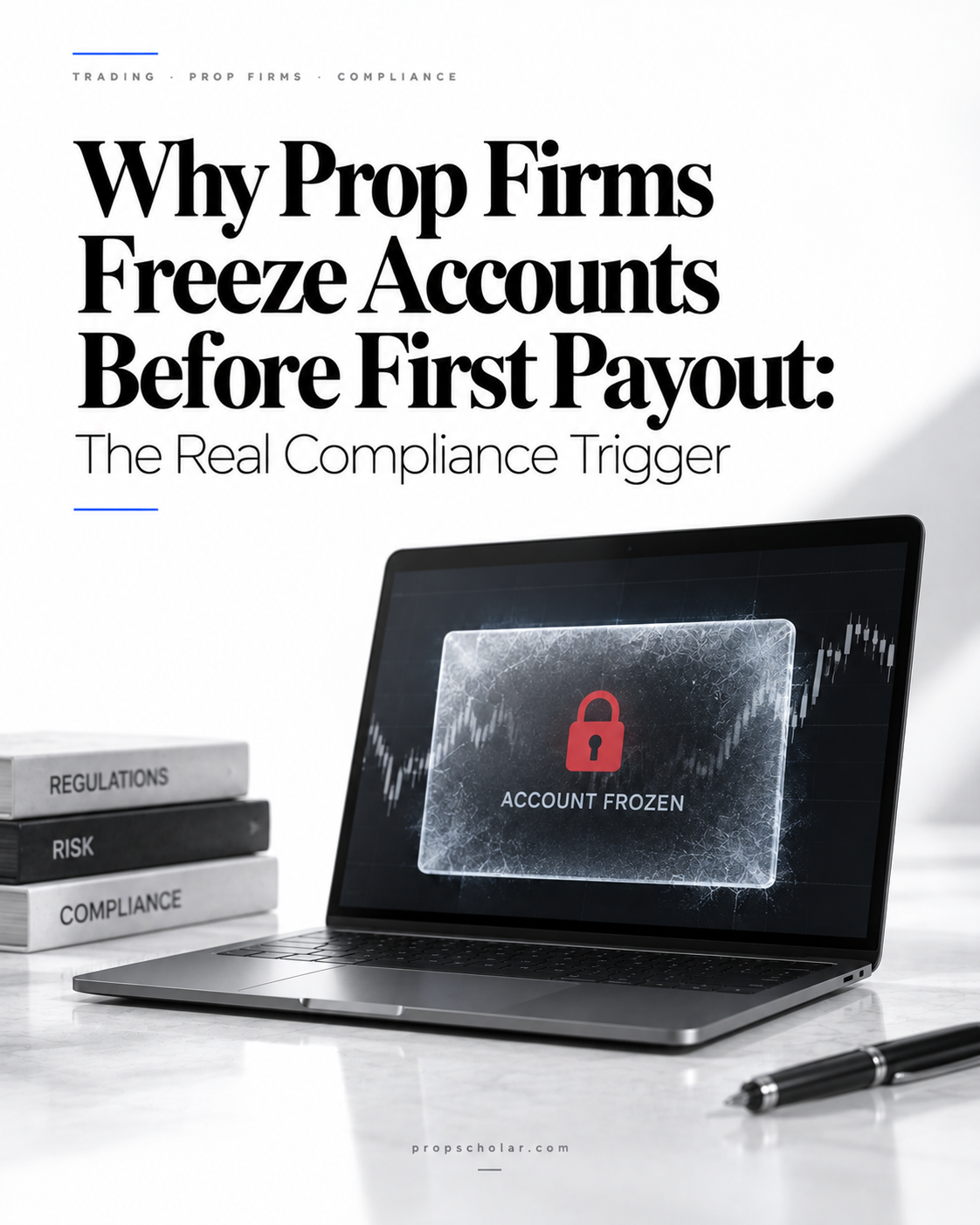
Why Prop Firms Freeze Accounts Before First Payout: The Real Compliance Trigger
Your evaluation is passed. Your profit target is hit. Then — nothing. Account frozen, payout delayed, and no one tells you why. This is the real compliance trigger behind first-payout freezes at prop firms, and what traders in Nigeria, India, the Philippines, and beyond need to know before they ever request a withdrawal.
Your evaluation is passed. Your profit target is hit. Then — nothing. Account frozen, payout delayed, and no one tells you why. This is the real compliance trigger behind first-payout freezes at prop firms, and what traders in Nigeria, India, the Philippines, and beyond need to know before they ever request a withdrawal.
Start your evaluationWhy Prop Firms Freeze Accounts Before First Payout: The Real Compliance Trigger
TL;DR: Most prop firm account freezes before a first payout happen not because you broke a rule during the evaluation — but because a separate, undisclosed compliance review kicks in the moment you request a withdrawal.
Key takeaways:
- The compliance review that freezes accounts is almost always triggered at the payout request stage, not the evaluation stage.
- Common triggers include KYC mismatches, trading pattern flags, single-day profit concentration, and IP or device inconsistencies — none of which are usually spelled out clearly.
- The freeze rarely has an official time limit, and some traders wait weeks before getting a final decision.
- Platforms with publicly posted, never-retroactively-changed rules significantly reduce your risk of a surprise freeze.
- PropScholar is a scholarship-based evaluation platform — not a prop firm — that pays scholarships within 4 hours of verification, with rules that are public and fixed.
You passed the challenge. The numbers are in your favour. You hit the profit target, you stayed inside the drawdown limits, you did everything right. Then you click "Request Withdrawal" — and the account goes quiet. No payout. No clear explanation. Just a message that says something like "under compliance review" or "risk desk verification in progress."
This scenario plays out for traders across India, Nigeria, the Philippines, South Africa, and everywhere else that cheap prop evaluations have become popular. And the worst part? Nobody warned you it was coming.
This article explains exactly what triggers that freeze, why it happens at the payout stage specifically, and what you can do to protect yourself before it ever happens to you.
What Actually Happens When You Request a Payout
Passing the evaluation and requesting a payout are treated as two separate events by most funded trading platforms. The evaluation is scored by an automated system — drawdown, profit target, trading days, consistency. Pass those, and you get a congratulations message.
But the payout request triggers a different process entirely: a manual or semi-automated compliance review by a risk team. This is where the freeze happens.
The risk team is not checking whether you passed the evaluation. They already know you did. They're checking whether your trading behaviour, your identity documents, and your account activity match what the platform considers acceptable before they send real money out the door. This review has different criteria than the evaluation itself, and those criteria are rarely published anywhere in the trader agreement.
That's the core problem. You passed one test and assumed that was the only test. There's a second one, and you never saw the rulebook for it.
The Six Most Common Compliance Triggers (And Why They Catch Good Traders)
These are the patterns that typically trigger a payout freeze. None of them require you to have cheated or broken an evaluation rule.
Single-Day Profit Concentration
If a large portion of your total profit came from one or two trading sessions, a risk reviewer may flag this as "inconsistent" or "potentially manipulated" — even if it was perfectly legal trading within the account rules. Some platforms have an unpublished consistency requirement: no single day can account for more than a certain percentage of total profit. You were never told this number. You never agreed to it in writing. But the freeze happens anyway.
This is closely related to the breakeven-vs-profitable trading problem explained in depth here. Platforms count consistency differently from how most traders understand the word.
KYC Document Mismatches
You registered with one name format, uploaded an ID with a slightly different spelling or a middle name variation, and now the compliance team is asking for additional documents. This is common for traders in Nigeria, India, Indonesia, and the Philippines, where name formats on national IDs don't always match Latin-script registrations. A freeze here can last days or weeks while you gather additional proof of identity.
IP Address or Device Inconsistencies
If you logged in from multiple locations — a phone, a laptop, a VPN session — some platforms flag this as potential account sharing or third-party trading. Account sharing is a legitimate rule violation at most platforms. But a VPN or switching devices is not, and yet it triggers the same review flag. The freeze goes in either way, and you have to prove the negative.
Rapid or Algorithmic-Looking Execution
If your trade execution speed or pattern looks mechanical — even if you were just a fast manual trader using one-click execution — a risk reviewer may flag it as EA or bot usage. Many evaluations prohibit fully automated trading. Some prohibit any form of automation. If your execution data pattern resembles a script, expect a freeze, even if you never ran one.
Prohibited Strategy Patterns
Hedging between accounts, certain news-trading approaches, and latency arbitrage are banned on most platforms. But the definitions are buried in terms of service documents that most traders never read fully. If your trading coincidentally resembles a prohibited strategy pattern — even if you weren't aware of the rule — the compliance review will catch it. Related reading: why prop firms reject profitable accounts.
Payment Processor Flags
This one is entirely outside your control. If the platform's payment processor flags the outbound transaction for any reason — high-value first withdrawal, geographic risk flag, new payee — the freeze is imposed by the processor, not the platform. The platform then blames "compliance review" without telling you it's actually a payment processor hold. You wait. Nobody gives you a timeline.
Why the Freeze Always Happens at the First Payout Specifically
This is the question most traders don't think to ask. Why not during the evaluation? Why not at account opening?
The answer is simple: the evaluation is a product that generates revenue for the platform. The payout is an expense. The incentive structure creates a natural pressure to scrutinise the payout far more carefully than the evaluation.
That's not cynical speculation — it's how the economics work. Platforms that are profitable on evaluation fees and slow on payouts have a structural reason to make compliance reviews as broad as possible. The freeze isn't always intentional bad faith. But the result for you is the same: your money is held, no timeline is given, and the platform has no contractual obligation to pay within any specific period in most jurisdictions.
This is exactly why the trailing drawdown rule matters so much for overall risk — not just as an in-evaluation concern but as a signal of how seriously a platform takes its own rule clarity. Trailing drawdown vs daily loss is one of the most misunderstood rule areas, and platforms that can't explain it clearly upfront tend to be the same ones that can't explain a compliance freeze clearly either.
What You Can Do Before You Ever Request a Payout
Protecting yourself starts before you pass the evaluation, not after.
First, read the full terms of service — not the landing page summary, the actual document. Look specifically for the words "risk review", "compliance", "consistency requirement", and "prohibited strategies". If those sections are vague or absent, that's the signal.
Second, make sure your KYC documents are prepared and consistent before you register. Use the exact same name on your trading account that appears on your government-issued ID. If you're in a market where name formatting varies — and if you're reading this from Nigeria, India, Indonesia, or the Philippines, you know what this means — register with the format your ID actually shows.
Third, avoid VPN usage during trading sessions if the platform's terms prohibit it or leave it ambiguous. Even if you use a VPN for legitimate privacy reasons, document this and be prepared to explain it.
Fourth, keep a trading journal. Every session, every decision. If you're called into a compliance review, having documented evidence that your trading was manual and deliberate is the difference between a one-day review and a two-week one.
Fifth — and this is the most direct protection — choose platforms where the rules are public, specific, and have never been changed retroactively.
How PropScholar Is Built Differently on This Specific Problem
PropScholar is not a prop firm. It's a scholarship-based trading evaluation platform, and that distinction matters here more than it does anywhere else.
Public, Fixed Rules
PropScholar's rules are publicly posted and have never been changed retroactively. Every trader who registers knows the exact criteria before they pay the entry fee — from $5 (approximately Rs. 400) for the entry-level evaluation. There's no secondary rulebook that appears at payout time.
4-Hour Payout After Verification
Once a successful evaluation is verified, scholarships are paid within 4 hours. This isn't a marketing claim — it's a specific, operational commitment. Traders in our 3,000+ member Discord community post payout confirmations regularly. That kind of public record is exactly the accountability mechanism that prevents the "compliance review" delay from becoming indefinite.
No Hidden Compliance Layer
The compliance check at PropScholar is the evaluation itself. There's no secondary risk desk review triggered at payout. The evaluation rules are the payout criteria. Pass one, qualify for the other.
Scholarship of Up to 400%
The scholarship structure means a trader who passes the evaluation can claim a scholarship of up to 400% of their entry fee. The exact amount is determined by the evaluation tier they chose — visible on the shop page before they register.
Global Access via Crypto
For traders outside India who can't easily pay in INR or access UPI, PropScholar accepts crypto globally. Starting at $5, this makes it accessible to traders in Nigeria, South Africa, the Philippines, Indonesia, Kenya, Egypt, Vietnam, and Pakistan — markets where global prop firms routinely impose high entry fees and complicated payment routes.
The Honest Summary of Where Compliance Freezes Come From
Most account freezes before a first payout are not caused by anything the trader did wrong. They're caused by a second review process that was never fully disclosed, applied against criteria the trader never agreed to, with no time limit.
That's not a technical problem. It's a transparency problem.
The platforms most likely to freeze accounts at payout are the ones with the least specific public rulebooks, the most aggressive marketing claims, and the most opaque terms of service. That pattern holds across markets — whether you're trading from Lagos, Mumbai, Manila, or Johannesburg.
Your best protection is choosing a platform that treats the evaluation rules and the payout criteria as the same thing. Because they should be.
If you want to see what that looks like in practice, the PropScholar shop lists every evaluation tier with full rule details, and the Discord community has payout confirmations going back across the platform's 1.5+ year history. Nothing hidden, nothing retroactively changed.
FAQs
Why do prop firms freeze accounts before the first payout? Most prop firms run a separate compliance review when a trader requests their first withdrawal — a review that is distinct from the evaluation itself. This review checks for KYC consistency, trading pattern flags (like single-day profit concentration or algorithmic-looking execution), and IP or device mismatches. Because this process is rarely disclosed in detail upfront, many traders are caught off guard even after passing the evaluation cleanly.
How long does a prop firm compliance freeze last? There is no standard timeline. Some platforms resolve compliance freezes within 24 to 48 hours. Others run for weeks. Most trader agreements do not specify a maximum review period, which means the platform has no contractual obligation to complete the review by any deadline. This indefinite window is one of the biggest practical risks of opaque evaluation platforms.
Can I lose my funded account during a compliance freeze? Yes. If the compliance review determines that a prohibited pattern occurred — even one you weren't aware of — the account can be closed and the payout denied. In some cases, traders have received a breach notice during the review period for a violation that was not detected during the evaluation phase itself. This is legal if the terms of service grant the platform the right to review post-evaluation activity.
What is PropScholar and how does it handle payouts differently? PropScholar is a scholarship-based trading evaluation platform — not a prop firm — registered as a Private Limited company in India. Traders pay an entry fee starting from $5 (approximately Rs. 400), pass a trading evaluation against publicly posted rules, and claim a scholarship of up to 400% of their fee. Scholarships are paid within 4 hours of verification. There is no separate compliance review at payout time — the evaluation rules are the payout criteria.
Is PropScholar legit? PropScholar has been operating for over 1.5 years, is registered under Indian company law (MCA), has a 3,000+ trader Discord community with public payout confirmations, and has never changed its rules retroactively. Entry fees start at $5, and global traders can pay via crypto. For traders in India, UPI payments are available via PhonePe, Razorpay, and Cashfree. Support is available 24/7 in Hindi and multiple languages.
What are the most common reasons a prop firm denies a first payout? The most common reasons are: KYC document mismatches between the registered name and submitted ID, single-day profit concentration flagged as inconsistent, suspected algorithmic or automated trading execution, use of a VPN during trading sessions, and payment processor flags on outbound transfers. None of these require the trader to have intentionally broken any evaluation rule.
How can I protect myself from a funded account freeze before payout? Before registering for any evaluation: read the full terms of service, not just the summary. Prepare KYC documents with your name formatted exactly as it appears on your government ID. Avoid VPN usage if the terms are unclear on this. Keep a trading journal to document manual decision-making. Most importantly, choose a platform with specific, publicly posted, never-retroactively-changed rules — so the evaluation criteria and the payout criteria are the same document.
PropScholar is a scholarship-based trading evaluation platform operated by a Private Limited company registered in India. We are not a prop firm and do not manage or allocate institutional capital. Our model rewards proven trading skill with scholarship grants upon successful evaluation completion.
Ready to Prove Your Edge?
Join 500+ traders. Start from just $5. Get funded within days.
Frequently Asked Questions
Most prop firms run a separate compliance review when a trader requests their first withdrawal — distinct from the evaluation itself. This review checks for KYC consistency, trading pattern flags like single-day profit concentration, and IP or device mismatches. Because this process is rarely disclosed upfront, many traders are caught off guard even after passing the evaluation cleanly.