
Pay-Per-Attempt Blowouts: Why Beginners Lose in 48 Hours
Pay-per-attempt models silently push beginners toward reckless trades. See how scholarship-based evaluations change the incentive structure from day one.
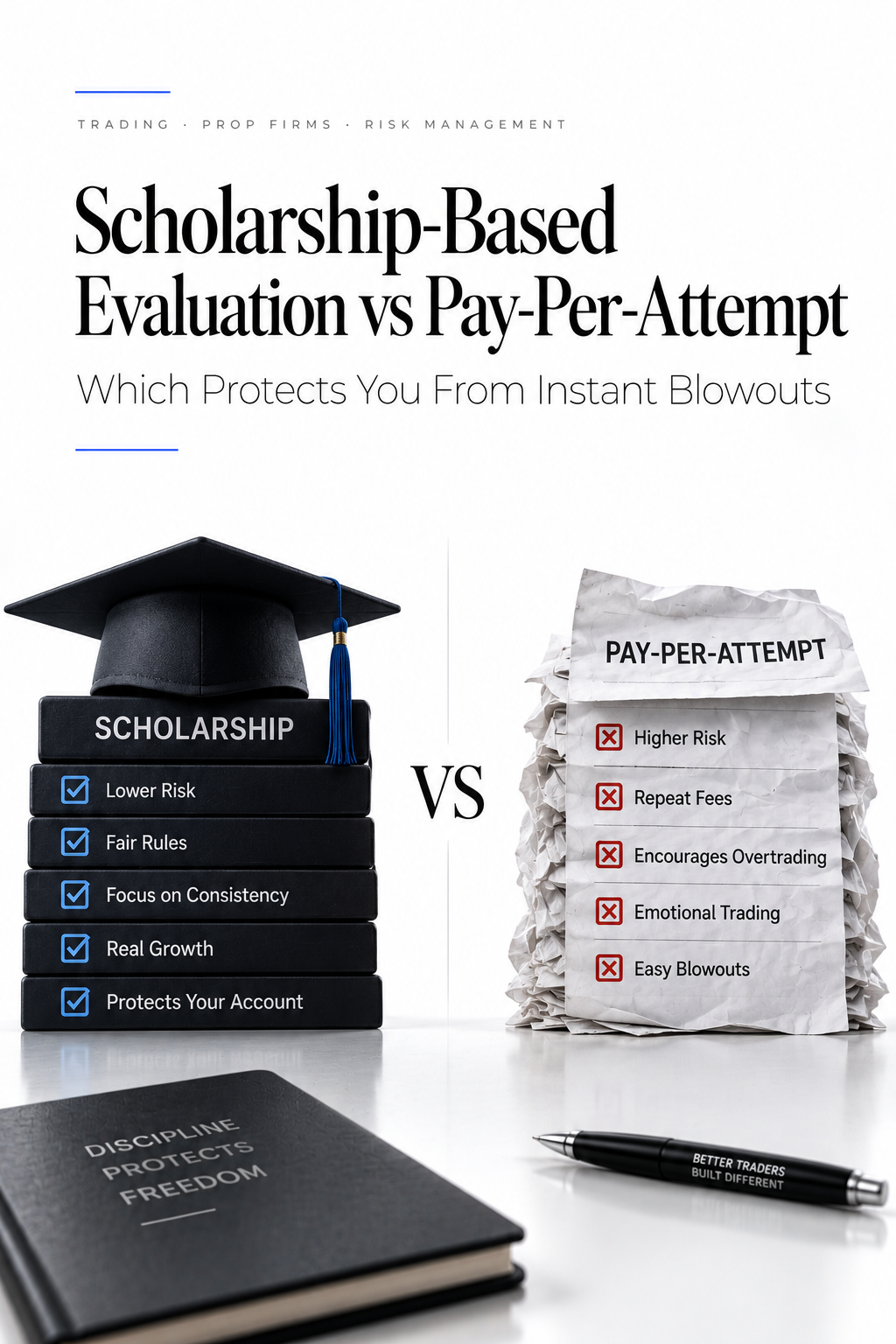
Pay-per-attempt models silently push beginners toward reckless trades. See how scholarship-based evaluations change the incentive structure from day one.
Start your evaluationScholarship-Based Evaluation vs Pay-Per-Attempt: Which Protects You From Instant Blowouts
TL;DR: Pay-per-attempt models let you blow your account and just buy back in — which sounds flexible but quietly encourages reckless trading. Scholarship-based evaluations link your financial reward to the quality of your process, not just your willingness to keep paying fees.
Key takeaways:
- Pay-per-attempt models charge you every time you fail, which can make reckless re-entries feel normal.
- Scholarship-based evaluations reward a consistent process, not just surviving one lucky run.
- The structure of an evaluation shapes the behavior of the trader inside it — this is not a small detail.
- PropScholar is a scholarship-based evaluation platform starting from $5 (around Rs.400), with scholarships up to 400% paid within 4 hours of verification.
- Which model protects you from instant blowouts depends less on the rules on paper and more on what each model incentivizes you to do under pressure.
You open a new funded account on a Sunday evening. By Tuesday morning it's gone. Not because you're a bad trader — because something about the setup made you take a trade you knew, somewhere in the back of your mind, you probably shouldn't have taken.
That experience is so common in funded trading communities that it barely gets commented on anymore. Traders just shrug, pay the next attempt fee, and go again. But the question worth asking is: did the model itself set you up for that blowout? Because how an evaluation is structured determines how you behave inside it. And most people evaluating prop platforms are comparing drawdown limits and profit targets when they should be comparing incentive structures.
That's what this article is actually about.
What pay-per-attempt actually means for your trading behavior
Pay-per-attempt is the dominant model in funded trading right now. You pay a fee — sometimes $150, sometimes $300, sometimes more — and you get one shot at passing an evaluation. If you blow the account, you pay again. Some platforms offer discounts on re-attempts, some don't. The sales angle is usually "it's affordable" or "unlimited retries."
Here's the problem that doesn't get talked about enough: when re-entry is always an option, the psychological cost of blowing an account drops. It should feel significant to lose a funded evaluation. If it just feels like buying another ticket, you're not being conditioned to protect capital — you're being conditioned to try again regardless of why you failed.
This is especially true for beginner traders in markets where $50 or $100 is a meaningful amount of money, but not catastrophically painful. The math becomes: "I'll try this aggressive trade. If it hits, I'm through. If it misses, I'll just re-attempt." That logic is not wrong exactly — but it's the logic of a gambler, not a trader. And the pay-per-attempt model does nothing to push back against it.
There's also a compounding cost problem. Attempt one: $150. Attempt two: $120 (discounted). Attempt three: $150 again because the discount expired. By the time a trader with genuinely decent skills finally passes, they've spent $400+ on entry fees alone. That's money that never comes back. The scholarship they eventually earn has to exceed that total before they've made a real profit from the whole exercise.
What scholarship-based evaluation actually changes
A scholarship-based evaluation is a different frame. You're not buying repeated access to an account — you're demonstrating a level of trading competence that earns a reward. PropScholar, for example, isn't structured as a prop firm at all. It's a scholarship-based evaluation platform where passing the evaluation means you've earned a scholarship grant of up to 400%, paid within 4 hours of verification.
That distinction matters more than it sounds. When the outcome is framed as something you earn rather than something you buy, it changes what you're optimizing for. You're not trying to survive one lucky run. You're trying to demonstrate a repeatable process. Those two goals produce different trading behaviors, especially when you're under pressure at 2% drawdown from the daily limit.
The entry cost at PropScholar starts at $5 globally — roughly Rs.400 in India, or the equivalent in Naira, Pesos, Rupiah, or whatever your local currency converts to. That low floor matters because it makes the evaluation genuinely accessible to traders in emerging markets without requiring them to wire $200 to a foreign platform. But it's not just about affordability. The model underneath the low fee is what actually protects your account behavior.
Why the structure of an evaluation determines blowout risk
Instant blowouts — accounts gone within 24 to 48 hours — almost always trace back to one of two things. Either the trader didn't understand the rules, or the trader understood the rules but made an emotional decision anyway.
Pay-per-attempt models don't address either of those causes. They process the payment and hand you another account. Scholarship-based models, when designed well, build the rule structure into the evaluation itself in a way that discourages the specific behaviors that cause instant blowouts.
The most common instant blowout trigger is a single oversized trade, usually taken in the first session. The trader is either excited, impatient, or trying to get ahead quickly so they can relax. An evaluation structure that has clear daily drawdown limits and publicly posted, unchanging rules creates a framework that, if you actually read it, makes it obvious why that trade will end your attempt.
PropScholar's rules are public and have never been changed retroactively. That's not a marketing line — it's a meaningful operational fact. When rules shift after you've started an evaluation, it creates uncertainty and sometimes paranoia that leads to worse trading decisions. When you know exactly where the boundaries are and you know they won't move, you can plan around them.
The hidden cost comparison: total spend, not entry fee
This is where a lot of beginners make a mistake. They compare evaluation platforms on the headline entry fee and call it a day. But the real number to compare is your expected total spend before you either pass or quit.
With a pay-per-attempt model at $150 per attempt, three failed attempts costs you $450 — before you've earned a cent. With a scholarship-based evaluation starting at $5, even multiple attempts cost a fraction of that. At PropScholar, the scholarship you can earn goes up to 400% of your evaluation fee. So if you paid $5 and earned a 400% scholarship, that's a $20 return before you've scaled to larger accounts. The percentage itself scales with the account size you're evaluating on.
The point isn't that one specific number is the magic answer. The point is that when you run the full math — entry fee, expected attempts before passing, scholarship or payout received — the scholarship model tends to produce a better net position for a beginner trader who is still learning, still making mistakes, and still needs the cost of failure to be survivable.
PropScholar's model: what the scholarship structure looks like in practice
PropScholar has been operating for over 1.5 years as a Private Limited company registered in India. It's not a prop firm. It does not manage or allocate institutional capital. What it does is evaluate trading skill and reward passing traders with scholarship grants.
The evaluation platform accepts payment via UPI in India (through PhonePe, Razorpay, and Cashfree) and via crypto globally — which means traders in Nigeria, the Philippines, Indonesia, Kenya, South Africa, Pakistan, Bangladesh, Egypt, Vietnam, and anywhere else with crypto access can participate without needing a foreign bank account or a wire transfer that costs more than the evaluation itself.
Support runs 24/7 in Hindi and multiple other languages. The Discord community has over 3,000 traders. Both of those things matter more than they might seem: when you're inside a live evaluation and you're not sure whether a specific trade setup violates a rule, being able to ask a human (or get an AI-assisted response) in your own language within minutes is the difference between a smart decision and a panic trade that blows your account.
PropScholar also operates a marketplace for real prop firm challenges at INR/UPI pricing, so if your goal is eventually to access institutional-style capital through a traditional prop firm, that pathway exists within the same ecosystem.
How the 400% scholarship actually works
The scholarship is calculated as a percentage of your evaluation fee and paid upon verification of a successful evaluation. The maximum scholarship is 400%. Payment happens within 4 hours of verification — not "within a few days" or "within the next payment cycle." That specificity is deliberate. It's one of the things that separates a platform with a real operational backend from one that promises payouts and delivers delays.
Why public, unchanging rules matter for blowout prevention
If a platform can change its rules after you've started an evaluation, you can never fully trust the environment you're trading in. That uncertainty leads to one of two bad outcomes: either you trade too conservatively and can't hit the profit target, or you trade aggressively to "get it done before anything changes" and blow the account.
Rules that are fixed in advance, publicly visible, and never retroactively altered let you treat the evaluation like a real trading environment with known parameters. That's the mental state that produces good trading decisions. And good trading decisions are the only real protection against instant blowouts.
Which model is right for you — the honest answer
If you've already passed funded evaluations before and you know your process is solid, the model matters less. You'll pass a pay-per-attempt evaluation and move on.
If you're still developing as a trader — if you've blown evaluations before, if you trade emotionally under pressure, if you're in a market where $150 in evaluation fees actually hurts — the scholarship-based model is structurally better for you. Not because it's easier. Because it's cheaper to fail, it rewards the right behavior, and the total cost of your learning journey is lower.
The platforms you should be cautious about are the ones that make re-attempts feel frictionless and cheap without actually teaching you why you failed. Unlimited retries sound generous. But unlimited retries without a feedback mechanism that changes your behavior is just a subscription to losing money slowly.
PropScholar's model — a real evaluation, real rules, a scholarship reward for passing, and a community of 3,000+ traders where you can see actual payout proof — is built around a different assumption: that you're trying to become a better trader, not just trying to get lucky once.
That's the assumption worth betting on.
Frequently Asked Questions
What is a scholarship-based trading evaluation? A scholarship-based trading evaluation is a model where you pay an entry fee, complete a trading evaluation under defined rules, and receive a scholarship grant if you pass — rather than being paid a salary or profit split from a managed account. PropScholar is a scholarship-based evaluation platform starting from $5, offering scholarships up to 400% of the entry fee, paid within 4 hours of verification.
How does pay-per-attempt prop evaluation work? In a pay-per-attempt model, you pay a fee each time you attempt an evaluation. If you fail, you pay again for the next attempt. Some platforms offer discounts on re-attempts. The key issue for beginners is that the cumulative cost of multiple failed attempts can quickly exceed the value of any scholarship or payout received, especially when the root cause of failure isn't addressed between attempts.
Why do instant blowouts happen in funded trading evaluations? Instant blowouts — accounts lost within the first 24 to 72 hours — almost always result from oversized trades, emotional entries in the first session, or misunderstanding the daily drawdown rules. Evaluation structures with clear, publicly fixed rules reduce the uncertainty that triggers panic trading. PropScholar's rules are public and have never been changed retroactively, which gives traders a stable framework to plan around.
Is PropScholar a prop firm? No. PropScholar is a scholarship-based trading evaluation platform, not a prop firm. It does not manage or allocate institutional capital. It evaluates trading skill and rewards successful traders with scholarship grants. It's registered as a Private Limited company in India and has been operating for over 1.5 years.
How does PropScholar accept payments from traders outside India? PropScholar accepts crypto payments globally, which means traders in Nigeria, the Philippines, Indonesia, Kenya, South Africa, Pakistan, Bangladesh, Egypt, Vietnam, and other markets can participate without needing a foreign bank account. In India, UPI payments are supported via PhonePe, Razorpay, and Cashfree. Entry fees start from $5.
What is the maximum scholarship available at PropScholar? The maximum scholarship available through PropScholar's evaluation is 400% of the entry fee paid. Scholarships are paid within 4 hours of successful evaluation verification. The exact amount scales with the evaluation tier chosen at the time of entry.
Can a beginner trader realistically pass a scholarship-based evaluation? Yes, but the key word is realistically — meaning with proper preparation, an understanding of the specific drawdown and profit target rules, and the discipline to stick to a defined trading plan. The scholarship model is actually more forgiving for beginners in terms of total cost, because entry fees start at $5 and the incentive structure rewards consistency rather than just a single lucky run.
PropScholar is a scholarship-based trading evaluation platform operated by a Private Limited company registered in India. We are not a prop firm and do not manage or allocate institutional capital. Our model rewards proven trading skill with scholarship grants upon successful evaluation completion.
Related reading
- Free Funded Account Nigeria 2026: Qualify Without Paying Upfront
- How to Get a Direct Payout From a Trading Evaluation in Hours, Not Weeks
- How PropScholar Scholarship Payouts of Up to 400% Actually Work
- How to Get Paid Quickly After Passing a Trading Evaluation
- Cheap Prop Firm 4-Hour Payout: Is It Actually Real?
- Blown Trading Account Indonesia? Restart for Under Rp80,000
Ready to Prove Your Edge?
Join 500+ traders. Start from just $5. Get funded within days.
Frequently Asked Questions
A scholarship-based trading evaluation is a model where you pay an entry fee, complete a trading evaluation under defined rules, and receive a scholarship grant if you pass — rather than being paid from a managed account. PropScholar is a scholarship-based evaluation platform starting from $5, offering scholarships up to 400% of the entry fee, paid within 4 hours of verification.
More From PropScholar
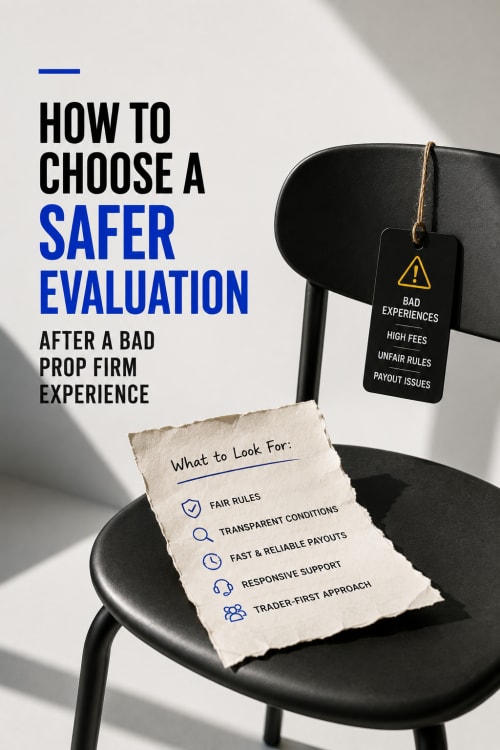
Scholarship Model
Scholarship Evaluation vs Prop Firm: Key Legal Differences
14 min read
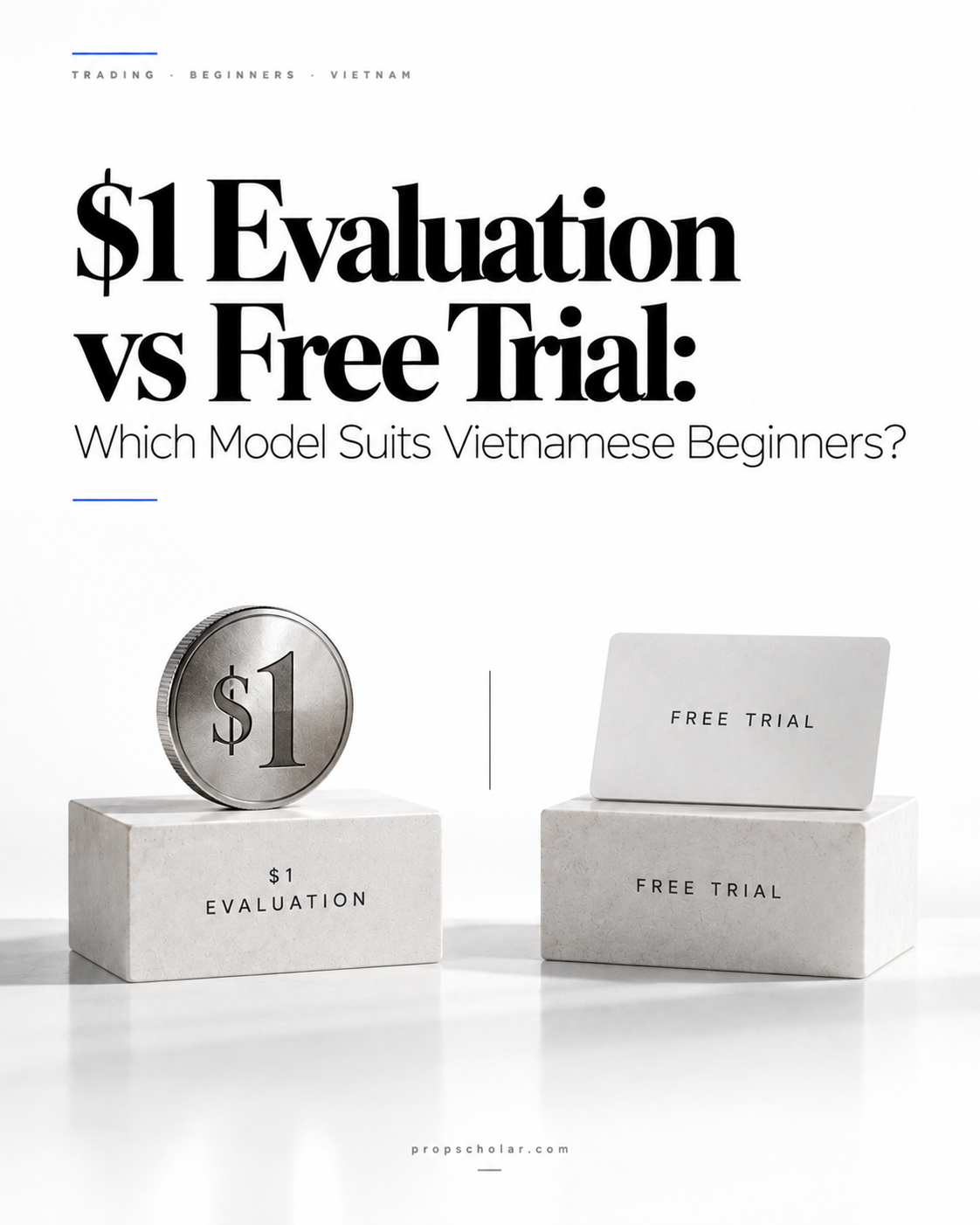
Scholarship Model
$1 Evaluation vs Free Trial: Which Model Suits Vietnamese Beginners
11 min read

Scholarship Model
How Fast Payouts Work and Why 4-Hour Verification Matters
16 min read
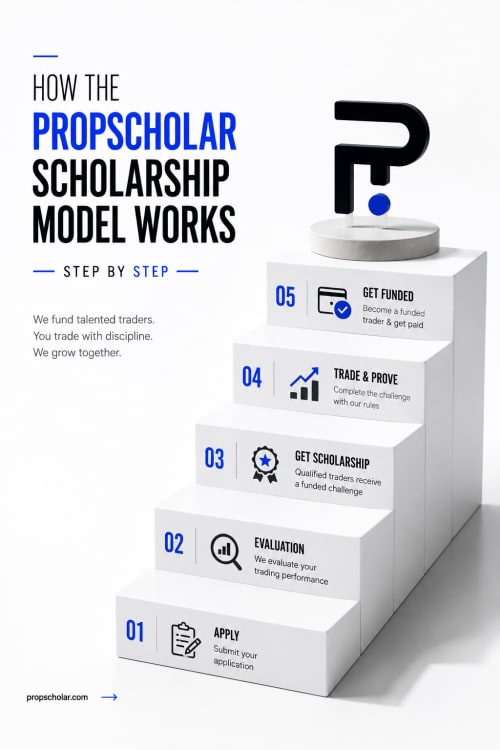
Scholarship Model
How the PropScholar Scholarship Model Works Step by Step
12 min read
Scholarship Model
Egypt P2P USDT Trading Evaluation: $5 Real Cost Breakdown
12 min read

Prop Trading Education
Best Pay After Pass Prop Firm 2026 — And Why You Should Skip Them
11 min read