
7 Red Flags in Fake Trading Challenge Payout Screenshots
Fake payout screenshots take 2 minutes to make. These 7 red flags help you spot fabricated proof before you pay any challenge fee — even $1.
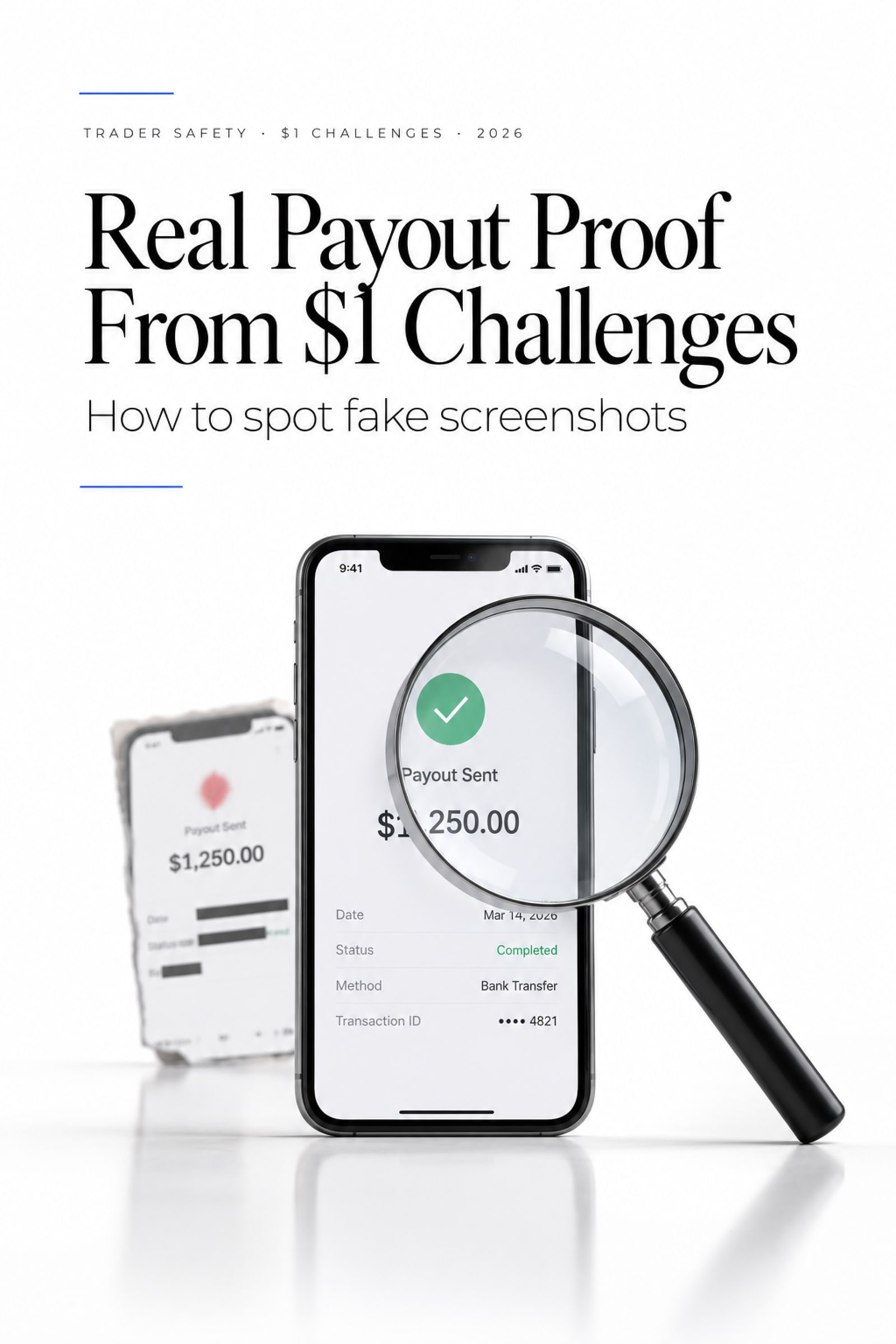
Fake payout screenshots take 2 minutes to make. These 7 red flags help you spot fabricated proof before you pay any challenge fee — even $1.
Start your evaluationReal Payout Proof From $1 Challenges: How to Spot Fake Screenshots
TL;DR: Fake payout screenshots are cheap to make and common in the low-cost challenge space. Before you pay anything, there are seven specific red flags you can check in under five minutes — and real platforms give you evidence that isn't a screenshot at all.
Key takeaways:
- A screenshot proves nothing on its own. Anyone can edit a payment image in minutes.
- The safest payout proof lives in a public, searchable community — not a curated Instagram story.
- Legitimate platforms have a verifiable company registration, a public rule set, and a track record that doesn't change when you ask hard questions.
- PropScholar processes scholarship payouts within 4 hours of verification — and has a 3,000+ trader Discord where those payouts are posted publicly.
- Knowing the red flags protects the money you haven't paid yet, which is worth more than any challenge fee.
You found a platform offering a trading challenge for $1, maybe $3. The sales page shows a dozen screenshots — PayPal transfers, Binance wallet credits, Wise receipts — with big numbers and happy trader names. Your instinct says something feels off, but you can't explain why.
That instinct is worth trusting. The low-cost challenge space has a real problem with fabricated payout proof, and it costs traders real money every week. This isn't about making you paranoid. It's about giving you a concrete checklist so you can tell the difference in five minutes flat.
Why Fake Screenshots Are So Easy to Make
This is the uncomfortable truth: a payout screenshot costs nothing to fabricate. Free browser extensions, basic photo editors, and even mobile apps can alter a payment amount, a name, or a date in under two minutes. A $47 payout becomes $4,700. A declined transaction becomes approved. A completely fictional Binance transfer gets a real-looking transaction ID.
The $1-and-$5 challenge space attracts this because the entry fees are small enough that most traders absorb the loss and move on without filing a complaint. That's exactly what bad actors count on.
What makes it worse is that social proof works on humans at a near-automatic level. You see twenty screenshots of happy traders, your brain starts believing the pattern, and the critical part of your thinking quiets down. Knowing that's happening is the first line of defense.
The 7 Red Flags That Separate Fake Proof From Real
Red Flag 1: Screenshots Only, No Searchable Community Record
If every single piece of payout proof is a static image — on a website, a Telegram channel, or an Instagram highlight — that's a serious warning. Real payouts leave traces in places the platform doesn't fully control: public Discord servers, third-party forums, Reddit threads, TrustPilot reviews written by strangers.
A curated gallery of screenshots tells you nothing. A public Discord with hundreds of payout posts from different users, spanning different dates, different account sizes, and different countries — that's actual evidence.
Red Flag 2: Transaction IDs That Don't Resolve
Every legitimate crypto transfer has a transaction hash you can paste into a blockchain explorer (Etherscan, BSCScan, Solana explorer, etc.) and verify independently. Every Wise or PayPal transfer has a reference number. Ask for one. If the platform provides a transaction ID and it returns no result on the relevant blockchain explorer, the screenshot is fake. If they refuse to provide one, treat that as your answer.
Red Flag 3: The Math on the Scholarship Doesn't Add Up
Look at what they're claiming. If someone paid $1 for a challenge and the payout screenshot shows $800, ask how that ratio works from a business perspective. Legitimate platforms are transparent about the scholarship structure — what percentage, under what conditions, paid from what source. Vague answers like "we share profits from our trading desk" are a red flag, especially from a platform operating for under a year with no audited disclosure.
Red Flag 4: No Verifiable Legal Registration
A real platform can name the country it's registered in and the registration type. PropScholar, for example, is a Private Limited company registered in India under the MCA — you can look that up. If a platform's "About" page says nothing about legal structure, if the domain was registered three months ago, or if the team is entirely anonymous, the screenshots mean nothing regardless of how convincing they look.
Red Flag 5: Rules That Change Quietly
One of the more damaging patterns in this space is retroactive rule changes — a platform that shifts its payout conditions after traders have already paid, or adds new restrictions just before someone is about to qualify. You won't see this advertised. You'll only catch it by checking whether the platform's rules are publicly documented, time-stamped, and consistent.
We've never changed PropScholar's rules retroactively. The evaluation structure you sign up for is the one you complete. That's worth more than any screenshot.
Red Flag 6: No Real Support Channel You Can Actually Reach
Before you pay, send a question to their support. Not a FAQ — an actual question about their payout process, their company registration, or their rule documentation. A legitimate platform responds. If you get an automated deflection or silence, that tells you what post-payment support will look like when you actually need it.
Red Flag 7: Social Proof Concentrated in One Place They Control
If 100% of the positive reviews, payout screenshots, and testimonials exist only on channels the platform administers — their own Telegram, their own website, their own Instagram — that's controlled narrative, not evidence. Real credibility leaks out into spaces the platform doesn't own.
What Real Payout Proof Actually Looks Like
Real proof is multi-layered. It's not one screenshot — it's a pattern of evidence across independent sources. Here's what it looks like in practice.
A trader in Nigeria pays the entry fee in crypto, passes the evaluation, and posts in a public Discord server with their payout receipt. Other traders in that same server ask questions. Someone cross-checks the transaction hash. The date matches the claimed timeline. The platform's admin confirms it publicly. Other traders from different countries have done the same thing in the same server over months.
That's a very different picture from a row of green-tinted payment screenshots on a landing page.
For global traders checking PropScholar specifically: our payout verification process is designed to be cross-checkable. Scholarship payouts go out within 4 hours of verification, and traders post receipts in our Discord — a server with over 3,000 members that you can read before you ever create an account.
How PropScholar Handles Payout Verification
PropScholar is a scholarship-based evaluation platform, not a prop firm. The model is straightforward: you pay an entry fee starting from $5 (or around Rs.400 in India), you complete the trading evaluation, and if you pass, you receive a scholarship of up to 400% of your entry fee — paid within 4 hours of verification.
Global traders pay via crypto. Indian traders have UPI options through PhonePe, Razorpay, and Cashfree. The payout method is matched to what actually works in your country.
We're also a marketplace for real prop firm challenges, so if you're looking at a more traditional funded account path, you can access those at INR pricing through the same platform.
On the question of proof: we actively encourage traders to post payout receipts in our public Discord. We don't curate what gets posted. Someone had a question about payout timing at 2 AM once — our 24/7 support team, with Hindi and multi-language capability, responded. That kind of support infrastructure doesn't exist at platforms running screenshot-based marketing with no real back-end.
If you want to understand what distinguishes trustworthy programs more broadly, this breakdown of what to look for in a trustworthy funded trading program covers the structural questions every beginner should ask.
Before You Pay Anything: A Five-Minute Verification Routine
Here's the actual process to run before handing money to any cheap challenge platform.
First, search for the platform name plus "scam" or "review" on Reddit, Trustpilot, and Forex Peace Army. Ignore what shows up on the platform's own pages. Second, find their public community — Discord, Telegram, forum — and scroll back at least three months. Are there payout posts from different users? Are there complaints? Are complaints responded to?
Third, ask support one specific question: "Can you give me a transaction hash from a recent payout I can verify on a blockchain explorer?" The response tells you everything. Fourth, look up the company name or domain age. A platform launched four months ago with no legal disclosure and a flashy screenshot gallery is a high-risk bet regardless of how good the deal looks.
Fifth, check whether the rules are written down and public. If you can't find a clear, dated ruleset, the terms you're agreeing to can be changed after you pay.
The safest way to get trading capital as a new trader always starts with this kind of due diligence — not after you've paid, but before you've even created an account.
The Bigger Picture: Why This Matters More in Emerging Markets
For traders in Nigeria, Indonesia, the Philippines, South Africa, Pakistan, Kenya, and similar markets, the stakes of getting scammed are higher in relative terms. A $5 entry fee might be a smaller number in USD, but it represents real purchasing power in local currency. Getting burned once doesn't just cost money — it costs the trust that makes trying again feel possible.
The low-cost challenge space could genuinely serve these traders. A $5 evaluation is a meaningful entry point for someone building a trading career without a large initial budget. But that only works if the platform behind it is real. The screenshot fraud problem actively damages the legitimate end of this market by making every cheap challenge look suspicious.
Your job as a trader is to be harder to fool than average — and now you are.
PropScholar is a scholarship-based trading evaluation platform operated by a Private Limited company registered in India. We are not a prop firm and do not manage or allocate institutional capital. Our model rewards proven trading skill with scholarship grants upon successful evaluation completion.
Related reading
- Are Free Funded Accounts Real? What 'Free' Prop Offers Actually Cost You
- Is PropScholar Legit or Fake? The Honest 2026 Review Every Trader Should Read Before Paying
- The Safest Way for a College Student to Start Trading and Not Lose Money
- Alternatives to Prop Firms That Change Rules After You Pass
- Is PropScholar Legit? An Honest Review With Payout Proof
- Why Easypaisa 'Instant Fund Release' Prop Challenges Fail Pakistani Day Traders (2026 Reality Check)
Ready to Prove Your Edge?
Join 500+ traders. Start from just $5. Get funded within days.
Frequently Asked Questions
Look for transaction IDs you can verify independently on a blockchain explorer or payment reference system. If the platform only shows static screenshots with no verifiable transaction hash, no public community with searchable payout history, and no legal registration information, treat the proof as unverified. Real payout proof has a paper trail that exists outside channels the platform controls.
More From PropScholar

Trader Safety
Why $1 Trading Challenges Fail for Beginners in Emerging Markets
12 min read
Trader Safety
Verify Prop Firm Payouts Without a Lawyer: 3 Free Methods
11 min read
Trader Safety
The Payout Proof Myth: Why Prop Firms Show Winners, Not Withdrawals
11 min read
Trader Safety
Blockchain vs Screenshot: How to Check If a Prop Firm's Payout Proof Is Real
13 min read
Trader Safety
First Payout Denied After 10% Win: What Prop Firms Don't Tell You
11 min read
Trader Safety
Is Online Prop Trading Safe for Indonesian Traders?
10 min read