Prop Firm Rules That Disqualify Profitable Traders: The Math
Trailing drawdown, consistency rules, news bans — see exactly how common evaluation rules eliminate real traders before payout, and the math behind each.
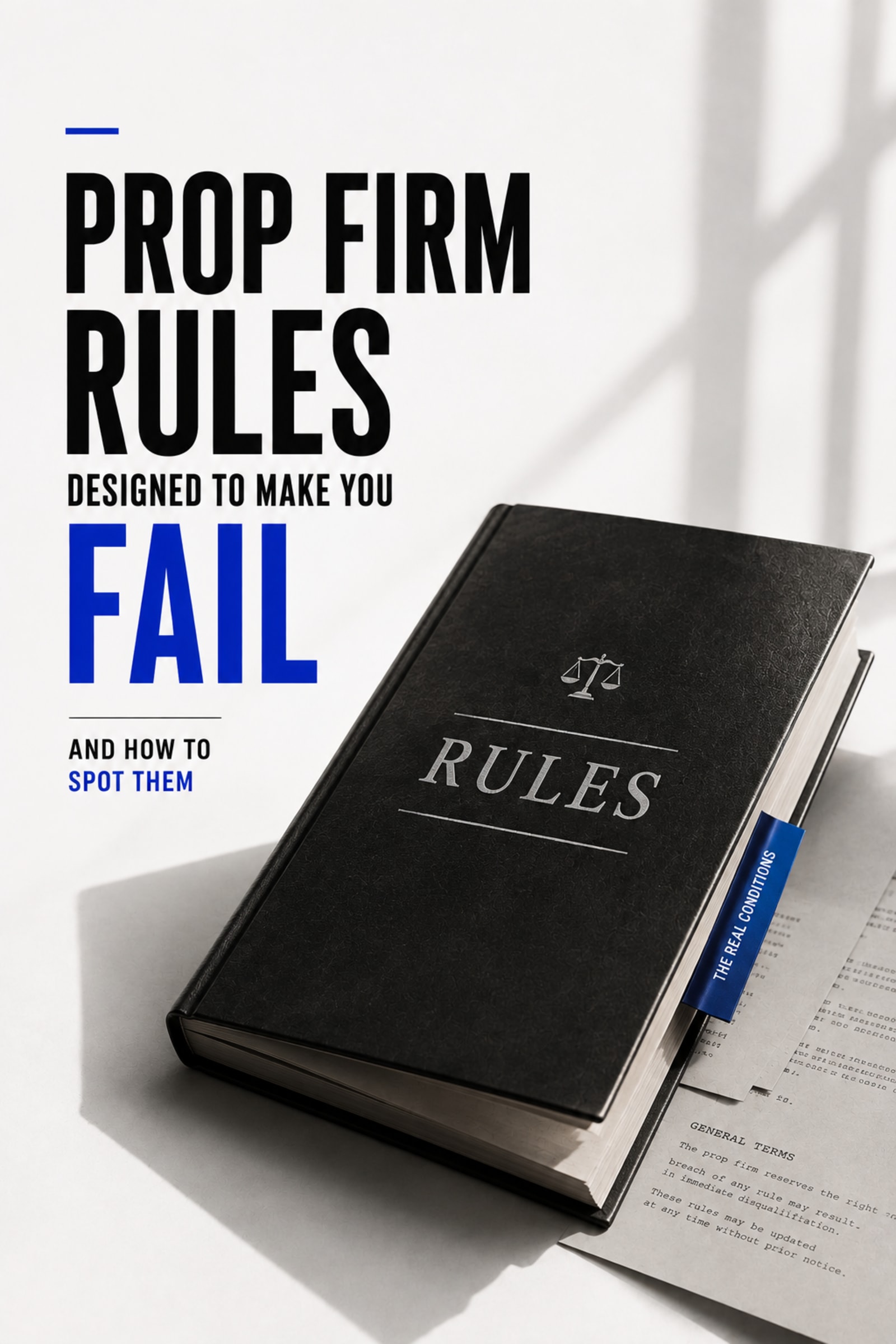
Trailing drawdown, consistency rules, news bans — see exactly how common evaluation rules eliminate real traders before payout, and the math behind each.
Start your evaluationProp Firm Rules Designed to Make You Fail (And How to Spot Them)
TL;DR: Some evaluation rules genuinely protect the business. Others are structured so precisely that almost no real trading style can survive them — and those exist to collect fees, not pay traders.
Key takeaways:
- Several common prop firm rules are calibrated so tightly that profitable traders still get disqualified.
- The trailing drawdown, rigid consistency rules, and news-trading bans are the most frequently abused.
- Rules buried in FAQs or added after sign-up are a serious red flag.
- You can identify a fair evaluation before you pay by reading the rule document in full and running the math yourself.
- PropScholar publishes its rules publicly, has never changed them retroactively, and pays verified scholarships within 4 hours.
You save up, pay the challenge fee, trade carefully for weeks, hit the profit target — and then get told you're disqualified. The reason? A rule you either didn't fully understand or didn't even see until it was too late.
This happens more than most people talk about publicly. The traders in our Discord community share stories like this regularly. And the frustrating part isn't losing — it's the suspicion that the rule that got you wasn't there to manage risk. It was there to manage you.
Some rules are completely legitimate. Drawdown limits make sense. Minimum trading days prevent random luck. But some rules are written, calibrated, or enforced in ways that make it structurally impossible for most real trading styles to survive — and that's what this article is about.
Let's go through the most common ones, exactly how they work against you, and what you should demand instead.
Why Some Evaluation Rules Benefit the Platform, Not the Trader
Any evaluation platform has a business reason to keep payout rates low — that's true and not inherently dishonest. What becomes a problem is when rules are designed specifically to eliminate traders who are genuinely profitable, just because their style doesn't fit a narrow, arbitrary template.
Think about it from the fee side: if a platform charges $200 for a challenge and almost nobody passes, the revenue model doesn't depend on finding good traders. It depends on collecting entry fees. That incentive doesn't disappear just because the platform claims to be looking for talent.
A fair evaluation identifies skill. An unfair one manufactures reasons to disqualify skill once it shows up.
The six patterns below are the ones that come up over and over.
The Trailing Drawdown — The Rule That Moves Against You as You Win
A standard maximum drawdown rule is straightforward: your account can't drop more than X% from the starting balance. That's fair — it mirrors how real risk management works.
A trailing drawdown is different. It follows your equity peak upward, locking in the highest point your account has ever reached. So if you start at $10,000, hit $11,000, and then give back $1,000 back to $10,000 — you're already near the breach point even though you haven't lost a cent of the original balance.
This is the part the marketing rarely explains clearly: the moment you make money, your effective breathing room shrinks. Every new high watermark tightens the rope around your neck.
Swing traders and position traders are particularly vulnerable. If you hold a trade overnight and it moves against you temporarily before recovering, the trailing system may have already marked you as breached — even if the trade closes green.
The rule isn't illegitimate in principle. It does test whether a trader can protect gains. But when the trailing distance is very tight — say 4-5% on a volatile instrument — it becomes nearly impossible to survive a normal retracement. That's not a risk management tool. That's a trap.
What to check: Ask exactly when the trailing stops moving. Many platforms lock the drawdown floor once it reaches the initial balance level. If they don't, your downside risk never stops growing as you succeed.
The Consistency Rule — Profitable Trades That Get You Eliminated
The consistency rule is one of the most quietly damaging patterns in evaluations today. We've covered it in depth in two separate articles — the 15% consistency rule trap and whether the consistency rule is actually a scam — because it deserves that much attention.
Here's the core problem: a consistency rule says no single trading day's profit can exceed a certain percentage of your total profit. Common versions cap it at 30% or even 20%. Sounds reasonable — it prevents someone from getting lucky once and calling it skill.
But here's what actually happens. Markets don't distribute opportunity evenly across days. A major economic announcement, a gap open, a session where your setup triggers cleanly — these naturally produce outsized days. A real trader might have three quiet days and one exceptional day. If that one day crosses the threshold, all of the profits may become ineligible for payout, or the account gets voided entirely.
You traded well. You managed risk. You hit the target. And you still don't get paid because one Tuesday was too good.
For instant funding accounts that layer a consistency rule on top, it gets worse. The account is framed as immediate access to capital, but the consistency requirement means you can never take full advantage of a strong opportunity without risking disqualification. That's not funding — it's a performance cage.
The News Trading Ban — Discretionary Enforcement You Can't Predict
Banning news trading is a legitimate business decision. High-impact news causes spreads to spike, execution to become unreliable, and simulated accounts to behave very differently from live ones. A platform that disallows trading around major news releases is protecting the integrity of the evaluation environment. That's defensible.
The problem is enforcement that's selective or retroactive. Traders have reported situations where a position was opened 30 minutes before a news event, didn't move on the news at all, and was still flagged as a news trade because it was open during the window. Others find that the "banned news window" isn't defined in minutes anywhere in the official rules — leaving the platform with full discretion to decide what counts.
When a rule is enforced by human review with no clear written standard, the incentive to flag borderline cases before payout becomes a serious concern. A trader who would have been paid $2,000 is worth flagging over. A trader who lost and owes nothing isn't.
The legitimate version of this rule specifies: which news events are banned, how many minutes before and after the event the restriction applies, and what instruments it covers. If you can't find those three things written down clearly, the rule can be used against you for almost any trade.
Minimum Trading Days — The Rule That Forces You to Over-Trade
Requiring a minimum number of active trading days sounds protective — it prevents a gambler from going all-in on day one and calling it a passing result. Fair enough.
But when the minimum is set high — 20, 25, or 30 trading days — combined with a tight profit window, it creates a different pressure: you have to trade every single day even when the market isn't giving you anything to work with. And trading when you shouldn't is how accounts blow up.
The legitimate version: a minimum of 5 to 10 trading days over the evaluation period, with no requirement on which specific days. That's enough to confirm the result wasn't a fluke without forcing the trader to manufacture setups on quiet days.
If the minimum days are high AND the evaluation window is short, run the math before you pay. You may be signing up for an exercise in forced trading, not skill demonstration.
Rules Buried in FAQs or Added After Sign-Up
This one doesn't get discussed enough. The core rule document isn't the only place rules live. Some platforms maintain a separate FAQ, a Discord pinned post, or a terms-of-service update that contains additional restrictions — restrictions that directly affect whether your trades qualify for payout.
If you read the main rules page and paid your fee, you did not necessarily agree to what's in the FAQ from three months ago. And if a platform adds a new restriction after you've already started trading, that's not a policy update — it's a retroactive change applied to a live participant.
Ask yourself: does this platform have a single, version-controlled rule document? Is the date of last update visible? Do they commit publicly to never changing rules retroactively for active accounts?
These aren't unusual demands. They're what any fair evaluation should provide by default.
PropScholar publishes its rules publicly and has not changed them retroactively in over 1.5 years of operation. That's a verifiable fact you can confirm before paying anything — and it matters more than any marketing claim.
The "Third-Party Risk" Clause — Vague Enough to Mean Anything
Some evaluation agreements include a clause stating that if the platform's liquidity provider, risk desk, or technology infrastructure flags unusual behavior, your results may be voided. The catch: "unusual" is never defined precisely.
In practice, this clause creates a backstop that lets a platform override any specific rule. Even if you followed every stated requirement, the third-party risk clause can theoretically be invoked. You have no way to know what triggers it, no way to trade around it, and no meaningful recourse when it's applied.
A clause like this may exist for legitimate reasons — protecting against coordinated manipulation or toxic flow. That's real. But it should be written narrowly: what specific behaviors trigger it, what the review process looks like, and whether the trader gets a detailed explanation. Vague = dangerous.
What Fair Evaluation Rules Actually Look Like
Now that we've covered the patterns to avoid, here's the positive case — what you should actually demand from any platform before paying.
A single, public rule document with a visible last-updated date
No rule buried in FAQs. No "as determined by our risk team." One document, dated, with version control. If the rules change, active participants are grandfathered under the version they agreed to.
Drawdown rules that are static, not trailing — or a trailing rule with a defined floor
You should know your exact maximum loss from day one. If trailing drawdown is used, the floor should lock once it reaches the initial balance level, so at minimum you're never penalized for protecting what you started with.
Consistency rules that are either absent or have a high enough cap to accommodate real market behavior
If a consistency rule exists, 30% is a rough minimum threshold to be workable. Below that, you're fighting the rule more than the market. Better still: no consistency rule for evaluations, full stop.
News trading restrictions defined in minutes and instruments
Not "around high-impact events" — but "15 minutes before and after events marked red on [specific calendar]." Written down. Enforced automatically. Not at reviewer discretion.
Minimum trading days of 5-10, not 20-30
Enough to confirm real activity. Not enough to force manufactured trades.
How PropScholar Approaches Evaluation Rules
PropScholar is a scholarship-based trading evaluation platform, not a prop firm. The model is straightforward: pay an entry fee starting from as low as $5, pass the evaluation, and claim a scholarship of up to 400% — paid within 4 hours of verification.
The rules are public. They have not changed retroactively in over 1.5 years. If you're in India, you can fund via UPI through PhonePe, Razorpay, or Cashfree. If you're in Nigeria, the Philippines, Indonesia, South Africa, or anywhere else, the platform accepts crypto globally — no international bank transfer needed, no currency conversion hassle.
We also run a marketplace that sells real prop firm challenges at INR/UPI pricing for Indian traders who want to explore other options — so you can compare what the rules of larger platforms actually look like before committing to them.
Our Discord community has over 3,000 traders, and payout screenshots are posted there regularly. That's not a marketing claim — you can go check before you ever pay us anything.
Is PropScholar the right platform for every trader? Not necessarily. But if you've been burned by a rule you didn't see coming, or you're tired of paying $200-$500 for evaluations that seem designed to eliminate you, it's worth understanding what a lower-cost, rules-transparent alternative actually looks like.
The Questions You Should Ask Before Paying Any Evaluation Fee
Before you pay anything to any platform — PropScholar included — go through this list:
Where is the complete rule document, and when was it last updated? Does a consistency rule exist, and if so, what's the cap? Is the drawdown static or trailing, and does the trailing floor lock? Are news trading restrictions defined precisely in minutes and instruments? Is there a third-party risk clause, and how is it defined? What happens to your active account if the rules change?
If you can't find clear answers to all of these, that's your answer.
Frequently Asked Questions
What prop firm rules are most often used to deny payouts? The most common disqualification triggers are consistency rule breaches, trailing drawdown violations, and news trading flags. Consistency rules can eliminate a trader for having one strong day. Trailing drawdowns move against you as you profit. News trading bans are sometimes enforced with no clear written definition of what counts as a violation. All three can apply to trades that were technically profitable and responsibly managed.
Is the trailing drawdown rule fair? It depends on how it's calibrated and whether it has a floor. A trailing drawdown that locks once it reaches the starting balance is manageable — it means you can't lose your original capital, and after that the rule stops moving. A trailing drawdown with no floor or a very tight trailing distance is structurally difficult to survive for swing traders, because every new high tightens the restriction. Check whether the floor locks before you pay.
How do I know if a prop firm rule was designed to disqualify me? The clearest signal is vagueness with high stakes. If a rule says something like "as determined by our risk team" or "unusual trading behavior" without defining what that means, it can be applied selectively. A fair rule is precise enough that you can write a trading plan around it. If you can't paraphrase a rule in one concrete sentence, it's too vague to be fair.
Can a prop firm change its rules after I've started the evaluation? Some do, and that's a serious problem. Any change applied to an active account mid-evaluation is a retroactive rule change — the trader agreed to different terms when they paid. Look for platforms that commit publicly to not changing rules for active participants. PropScholar has not changed its rules retroactively in over 1.5 years of operation.
Is PropScholar a prop firm or something different? PropScholar is a scholarship-based trading evaluation platform, not a prop firm. It does not manage or allocate institutional capital. The model works like this: pay an entry fee from $5, complete an evaluation by meeting trading targets within the rules, and receive a scholarship grant of up to 400% of the entry fee — paid within 4 hours of verification. The rules are public and have not changed since launch.
What is the minimum a trader should pay for a fair evaluation? There's no fixed minimum, but cost shouldn't be the primary filter — rule transparency is. A $500 evaluation with clear, fair rules is a better deal than a $30 evaluation with a vague consistency clause and a discretionary risk clause. That said, PropScholar's evaluations start at $5, which makes reading the full rules before paying a very low-risk exercise regardless of outcome.
Where can I see PropScholar payout proof before paying anything? The PropScholar Discord community has over 3,000 members and includes payout screenshots posted by traders. You don't need to pay to join — join first, verify what you see, and then decide. That's the right order of operations for any evaluation platform.
PropScholar is a scholarship-based trading evaluation platform operated by a Private Limited company registered in India. We are not a prop firm and do not manage or allocate institutional capital. Our model rewards proven trading skill with scholarship grants upon successful evaluation completion.
Related reading
- The Safest Way for a College Student to Start Trading and Not Lose Money
- Are Free Funded Accounts Real? What 'Free' Prop Offers Actually Cost You
- Is PropScholar Legit or Fake? The Honest 2026 Review Every Trader Should Read Before Paying
- Why Easypaisa 'Instant Fund Release' Prop Challenges Fail Pakistani Day Traders (2026 Reality Check)
- Is Online Prop Trading Legit or a Scam? A Complete Trust Guide
- Is PropScholar Legit? An Honest Review With Payout Proof
Ready to Prove Your Edge?
Join 500+ traders. Start from just $5. Get funded within days.
Frequently Asked Questions
The most common disqualification triggers are consistency rule breaches, trailing drawdown violations, and news trading flags. Consistency rules can eliminate a trader for having one strong day. Trailing drawdowns move against you as you profit. News trading bans are sometimes enforced with no clear written definition of what counts as a violation. All three can apply to trades that were profitable and responsibly managed.