
Passed Your Challenge, Still Waiting for Money? The 4-Hour Fix
You passed a prop firm challenge and now you're refreshing your inbox waiting for a payout that may take days, weeks, or never arrive. Here's why that happens, what it costs you, and how PropScholar's direct payout model gets you the money within 4 hours of passing, publicly verifiable, no activation fees.
You passed a prop firm challenge and now you're refreshing your inbox waiting for a payout that may take days, weeks, or never arrive. Here's why that happens, what it costs you, and how PropScholar's direct payout model gets you the money within 4 hours of passing, publicly verifiable, no activation fees.
Start your evaluationPassed Your Challenge, Still Waiting for Money? The 4-Hour Fix
TL;DR: Waiting days or weeks for a payout after passing a prop firm challenge is a real and common problem. PropScholar's direct payout model solves it: pass the evaluation, get paid within 4 hours, publicly verifiable. The smallest evaluation starts at $5.
Key takeaways:
- Many traders pass evaluations and wait days, weeks, or longer for their money, with no clear reason given.
- PropScholar is a scholarship-based evaluation platform, not a prop firm. When you pass, you receive a direct cash payout, not a funded account to manage.
- Payouts are processed within 4 hours of your request and are publicly listed at propscholar.com/payout-proof.
- The Freedom 5K costs $5 (Rs.499 in India) and pays $20 on a pass. The 50K costs $50 and pays $200.
- Payments are UPI in India, and USDT or PayPal everywhere else.
You did everything right. You hit the profit target, stayed inside the drawdown limits, avoided the violations. You passed. And now you're waiting. Refreshing your email. Checking your account dashboard. Wondering if the message got lost somewhere, or if there's a step you missed, or if something is quietly wrong.
You are not alone in this. The gap between "you passed" and "you got paid" is one of the most frustrating experiences in trading, and it's talked about constantly in every trading community. It's not a glitch. It's often how the model works.
This article is about why that gap exists, what it actually costs you, and how PropScholar's approach closes it entirely.
Why Does Payout Take So Long After Passing a Prop Firm Challenge?
The short answer is that in most evaluation models, passing the challenge is not the moment you get paid. It's the moment you get access to the next step.
Most prop firm evaluations work like this: you pass, then you receive a funded account. That funded account has its own rules: a minimum number of trading days before your first withdrawal, a minimum profit split threshold, a withdrawal schedule (weekly, bi-weekly, monthly), and sometimes a manual verification period. Some firms require you to trade the funded account for at least 10 days. Some pay out on a fixed calendar date regardless of when you pass. Some take 3 to 7 business days just to process the request once you submit it.
None of that is necessarily dishonest. It's just how the model is built. But if you passed your evaluation expecting money to arrive soon, the structure can feel like a hidden delay you weren't warned about clearly enough.
There's another layer too. Some firms conduct additional manual reviews after you pass, checking for news trading violations, lot limit breaches, or patterns that might trigger a rule check. That review can take days. If something looks unusual in your trading, it can take longer.
The result: a trader who passed a challenge two weeks ago might still be working toward their first actual payout, with no guaranteed date in sight.
The PropScholar Model Is Built Differently
PropScholar is not a prop firm. It's a scholarship-based trading evaluation platform. That distinction matters a lot here because it changes the entire payout structure.
Here's how it works for firm accounts. You go to the PropScholar shop, pick the firm challenge you actually want to get (the firm account from an external firm you have your eye on), and instead of buying that challenge directly, you pay a small PropScholar evaluation fee. You then trade a demo account with PropScholar's rules. When you pass, PropScholar pays you a direct cash payout equal to the full published price of that firm challenge, within 4 hours of your request.
That money is yours. You can spend it on that firm challenge. You can spend it on something else. There's no activation fee, no "pay after pass" catch, no monthly subscription. The firm account guides at propscholar.com/guides explain which firm challenges are available and what their published prices look like, so you know exactly what payout you're working toward before you buy.
For the Freedom Account, PropScholar's own one-step evaluation, the payout is a fixed scholarship amount: $20 on the 5K, $42 on the 10K, $60 on the 15K, $100 on the 25K, and $200 on the 50K. Same 4-hour processing guarantee. Same public payout proof.
Every payout PropScholar has made is publicly listed at propscholar.com/payout-proof. You can verify any of them. That level of transparency is unusual, and it exists because PropScholar's model depends on it.
What "Funded" Actually Means vs What "Paid" Means
This is worth spelling out clearly because the two words get conflated constantly.
"Funded" means you have been given access to a trading account with a notional balance. It is not cash. You cannot withdraw it, spend it, or send it anywhere. It becomes money only when you trade profitably in that account, meet the payout conditions, and successfully submit and process a withdrawal.
"Paid" means cash has moved to you. USDT in your wallet. Rupees on your UPI. That's real.
In the standard prop firm model, passing the challenge gets you funded. Getting paid takes additional time and trading after that. In PropScholar's model, passing the evaluation gets you paid. The funded account question is separate, and it's your choice what to do with the scholarship you receive.
If you want to dig deeper into this distinction, the article Funded Is Not Paid covers it in full.
What the PropScholar Evaluation Actually Requires
Being honest about what you're signing up for is the only fair way to present this.
The Freedom Account is a one-step evaluation. One 10% profit target. Maximum loss of 6% of the initial account size. Daily loss limit of 3% of the higher of starting equity or balance. No minimum trading days, no time limit, no minimum profitable days. Weekend holding is allowed.
There are lot limits, and they're real. On the $10,000 Freedom Account, the maximum open lots are 4.00 for forex, 0.40 for gold, 0.20 for BTCUSD, and 0.50 for indices like NAS100. These aren't designed to make passing impossible. They're designed to prevent the kind of single-trade blowup that makes the payout unsustainable. Each asset class is independent and you can't borrow headroom between them.
News trading is not allowed. No opening or closing positions from 10 minutes before to 10 minutes after a high-impact news event. That includes take-profit and stop-loss closes. A news trading violation breaches the account.
The inactivity rule is 14 days. Copy trading between two PropScholar accounts is not permitted.
The fastest recorded pass is 2 hours. That's not typical, and you shouldn't expect it. Most traders take longer. Some don't pass at all. The evaluation fee is real money, and it can be lost. That's the honest version.
How to Start: Pricing and Payment
The Freedom 5K costs $5, or Rs.499 in India. That's the entry point. The 10K is $10 (Rs.999). The 15K is $15 (Rs.1,499). The 25K is $25 (Rs.2,499). The 50K is $50 (Rs.4,999).
You can buy as many Freedom Accounts as you want, in any size, simultaneously.
In India, payment is by UPI. Outside India, PropScholar accepts USDT and other cryptocurrencies via NOWPayments, and PayPal. For traders in Nigeria, the Philippines, Kenya, Ghana, South Africa, Pakistan, Bangladesh, Indonesia, Vietnam, and Egypt, the practical path is to buy USDT on a local peer-to-peer exchange funded by a local bank transfer, then pay PropScholar directly in USDT at checkout. It's genuinely straightforward once you've done it once.
A Practical Comparison: The Two Models Side by Side
Standard Prop Firm Evaluation: What You're Actually Getting
You pay an upfront fee, typically anywhere from $50 to several hundred dollars depending on account size. You pass the challenge and receive a funded account. You then trade that funded account under its own separate ruleset. Your first withdrawal is available after a minimum number of trading days, a minimum profit threshold, and a manual review. Processing time after submitting a withdrawal varies by firm.
The total time from passing the challenge to actual cash in your wallet can be weeks. It depends entirely on the firm's schedule.
PropScholar Evaluation: What You're Getting
You pay a small evaluation fee, from $5. You pass the one-step evaluation on a demo account. You submit your payout request. PropScholar processes it within 4 hours. Cash moves in USDT or via UPI. You decide independently what to do with it, including buying the firm account you wanted in the first place.
The difference is structural, not just speed. The payout isn't contingent on further trading after you pass. It's contingent on passing. That's the whole thing.
The Honest Catch Section
There are things PropScholar's model can't do for you, and you should know them.
The scholarship amounts are fixed and finite. $20 on the 5K is not a lot of money. It's enough to cover a firm challenge at that size, which is the point, but it's not a living income. If you're looking for a sustainable trading income stream, that comes from actually getting good at trading, not from scholarship amounts.
Most traders don't pass on their first attempt. The evaluation has real rules and real consequences for breaking them. The fee can be lost. If you treat the $5 as genuinely low-stakes, that framing helps. If you're staking money you can't afford to lose, no evaluation fee is small enough.
PropScholar has been operating for about 1.5 years. It's a registered Indian company (CIN U85499JH2026PTC027330). It's not a large multinational firm. The payout proof page exists specifically so you can verify that payouts happen before you decide anything.
Why This Matters More Than It Might Look
The payout delay problem in trading evaluations isn't just inconvenient. It changes what passing actually means to a trader.
When you pass and then wait, you're in a strange limbo. You've proven your skill on the evaluation, but the financial reward is conditional on more trading, more time, and more compliance with rules you're still learning. For traders who are earlier in their journey, that limbo can drain motivation fast.
When the payout happens within 4 hours of passing, the feedback loop closes. You passed, you got paid, that's the evidence of what you're capable of. You can reinvest into a larger evaluation, buy the firm account you've been targeting, or just hold the money. The decision is yours immediately.
There's something about speed that makes the validation real. It's the difference between "you passed, good luck" and "you passed, here's the money, now decide what's next".
If you want to talk through the right evaluation size for where you are right now, the PropScholar Discord community has 3,000+ traders who've been through it and are genuinely active. It's the most direct way to get honest, specific input.
FAQs
Q: I passed a prop firm challenge but haven't received a payout. What's happening?
In most traditional prop firm models, passing the evaluation gives you access to a funded account, not an immediate cash payout. Your actual money becomes available only after trading the funded account for a minimum number of days, reaching a profit threshold, and completing a manual review process. The timeline varies by firm and can stretch to weeks. PropScholar's model is different: you pass the PropScholar evaluation and receive a direct cash payout within 4 hours of requesting it.
Q: How does PropScholar pay out within 4 hours?
When you pass a PropScholar evaluation and submit a payout request, the team processes it within 4 hours. In India, payment arrives via UPI. Outside India, it's USDT or PayPal. Every payout PropScholar has made is publicly listed at propscholar.com/payout-proof so you can verify it before you buy anything. The 4-hour window is a real operating commitment, not a marketing claim.
Q: Is the PropScholar Freedom 5K really just $5?
Yes. The Freedom 5K evaluation costs $5 (Rs.499 in India) and pays $20 if you pass. It's a one-step evaluation with a 10% profit target, 6% maximum loss, and 3% daily loss limit. There's no minimum trading days requirement and no time limit. You can buy as many as you want. The fee is real money and can be lost if you don't pass, so treat it honestly.
Q: What can I do with the PropScholar payout once I receive it?
Anything you want. The most common use is buying the external firm challenge you were targeting in the first place, since PropScholar's payout is calibrated to cover that cost. But the money is yours. You can use it toward a larger PropScholar evaluation, hold it, or spend it on something else entirely. There's no requirement to reinvest.
Q: Can traders outside India use PropScholar?
Yes. PropScholar serves traders globally. Outside India, payment is accepted in USDT (via NOWPayments) or PayPal. Traders in Nigeria, the Philippines, Indonesia, South Africa, Kenya, Pakistan, Bangladesh, Vietnam, and Egypt typically buy USDT on a local P2P exchange funded by a local bank transfer, then pay at PropScholar checkout. Payouts go back via USDT or PayPal.
Q: Does PropScholar have lot limits on the Freedom Account?
Yes, and it's worth knowing before you start. On the $10,000 Freedom Account, maximum open lots are 4.00 for forex, 0.40 for gold, 0.20 for BTCUSD, 0.50 for NAS100, and 0.30 for US30. Each asset class is independent. These limits exist across all account sizes and scale with account size. They're the most significant trading constraint on the Freedom Account and they're designed to prevent large concentrated losses.
Q: What is the PropScholar inactivity rule?
If you don't place a trade for 14 consecutive days, your evaluation account is considered inactive. This applies to the Freedom Account. It's a generous window, but it does mean you can't simply buy an evaluation and leave it open indefinitely without trading. As long as you trade at least once every two weeks, the inactivity rule won't affect you.
PropScholar is a scholarship-based trading evaluation platform operated by a Private Limited company registered in India. We are not a prop firm and do not manage or allocate institutional capital. Our model rewards proven trading skill with scholarship grants upon successful evaluation completion.
Related reading
- Free Funded Account Nigeria 2026: Qualify Without Paying Upfront
- How PropScholar Scholarship Payouts of Up to 400% Actually Work
- Trading Scholarship for Students in India 2026: How It Works and Who It Is For
- How to Get Paid Quickly After Passing a Trading Evaluation
- $1 Evaluation vs Free Trial: Which Model Suits Vietnamese Beginners
- How to Get a Direct Payout From a Trading Evaluation in Hours, Not Weeks
Ready to Prove Your Edge?
Join 500+ traders. Start from just $5. Get funded within days.
Frequently Asked Questions
In most traditional prop firm models, passing the evaluation gives you access to a funded account, not an immediate cash payout. Your actual money becomes available only after trading the funded account for a minimum number of days, reaching a profit threshold, and completing a manual review. The timeline varies by firm and can stretch to weeks. PropScholar's model is different: pass the evaluation and receive a direct cash payout within 4 hours of requesting it.
More From PropScholar
Scholarship Model
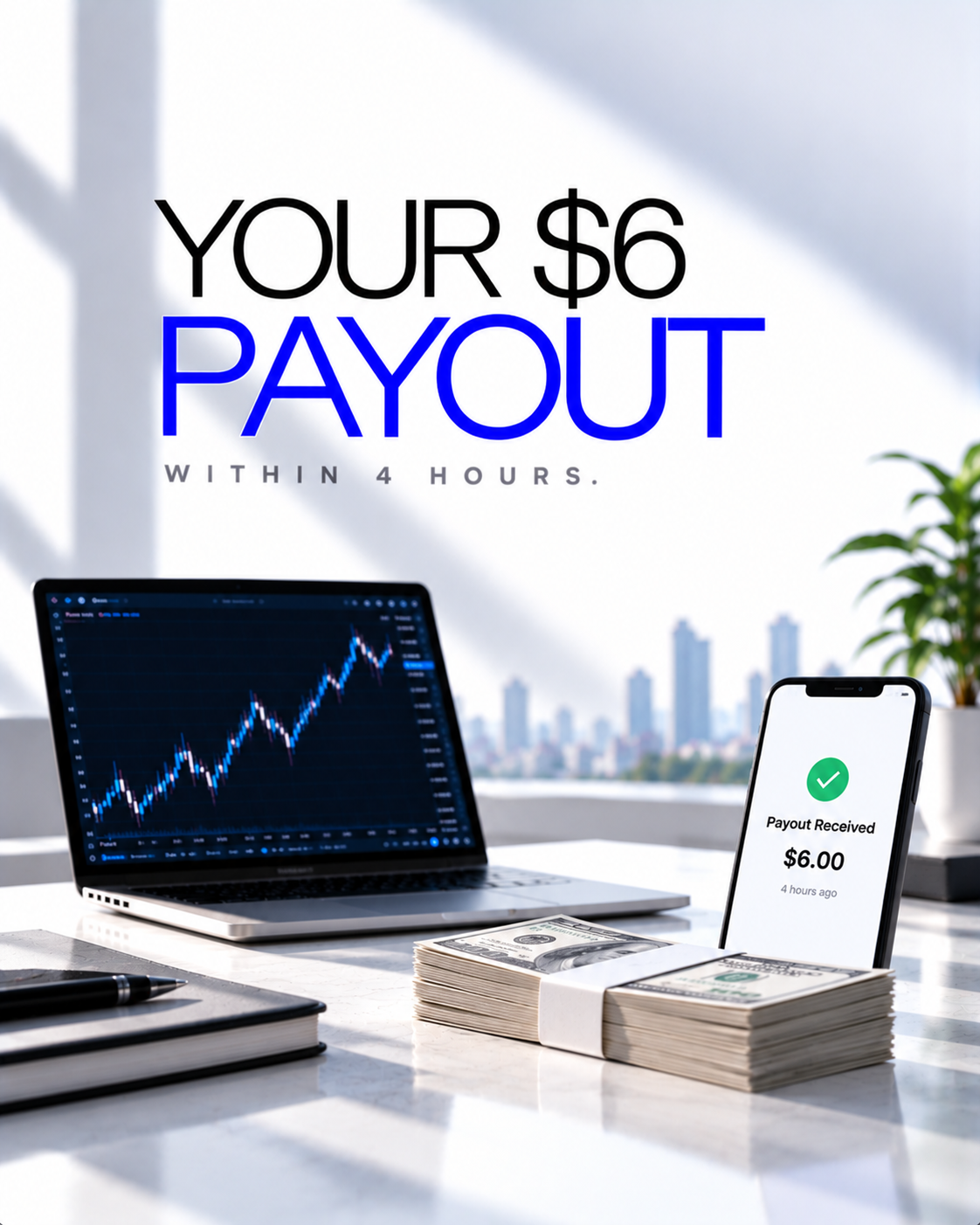
After You Pass the $1 Challenge: Your $6 Payout Within 4 Hours
11 min read

Scholarship Model
How Fast Payouts Work and Why 4-Hour Verification Matters
16 min read
Trading Comparison
Micro Funded Accounts Pay Pennies: The Math vs a $20 Direct Payout
11 min read

Evaluation Models
The Rs.500 Test: Bootcamp Account, Micro Account, or Direct Payout?
14 min read

Evaluation Models
Trading Competitions Reward Reckless Risk: The Disciplined Alternative
10 min read

Scholarship Model
Scholarship Evaluation vs Prop Firm: Key Legal Differences
14 min read