
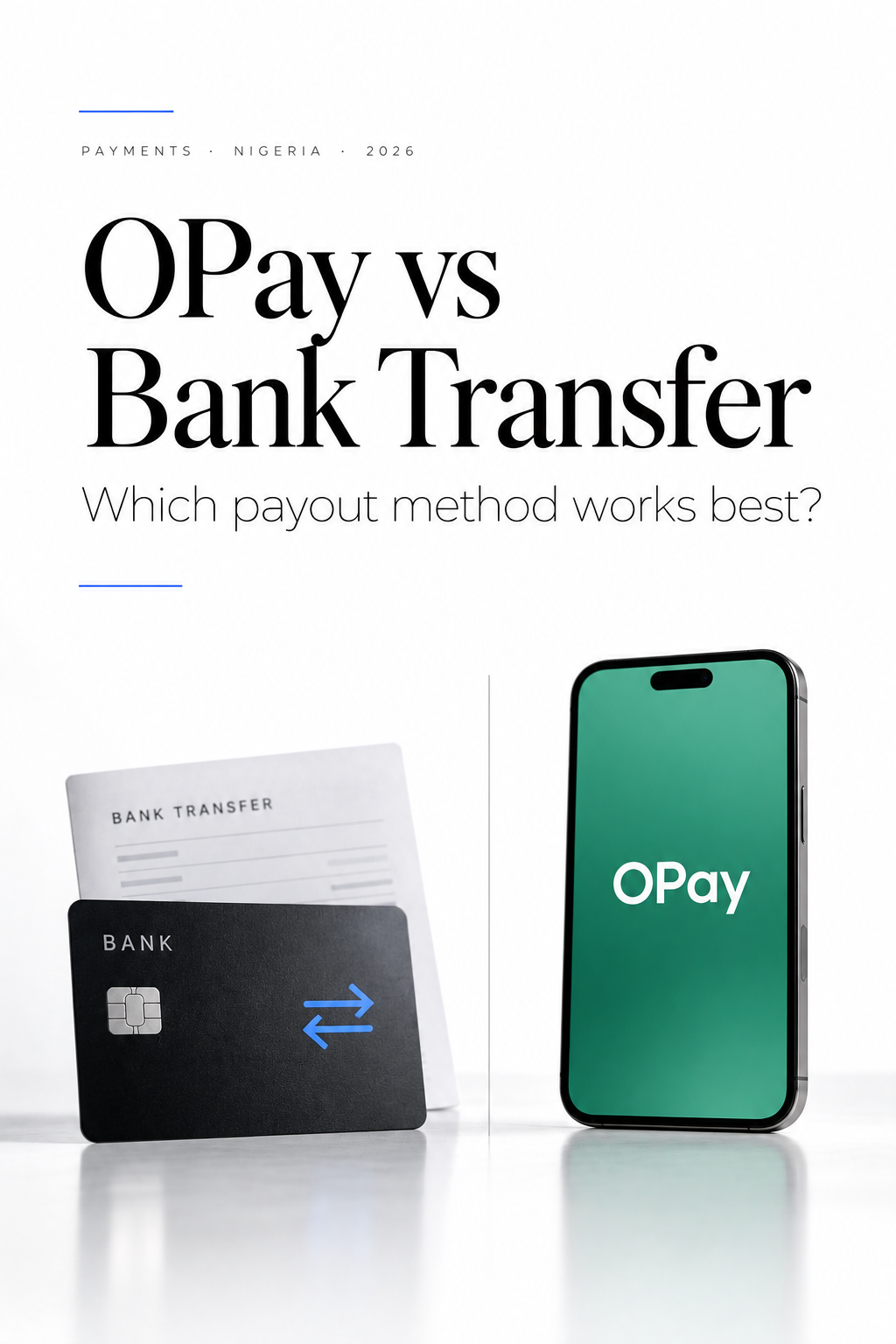
OPay vs Bank Transfer for Prop Firm Payouts in Nigeria
Nigerian traders are losing days — sometimes weeks — waiting for prop firm payouts stuck in bank transfer queues. This guide breaks down exactly how OPay and traditional bank transfer compare for receiving trading profits in Nigeria, which one keeps your money moving faster, and what you need to know before you choose a platform that actually pays you without the drama.
Nigerian traders are losing days — sometimes weeks — waiting for prop firm payouts stuck in bank transfer queues. This guide breaks down exactly how OPay and traditional bank transfer compare for receiving trading profits in Nigeria, which one keeps your money moving faster, and what you need to know before you choose a platform that actually pays you without the drama.
Start your evaluationOPay vs Bank Transfer for Prop Firm Payouts in Nigeria
TL;DR: OPay is faster and less likely to freeze your funds for prop firm payouts in Nigeria, but bank transfer is what most platforms default to. Crypto is the most reliable option for global platforms like PropScholar — and payouts arrive within 4 hours of verification.
Key takeaways:
- Bank transfers in Nigeria can take 24–72 hours or longer when compliance holds kick in for large or foreign-sourced credits.
- OPay processes transfers quickly for domestic peer-to-peer payments, but receiving international forex-linked income through it carries its own friction.
- Many prop firms and evaluation platforms pay via crypto (usually USDT), making the OPay vs bank transfer debate somewhat secondary for global payouts.
- PropScholar is a scholarship-based evaluation platform — not a prop firm — that pays verified traders within 4 hours, and accepts crypto globally from Nigerian traders.
- Your withdrawal method matters as much as passing the evaluation itself.
Let's sort this out properly — what actually causes payout delays in Nigeria, how OPay and bank transfer compare in practice, and what to look for when you're choosing a platform so your profits don't sit in limbo.
Why Payout Delays Hit Nigerian Traders Harder Than Most
Nigeria's banking environment creates specific friction that traders in the UK or US don't face. When a foreign payment — even a legitimate trading profit — lands in a Nigerian bank account, the receiving bank's compliance engine can flag it automatically. It's not personal. It's a system-level response to anti-money-laundering rules and CBN (Central Bank of Nigeria) guidelines around foreign inflows.
The result is a "post-no-debit" hold, where the funds show in your balance but you can't touch them until the bank's back office reviews the transaction. This can take 24 hours on a good day. On a bad day, with a public holiday or a manual review queue, it's 72 hours or more. Some traders have reported waiting five business days for a single payout, during which the naira rate moved enough to cut their effective earnings.
This isn't a theoretical risk. It's a routine experience for Nigerian traders receiving cross-border income — which is exactly what a prop firm or evaluation platform payout is classified as.
How OPay Actually Works for Receiving Profits
OPay has grown fast in Nigeria precisely because it cuts through the friction of traditional banking. For peer-to-peer transfers — someone sending you money locally — it's excellent. Near-instant, low fees, and it works even on weak internet connections. For a lot of everyday use cases, it genuinely outperforms the legacy banks.
For receiving trading profits from a foreign platform, though, the picture changes.
Most international prop firms and evaluation platforms don't have OPay as a payout option. OPay doesn't currently offer international receiving rails in the same way PayPal or a SWIFT-connected account does. So in practice, when a platform says they'll pay you via "bank transfer," they almost always mean a transfer to your GTBank, Zenith, Access, First Bank, or similar CBN-licensed commercial account — not your OPay wallet.
OPay does have a bank account feature (OPay Microfinance Bank), and some platforms can send NGN to that account number just like any other bank. If you receive NGN from a domestic source that way, it's fast. But if the originating institution is outside Nigeria and the funds are converted at the receiving end, you're back in the same compliance territory as any other bank.
So OPay's real speed advantage is domestic and NGN-denominated. For cross-border prop firm payouts, it doesn't automatically escape the delays that bank transfers face.
Bank Transfer for Prop Firm Payouts: The Real Bottlenecks
Bank transfer — meaning credit to your conventional Nigerian bank account — is the default payout method for many older prop firm structures. It's familiar, it's documented, and it works. When it works.
The problems are predictable:
Compliance holds are the biggest one. Any credit that a bank's system reads as foreign-sourced or unusually large for your account history can trigger a review. You'll see the credit, but you can't spend it.
Intermediary bank delays happen when the sending institution doesn't have a direct NGN relationship. The payment might route through a correspondent bank in the US or Europe, adding 1–3 business days before it even arrives at your Nigerian bank.
Exchange rate uncertainty is real too. If the platform sends USD and your bank converts it on receipt, the rate they apply might not be the parallel market rate you were counting on. This is less of a delay issue and more of an earnings erosion issue, but it matters.
Bank downtime is a Nigerian reality. CBN's NIBSS system has maintenance windows. Individual bank apps go down. Your payout arrives at midnight and the transaction posts at 8am the next business day.
None of this means bank transfer is useless. It means that for time-sensitive payouts, it's the least reliable option available to Nigerian traders right now.
The Crypto Route: Why Most Serious Nigerian Traders Are Using It
Here's what actually solves the delay problem: crypto.
USDT (Tether on TRC-20 or BEP-20) transfers settle in seconds to minutes, cost near nothing in fees, and bypass every single bank compliance hold described above. You receive USDT in your crypto wallet, then convert to NGN through a peer-to-peer exchange at whatever rate the market is offering. No CBN hold. No correspondent bank. No "processing" window.
This is why most globally-minded prop evaluation platforms have moved to crypto as their primary payout method — it works the same whether the trader is in Lagos, Manila, or Lahore. The money moves, and it moves fast.
For Nigerian traders specifically, the P2P NGN/USDT market is deep and liquid. Converting USDT to naira in your account is a routine, same-day operation on most major exchanges. The only friction is the conversion step itself, which is typically faster than waiting for a bank to clear a foreign transfer.
What PropScholar Does Differently for Nigerian Traders
PropScholar is not a prop firm. It's a scholarship-based trading evaluation platform — you pay an entry fee (starting from $5, which is roughly NGN 7,500–8,000 depending on current rates), pass a structured evaluation, and claim a scholarship grant of up to 400% of your entry fee. Payouts are made within 4 hours of verification.
That 4-hour window is the specific detail that matters here. It's not "within a few business days" or "3–5 working days pending compliance review." Four hours from verification. That's the commitment.
Payment for Nigerian traders going in (paying the entry fee) is via crypto — and the same applies on the way out. That means the bank transfer vs OPay debate largely doesn't apply to PropScholar payouts, because the settlement happens on-chain, not through Nigerian banking rails at all.
For traders who've been burned by delays before, this is the structural difference worth paying attention to. The payout speed isn't a marketing claim — it's built into how the platform operates, because crypto settlement removes the intermediaries that cause delays.
PropScholar has been operating for over 1.5 years, is registered as a Private Limited company in India, and maintains public rules that have never been changed retroactively. For Nigerian traders skeptical after dealing with platforms that quietly change their terms, that transparency matters.
Comparing Your Options: OPay, Bank Transfer, and Crypto
OPay for Prop Firm Payouts
OPay is best for domestic NGN transactions. It's fast for peer-to-peer, has a clean app, and works well for everyday money movement. For receiving cross-border trading profits directly from a foreign evaluation platform, it's not a primary option on most platforms' payout menus. If an NGN-based domestic payment ends up in your OPay account number, the speed is good. But you won't find "OPay" as a withdrawal option on most internationally-operating platforms.
Traditional Bank Transfer for Prop Firm Payouts
Bank transfer (GTBank, Zenith, Access, First Bank, UBA, etc.) is the default that most older platforms use. It's legitimate and traceable, but it carries real risk of compliance holds, especially for amounts that look foreign-sourced. If you're receiving regular payouts and your bank's compliance team starts flagging credits from an unfamiliar foreign sender, you could face escalating delays on each subsequent payment. Some Nigerian traders have had to visit bank branches physically to clear these holds.
Crypto (USDT) for Prop Firm Payouts
Crypto is the cleanest option for cross-border trading profits in Nigeria right now. Settlement is near-instant. There are no compliance holds at the receiving wallet level. You control the conversion to NGN and choose your own rate via P2P. The main requirement is that you're comfortable managing a crypto wallet and using a P2P exchange — both of which are basic skills worth learning if you're serious about trading income.
This comparison applies broadly across emerging markets too. Traders in Ghana, Kenya, Egypt, and Pakistan face similar bank friction — and the same crypto solution works there just as well. If you're curious how payment method friction plays out in a different context, the guide on bank transfer vs Vodafone Cash for prop firm payments in Egypt covers very similar dynamics.
Red Flags to Watch in Platform Payout Policies
Before you pay any entry fee to any evaluation platform, check the payout section of their terms. Some specific things that should concern you:
Any payout window described as "5–10 business days" for a digital platform is a red flag. Legitimate platforms with modern infrastructure don't need 10 days to send money. That window exists either because they're manually batching payments or because they're managing cash flow in a way that delays your money.
Platforms that don't specify a payout method upfront are asking you to trust them with your profits before you know how — or how quickly — they'll pay. That's not acceptable. The method, timeline, and any verification requirements should all be stated clearly before you pay anything.
Platforms that use "in review" as a catch-all status with no defined resolution window are structurally designed to delay. A real operation tells you exactly what the review involves, how long it takes, and who to contact.
PropScholar publishes its rules publicly and doesn't change them retroactively — which is a baseline standard that any platform you're considering should meet.
A Practical Checklist Before You Choose a Payout Method or Platform
Get your crypto wallet set up before you pass your first evaluation. TRC-20 USDT is the most commonly used for low-fee transfers. Don't wait until you're staring at a payout screen to figure this out.
Check the platform's payout currency. If it's USD via bank wire to your Nigerian account, ask their support specifically which correspondent bank they use and what the average clearing time to Nigerian accounts is. If they can't answer that, that tells you something.
For any platform using NGN bank transfer, test with the smallest available payout before you accumulate large profits. A small first transfer will tell you quickly whether your bank will hold it, and it's better to find that out with a small amount.
For PropScholar specifically, you pay entry in crypto, you receive your scholarship in crypto, and the clock starts the moment your verification is complete — not when their accounting team gets to it on Monday morning.
The Bottom Line for Nigerian Traders
OPay is a great tool for many things in Nigeria. It is not a direct solution for receiving cross-border trading profits from international evaluation platforms, because most platforms don't route payments there and because OPay's international receiving rails don't eliminate the compliance layer for foreign-sourced income.
Bank transfer works, but it's the option most likely to leave your profits sitting in a hold while naira rates move against you.
Crypto is the practical answer for Nigerian traders who want predictable, fast payout settlement — and it's the reason PropScholar's 4-hour payout commitment is actually achievable. When the mechanism is crypto, there's nothing to hold.
Your trading skill is the hard part. Where your money lands, and how fast, should be the easy part.
PropScholar is a scholarship-based trading evaluation platform operated by a Private Limited company registered in India. We are not a prop firm and do not manage or allocate institutional capital. Our model rewards proven trading skill with scholarship grants upon successful evaluation completion.
Related reading
- Best Prop Firm You Can Pay With UPI in 2026
- Cheap Prop Firm You Can Pay With UPI in India (2026)
- Best Prop Firm You Can Pay With PayPal (No Crypto Needed)
- Crypto USDT vs Card Payment: Which Payout Route Is Actually Faster in 2026
- Best UPI-Friendly Trading Evaluation for Indian Beginners 2026
- Can You Pay for a Trading Evaluation With Crypto? A Global Guide
Ready to Prove Your Edge?
Join 500+ traders. Start from just $5. Get funded within days.
Frequently Asked Questions
For domestic NGN transfers OPay is faster, but most international prop firm and evaluation payouts don't route to OPay directly. Bank transfers from foreign platforms to Nigerian banks frequently face compliance holds of 24–72 hours or more. Crypto (USDT) is currently the fastest and most reliable method for cross-border trading profits in Nigeria, bypassing bank compliance layers entirely.
More From PropScholar

Payments
Bank Transfer Prop Trading Challenge Nigeria 2026: Cheapest Way for College Students to Start
11 min read

Trader Safety
Instagram Reseller in Nigeria: Prove Trading Consistency Without Employment Records (2026)
11 min read
Payments
USDT vs Local Wallet: Your Real Payment Path in Nigeria, Kenya, and Bangladesh (2026)
11 min read
Payments
Why USDT Beats Local Payment Apps for Traders in Nigeria, Ghana, and Egypt
13 min read

Payments
Crypto Payment Prop Challenge Egypt 2026: $5 Entry in EGP
10 min read
Payments
GCash Payout Limits for Traders: What Filipinos Must Know
12 min read