Hidden Reset Costs in Trading Evaluations: Full Breakdown
Reset fees, add-ons and subscriptions can triple your real spend. Learn how to calculate total evaluation cost before you pay a single entry fee.
Reset fees, add-ons and subscriptions can triple your real spend. Learn how to calculate total evaluation cost before you pay a single entry fee.
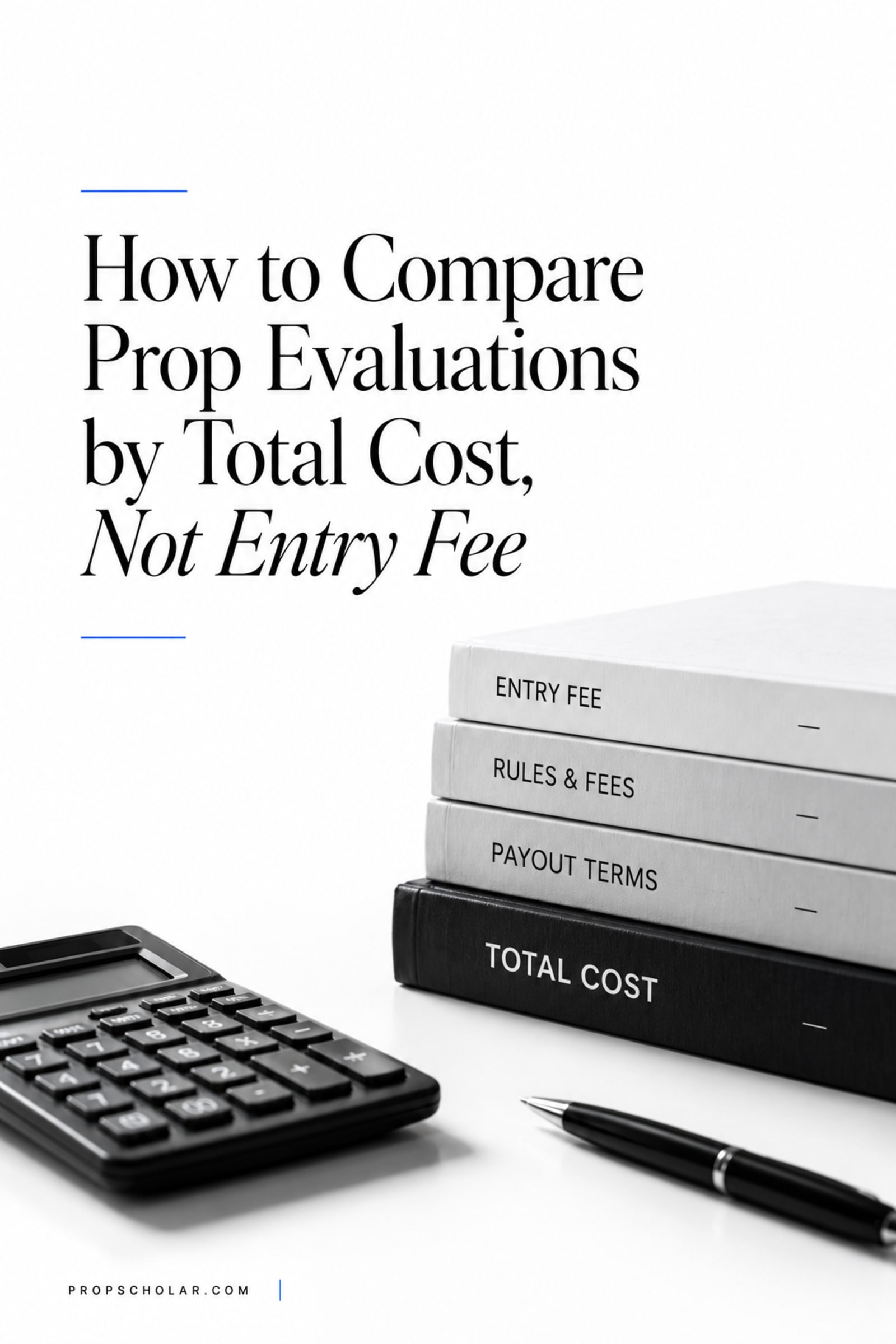
Start your evaluationHow to Compare Prop Evaluations by Total Cost, Not Entry Fee
TL;DR: The advertised entry fee is almost never the real cost of a trading evaluation. Add up resets, add-ons, and subscription charges before you compare — then look at what you can actually earn back.
Key takeaways:
- Entry fees can be a fraction of what you ultimately spend if you reset multiple times.
- Hidden costs include resets, optional add-ons, and in some models, monthly subscriptions.
- The right comparison metric is: total likely spend vs. maximum achievable scholarship or payout.
- PropScholar's evaluation starts at $5 (about Rs. 400), offers scholarships up to 400%, and pays within 4 hours of verification.
- Calculating total cost before you pay is a skill that saves you real money — and this article shows you exactly how to do it.
You've probably compared two or three evaluation platforms by their front-page price tags and picked the cheaper one. Most traders do. It feels logical. But then you blow a challenge, reset it, maybe reset again, add an add-on you thought would help — and suddenly you've spent three times what the "cheaper" option advertised. Meanwhile, a platform with a slightly higher entry fee and a genuine reset policy would have cost you far less.
This is one of the most common, and most expensive, mistakes new traders make when shopping for evaluations. The entry fee is a marketing number. The total cost is the number that actually matters.
Let me walk you through how to build a real cost comparison, step by step.
Why the Entry Fee Is the Wrong Number to Compare
Entry fees exist to get you in the door. They're designed to look low — and in isolation, they often are. A $49 challenge sounds affordable. A $99 one sounds like a serious commitment. But neither number tells you what you'll actually spend.
The costs that pile up come from what happens after you start.
If an evaluation has strict drawdown rules and a high failure rate by design, you are almost certainly going to reset at least once. A single reset at full price doubles your total cost. Two resets and you've paid three times the entry fee for a challenge you still haven't passed. Some platforms know this and structure their rules accordingly — not necessarily maliciously, but the economics work in their favor either way.
So the first shift you need to make is this: stop asking "how much does this cost to start?" and start asking "how much will this realistically cost me to complete?"
The Four Real Cost Components of Any Evaluation
Every evaluation platform you compare will have some combination of these four cost components. Work through all four before you form an opinion on value.
1. The Entry Fee
This is the base price you pay to access the challenge. It varies enormously — from a few dollars on low-cost platforms to several hundred dollars on larger account sizes. This is the number everyone compares. It's also the least informative number in isolation.
2. Reset Fees
What happens when you fail? That's the question most traders forget to ask. Some platforms let you reset at a discount — say, 20-50% of the original entry fee. Others charge the full entry fee again. A small number offer a free reset under specific conditions, which is genuinely valuable.
Before you pay for any evaluation, check the exact reset policy. Then be honest with yourself about how many attempts a challenging evaluation might take, especially while you're still developing as a trader. If the rules are tight and there's no reset discount, your expected total cost rises fast.
3. Optional Add-Ons
This is where things get murky. Many platforms offer "upgrades" at checkout or during the challenge — things like extended time limits, a higher profit split, or the removal of a specific rule like a consistency requirement. These can range from a few dollars to a significant percentage of the entry fee.
Some of these add-ons are genuinely useful. Others are effectively a tax on anxiety — you pay to feel safer without the underlying challenge changing much. The question to ask is whether the platform's base rules are reasonable enough that you don't need the add-on to have a fair shot. If the base product only works with add-ons, the real price is entry fee plus add-ons.
4. Subscription or Recurring Fees
Some evaluation models charge a monthly fee to keep your account active, separate from any one-time entry cost. This is less common but worth checking. If you're taking 60-90 days to pass a challenge and there's a monthly charge you missed in the fine print, that's a material addition to your total spend.
How to Calculate a "True Cost" Before You Sign Up
Here's the framework I'd use. It's simple, and it takes about five minutes.
Start with the entry fee. Then find the exact reset policy — full price, partial, or free — and multiply by the number of realistic attempts you might need. If you're a beginner, be conservative: assume at least one reset. Now add any add-ons you'd realistically purchase to make the rules workable. Finally, check whether there's a monthly fee and multiply by the expected completion time.
The formula looks like this:
True Cost = Entry Fee + (Reset Fee x Expected Resets) + Add-Ons + (Monthly Fee x Months)
Run this for every platform you're comparing. You'll often find the platform that looked cheapest is actually the most expensive once you account for likely behavior.
The Other Half of the Equation: What Can You Actually Earn Back?
Cost comparison without looking at the return side is incomplete. A $200 evaluation that pays out 80% of profits on a $100,000 account is a different proposition to a $15 evaluation that pays 100% on a $1,000 account. You need both sides of the equation.
Look for:
- Maximum scholarship or payout size. What's the ceiling? Is it realistic for someone at your skill level?
- Profit split percentage. What proportion of verified profits do you actually keep?
- Payout speed. "Fast payouts" is a common claim. Specific numbers are what matter. PropScholar, for example, pays scholarships within 4 hours of verification — that's a specific, verifiable commitment, not a vague promise.
- Scaling opportunities. Does passing the evaluation open a path to larger accounts or higher scholarships, or is it a one-time transaction?
What "Hidden" Really Means — and What It Doesn't
Let's be fair here. Not every platform with add-ons or reset fees is being deceptive. Some additional costs are clearly disclosed and genuinely optional. The problem is when costs are buried in terms and conditions, disclosed only after checkout, or structured in a way that makes the base product functionally incomplete without them.
The litmus test is simple: can you find every possible cost in under two minutes on the platform's main pages, without signing up or clicking through to checkout? If the answer is no, treat that gap as a yellow flag. Transparent platforms put their full fee structure in front of you before you have any reason to feel committed.
This is one reason rule clarity matters as much as price. If the evaluation rules are publicly documented, consistently enforced, and not changed retroactively, you can model your true cost accurately. If the rules are vague or buried, your cost estimate is unreliable no matter how carefully you calculate. PropScholar publishes its rules publicly and has never changed them retroactively — which means your cost model stays valid from day one.
A Practical Comparison: How to Use This When Shopping
Say you're a trader in the Philippines comparing three platforms. One advertises a low peso-equivalent entry fee but has a full-price reset policy, no free attempt, and a consistency rule add-on that costs extra to remove. Another has a higher upfront price but includes one free reset and no mandatory add-ons. A third — PropScholar — starts at $5, is accessible via crypto globally, and offers a scholarship of up to 400%.
If you realistically expect one reset before passing, the platform with the "cheap" entry fee may end up costing you more than the one with the higher headline price. And if the highest-priced option's rules are genuinely harder to pass, your reset count — and therefore your true cost — goes up again.
For traders navigating this across different currencies and payment systems, the payment method itself adds friction that has a cost. PropScholar accepts crypto globally, which means traders in Nigeria, Indonesia, Vietnam, or anywhere else with restricted banking access can actually pay without currency conversion headaches or blocked transactions. That's a real cost reduction that doesn't show up in the entry fee comparison but absolutely affects your total spend.
If you're specifically evaluating low-cost options for your market, the best low-cost trading evaluation guide for beginners worldwide has a more detailed breakdown, and the guide on how to choose the right trading evaluation in 2026 covers the broader criteria beyond cost.
How PropScholar Fits Into a Total-Cost Comparison
I'll be direct about where PropScholar sits in this framework, because that's the honest way to do this.
Entry and Reset Pricing
PropScholar evaluations start at $5 — approximately Rs. 400 for Indian traders, and accessible globally via crypto. This is genuinely low, not artificially low in a way that offsets elsewhere. The platform is a scholarship-based evaluation, not a prop firm, and it doesn't manage institutional capital — it rewards verified trading skill with scholarship grants.
Rule Transparency
Rules are publicly documented and have never been changed retroactively. That means when you calculate your true cost, the numbers you work out today will still be valid when you're midway through your challenge. There are no rule surprises that invalidate your prep.
Payout Speed and Scholarship Size
Scholarships go up to 400% of your evaluation entry amount, paid within 4 hours of verification. Payout speed is a real consideration in total-cost math — the longer you wait for earnings, the higher your effective cost of capital.
Global Accessibility
For traders in markets where standard card payments or bank transfers hit walls — Nigeria, Indonesia, Egypt, Pakistan, South Africa — crypto payment removes a cost that has nothing to do with the evaluation itself. For India-based traders, UPI through PhonePe, Razorpay, or Cashfree makes payment seamless. If you're specifically in South Africa or Egypt, there are dedicated guides covering affordable evaluations for Egyptian traders and prop firm alternatives for South African traders on a budget that go deeper on the payment and access angle.
The 3,000+ Trader Community
This one doesn't fit neatly into a cost column, but it affects your true cost indirectly. If you're learning from experienced traders in a live community, your reset count goes down. Fewer resets means lower true cost. PropScholar's Discord community of over 3,000 traders is active, multilingual, and includes payout proof from verified scholars — which is the kind of social evidence that's worth checking before you commit anywhere.
The Checklist: What to Verify Before Paying for Any Evaluation
Use this every time, for every platform you consider:
- Is the entry fee clearly listed before checkout, with no mandatory add-ons hidden at payment?
- What is the exact reset fee — full price, discounted, or free?
- Are all rules publicly documented in one place, not scattered across FAQs and terms?
- Have the rules ever changed after traders started their evaluations?
- What is the maximum scholarship or payout, and what's the realistic timeframe to reach it?
- How fast do payouts actually process — and is there a specific, verifiable commitment?
- Can you pay in a way that doesn't add friction or conversion fees in your country?
- Is there a community of active traders where you can verify real payout experiences?
Final Thought
Entry fees are designed to get your attention. Total cost is what you should be making decisions on. The calculation takes five minutes and can save you from spending three or four times what you expected on a challenge that was never as cheap as it looked.
PropScholar was built specifically to be transparent on all of these fronts — a $5 starting point, public rules that don't change, scholarships up to 400%, crypto payment globally, UPI for Indian traders, and payouts within 4 hours. That's not a slogan; those are the actual numbers. Run them against any competitor using the framework above and see where they land.
Questions? Reach out to the team at business@propscholar.com or drop into the PropScholar Discord where payout proof and real trader experiences are visible to anyone who wants to verify before they buy.
PropScholar is a scholarship-based trading evaluation platform operated by a Private Limited company registered in India. We are not a prop firm and do not manage or allocate institutional capital. Our model rewards proven trading skill with scholarship grants upon successful evaluation completion.
Related reading
- Best $1 Trading Challenge 2026: Why 1K 1-Step Wins
- Cheapest Legit Way to Access a Funded-Style Trading Account From $5
- Best Prop Firm in India 2026 (UPI-Friendly): Honest Comparison
- Cheapest Prop Firm in 2026: The Complete Price Comparison Guide (From ₹300 With FIFA Discount)
- Prop Firm Challenge Under $5: Cheapest Legit Funded Accounts Compared
- Cheapest Prop Trading Evaluation in 2026 Ranked by Real Total Cost
Ready to Prove Your Edge?
Join 500+ traders. Start from just $5. Get funded within days.
Frequently Asked Questions
Add the entry fee, the cost of any likely resets (at the platform's actual reset price, not the entry price), any add-ons you'd need to make the rules workable, and any monthly fees multiplied by your expected completion time. Then compare that total against the maximum payout or scholarship available. That ratio — true cost versus maximum return — is the meaningful comparison, not the entry fee in isolation.