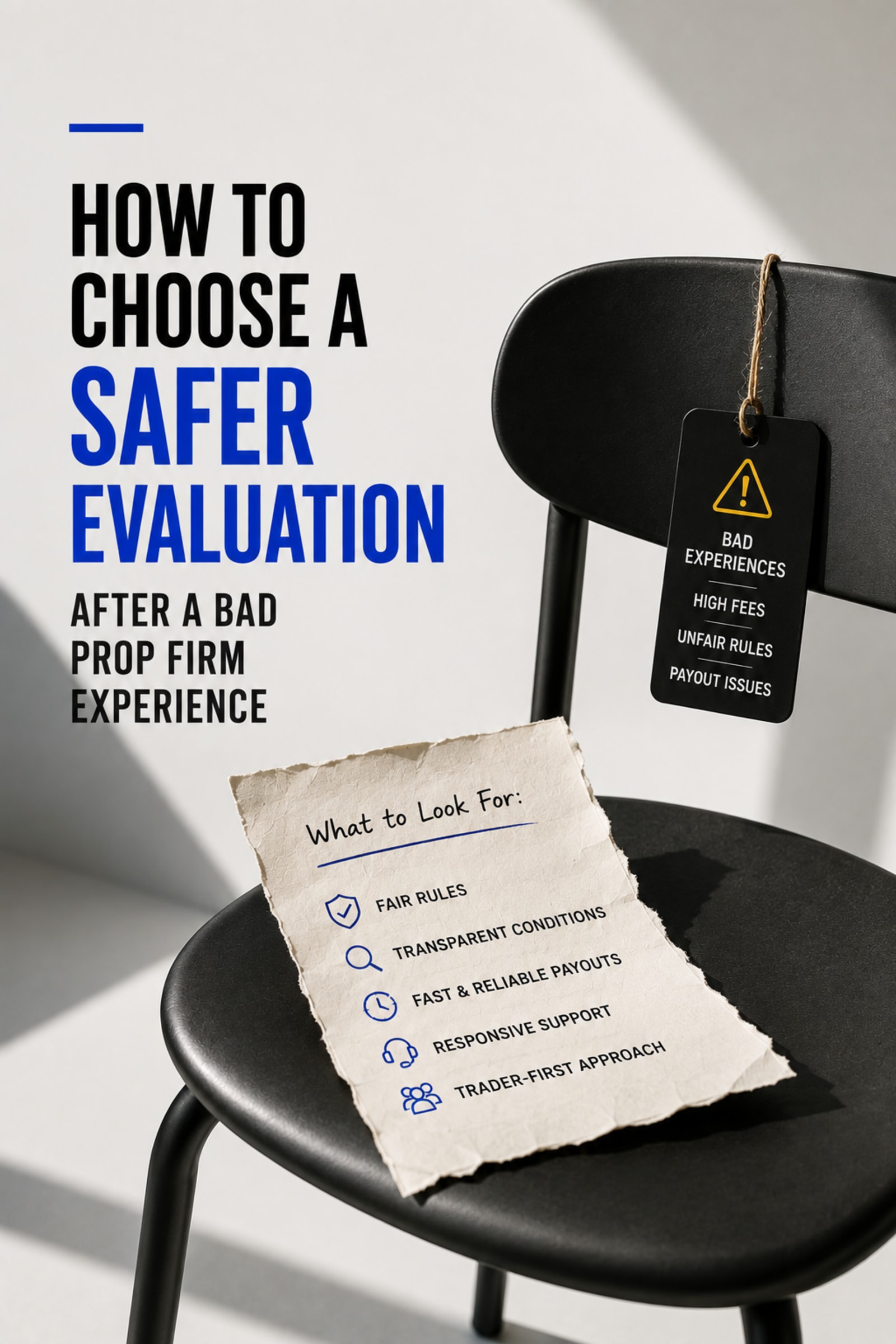
How to Choose a Safer Evaluation After a Bad Prop Firm Experience
Got burned by a prop firm that moved the goalposts, denied your payout, or hit you with surprise rules? You're not alone. Here's how to read a platform's red flags before you pay — and what a genuinely transparent evaluation actually looks like in 2026.
Got burned by a prop firm that moved the goalposts, denied your payout, or hit you with surprise rules? You're not alone. Here's how to read a platform's red flags before you pay — and what a genuinely transparent evaluation actually looks like in 2026.
Start your evaluationHow to Choose a Safer Evaluation After a Bad Prop Firm Experience
TL;DR: One bad experience doesn't mean you stop trading. It means you stop trusting blindly. Here's how to audit any evaluation platform before you hand over money — and what genuine transparency actually looks like.
Key takeaways:
- Rule changes applied retroactively to active challenges are the single biggest red flag to watch for
- Verify real payout proof before paying any fee — screenshots in a Discord server you can join for free count far more than a polished marketing page
- Transparent platforms publish their rules publicly and never update them mid-challenge
- PropScholar is a scholarship-based evaluation platform, not a prop firm, with challenges starting at $5 and scholarships paid within 4 hours of verification
- A 3,000-plus trader community with open chat is a genuine trust signal — silence is not
You paid the fee. You traded the rules as written. Then something changed — a new guideline you'd never seen, a payout request that went silent for weeks, or a support ticket that bounced between three people before dying. Getting burned by a bad evaluation experience is more common than any platform will admit, and it leaves a specific kind of frustration: you did the work, you followed the process, and it still didn't pay out.
The problem usually isn't your trading. It's that you chose a platform without knowing what to look for. Most traders pick a challenge based on a YouTube ad, a Reddit thread, or the size of the funded account. Almost nobody audits the platform's rules, payout history, or business structure before paying. That's what this guide fixes.
What Actually Goes Wrong With Bad Prop Firm Experiences
The pattern is almost always the same, even if the specific platform name changes. You pass the evaluation — sometimes a two-step challenge, sometimes a single phase — and then something blocks the payout. The most common causes:
Rules that appeared after you started. Some platforms quietly update their terms during an active challenge cycle. The new rule — say, a consistency requirement or a cap on your best-day profit — wasn't there when you paid. By the time you hit it, it's in the fine print and the support team treats it as gospel.
Vague breach definitions. A rule like "no excessive trading" or "maintain consistent risk" sounds reasonable. But if the platform doesn't define what those phrases mean numerically, they become whatever the compliance team decides they mean on the day you request a payout.
Payout delays with no timeline. Legitimate platforms have a stated payout window and they hit it. When a platform gives you "processing" status for three weeks with no update, that's not a backlog — that's a model that depends on delay.
No verifiable company structure. A platform with a landing page, a Telegram channel, and no registered entity anywhere is a real risk. If there's no company name, no registration number, no physical address, you have no recourse if something goes wrong.
None of this means every evaluation platform is bad. It means you need to know what to check.
The Checklist: What to Verify Before You Pay Again
This is the due diligence process I'd want every trader to run before paying for any evaluation — including PropScholar. If a platform passes all of these, your risk is genuinely lower.
Are the rules public, static, and version-dated?
Go to the platform's website right now and find the full ruleset. Not a FAQ, not a blog post — the actual trading rules that govern your evaluation. Can you read them without making an account? Are they dated? Does the platform explicitly state that rules won't change during an active challenge?
If the rules are locked behind a dashboard you can only access after paying, that's worth noting. It's not automatically disqualifying, but you should read them completely before starting.
Can you verify real payouts before joining?
Marketing pages show beautiful payout screenshots. That's not verification. Real payout proof means a community — Discord, Telegram, forum — where actual traders are posting their receipts and you can ask them questions. You can join PropScholar's Discord with 3,000+ active traders before you pay anything. That's exactly the kind of open community that matters.
Check how old the payout screenshots are, how many unique traders have posted them, and whether anyone is asking hard questions in the same server. A healthy community has both praise and honest criticism.
What is the payout timeline, exactly?
Not "fast" or "within a business week." An exact number. PropScholar pays scholarships within 4 hours of verification. That's a specific, checkable commitment. If a platform's answer to "how long does payout take" is a paragraph of caveats, that's telling you something.
Is there a registered business entity?
A legitimate platform should be able to tell you the legal name of the company, where it's registered, and ideally a registration number. PropScholar is a Private Limited company registered in India under MCA — that's verifiable, not just a claim. You don't have to be a lawyer to check a company registry, and in most countries it takes about five minutes online.
What does the entry fee actually cover — and what happens if you fail?
Some platforms sell you a challenge and then charge a reset fee, a swap fee, or a "compliance review" fee on top. Before you pay, map out the full cost of a realistic attempt including one or two failures. At $5 entry on PropScholar's smallest challenge, even two attempts costs less than a single coffee in most cities. That math changes your risk profile significantly.
Why "Rules Never Changed Retroactively" Is a Non-Negotiable
This deserves its own section because it's the one rule that, if violated, makes every other promise meaningless.
Imagine you start a challenge on the 1st of the month. The platform's rules say your maximum daily drawdown is 5%. You trade accordingly for two weeks, stay within 5%, and you're close to passing. On the 15th, the platform quietly updates the rule to 4%. Now your best trading days from week one technically breached the new threshold — and suddenly you're in violation of a rule that didn't exist when those trades happened.
This is not hypothetical. It happens. And there's almost no recourse when it does, because the platform's terms of service typically include a clause allowing them to update rules at any time.
PropScholar's position on this is simple and has been consistent since the platform launched: rules are published publicly and have never been changed retroactively across its 1.5-plus years of operation. That history matters. A platform can promise anything on its marketing page — what it's actually done over time is harder to fake.
For a detailed breakdown of how evaluation platforms compare on this point, the PropScholar vs top prop firms comparison is worth reading before you commit anywhere.
What a Scholarship-Based Model Means (and Why It's Different)
PropScholar isn't a prop firm. It's a scholarship-based trading evaluation platform. The distinction matters, especially after a bad experience with a traditional prop firm model.
In a standard prop firm model, the implied promise is that you're trading real capital and the firm is allocating institutional money to you after you pass. That framing creates expectations — and sometimes confusion — about what the relationship actually is.
PropScholar is transparent about what it does: you pay an entry fee (from $5 / roughly Rs. 400 for Indian traders), you complete a trading evaluation, and if you pass, you receive a scholarship grant of up to 400% of your entry fee. The scholarship is paid within 4 hours of verification. There's no ambiguity about what you're owed or when.
For beginners — especially those in emerging markets who found out the hard way that a $150 prop firm challenge is 40% of a month's income — the $5 entry point changes what "trying again" actually costs. Failing a $5 challenge is a learning experience. Failing a $150 challenge is a financial hit.
If you want to compare the full cost picture across different platforms, the cheapest legit prop firm comparison for 2026 runs through the real numbers including reset fees and hidden charges.
How PropScholar Handles the Specific Pain Points That Burned You Before
On rule transparency
The ruleset is public. You can read it before creating an account, before paying, before doing anything. The rules that exist today are the rules that have existed — no mid-challenge updates, no retroactive enforcement.
On payout speed
Scholarships are paid within 4 hours of verification passing. Not "within a few business days" or "as soon as our compliance team reviews." Four hours. If you're in India, that means UPI. If you're anywhere else in the world, PropScholar accepts crypto globally — no need for a specific local payment method that may or may not exist.
On support access
The platform offers 24/7 support in Hindi and multiple languages. That's not just a bullet point — for traders in India, Nigeria, the Philippines, or Indonesia who've dealt with English-only support that takes 72 hours to respond, real multilingual support is a genuine difference.
There's also an AI assistant called Scholaris that can answer rule questions, review your trading approach, and respond instantly — which means you're not stuck waiting for a human to tell you whether a trade you're planning would breach a drawdown rule.
On community verification
You don't have to take our word for any of this. The Discord community has over 3,000 traders. Join it for free. Ask anyone there about their payout experience. Look at the proof channels. Ask hard questions. A platform that's nervous about you talking to its user base is a platform that has something to hide.
If You're Not Ready to Try Again Yet — That's Fine
Some traders come out of a bad experience needing to rebuild confidence before spending money again. That makes complete sense. A few things worth doing in the meantime:
Read the evaluation rules of any platform you're considering — all of them, not just the headline numbers. Look specifically for language about rule changes, compliance discretion, and payout conditions. Vague language there is your early warning system.
Spend time in the community before you pay. Discord and Telegram are free to join. See how the support team responds to complaints, not just questions. See how the platform handles a trader who publicly posts a bad experience. The response tells you more than the FAQ.
For a comparison of what the current generation of AI-powered evaluation platforms actually offers, the honest comparison of AI-powered prop trading platforms in 2026 covers the technology gap between older platforms and newer evaluation-focused tools.
And if you want to understand what makes an evaluation platform genuinely trustworthy from a technology standpoint — not just a branding standpoint — the best AI-powered trading evaluation platform guide for India is a useful starting point even if you're not based in India, since the transparency criteria apply everywhere.
Making the Decision: A Clear Framework
Before paying for any evaluation after a bad experience, run this sequence:
First, find the full ruleset without logging in. If you can't, email support and ask them to send it. How they respond is already information.
Second, join the community and look for payout proof from the last 30 days. Not 2022. Last 30 days.
Third, search for the platform's legal entity name. Find the registration. If there isn't one you can verify, that's your answer.
Fourth, map out the total cost of two failed attempts plus one pass. If that number is painful, the entry fee is too high for your current situation.
Fifth, read the payout conditions word by word. Find the clause that says when they can refuse a payout. If it's broad enough to mean anything, it means nothing in your favor.
PropScholar clears all five of these. That's not a boast — it's just what the due diligence process looks like when you run it honestly.
Frequently Asked Questions
How do I choose a safer evaluation after a bad prop firm experience? Start by reading the full ruleset before paying — publicly, without logging in. Then verify real payout proof from the last 30 days in a community you can join for free. Confirm the platform is a registered legal entity. Check that rules cannot be changed during an active challenge. PropScholar meets all of these: rules are public, payouts happen within 4 hours, and it's registered as a Private Limited company in India.
What are the biggest red flags in a trading evaluation platform? Rules that change mid-challenge without notice, vague breach definitions that give the platform discretion to deny payouts, payout delays with no stated timeline, and no verifiable business registration. If a platform updates its consistency or drawdown rules while you're actively in a challenge, that's the clearest warning sign that the model may not be in your favor.
Is PropScholar a prop firm? No. PropScholar is a scholarship-based trading evaluation platform, not a prop firm. It doesn't manage or allocate institutional capital. You pay an entry fee from $5, complete a trading evaluation, and if you pass, you receive a scholarship of up to 400% of your entry fee, paid within 4 hours of verification. The distinction matters because it's a completely transparent model with no ambiguity about what you're owed.
How much does PropScholar cost and how do I pay? Entry fees start at $5 (approximately Rs. 400 for Indian traders). Traders in India can pay via UPI through PhonePe, Razorpay, or Cashfree. Traders globally can pay with cryptocurrency. PropScholar does not require a credit card or international bank transfer, which makes it accessible in emerging markets where those options are limited or expensive.
Can I verify PropScholar payouts before I pay anything? Yes. Join the PropScholar Discord community — which has over 3,000 active traders — for free before paying a cent. Payout proof is shared publicly in the community. You can ask existing traders directly about their experience, look at dated screenshots, and make your own judgment. Seeing real, recent payout proof from real traders is more reliable than any marketing claim.
What should I do if I'm not ready to try another evaluation yet? Take the time you need. In the meantime, read the ruleset of any platform you're considering in full, join their community and observe how disputes are handled, and check the platform's business registration. Rebuilding confidence starts with understanding exactly what went wrong before — usually it's a rule you didn't fully understand, not a failure in your trading.
Do evaluation platforms have to be regulated to be safe? Regulation varies by country and model. A registered business entity is a meaningful trust signal because it creates legal accountability and a way to escalate complaints. PropScholar is registered as a Private Limited company under India's MCA — verifiable independently. Registration alone isn't a guarantee of good practice, but the absence of any registration is a clear risk flag.
PropScholar is a scholarship-based trading evaluation platform operated by a Private Limited company registered in India. We are not a prop firm and do not manage or allocate institutional capital. Our model rewards proven trading skill with scholarship grants upon successful evaluation completion.
Related reading
- Cheapest Legit Way to Access a Funded-Style Trading Account From $5
- Best $1 Trading Challenge 2026: Why 1K 1-Step Wins
- Cheapest Prop Firm in 2026: The Complete Price Comparison Guide (From ₹300 With FIFA Discount)
- Best Prop Firm in India 2026 (UPI-Friendly): Honest Comparison
- Cheapest Prop Trading Evaluation in 2026 Ranked by Real Total Cost
- Pay-After-Pass Prop Firms: What the Alternative Actually Is
Ready to Prove Your Edge?
Join 500+ traders. Start from just $5. Get funded within days.
Frequently Asked Questions
Start by reading the full ruleset before paying — publicly, without logging in. Then verify real payout proof from the last 30 days in a community you can join for free. Confirm the platform is a registered legal entity. Check that rules cannot be changed during an active challenge. PropScholar meets all of these: rules are public, payouts happen within 4 hours, and it's registered as a Private Limited company in India.