
2026 in Review: What Indian Traders Learned and How to Start 2027 Right
2026 taught Indian traders some hard, expensive lessons about prop firm rules, daily drawdown limits, and what a demo account really means. Here's an honest recap of what went wrong for most people, what actually worked, and why a Rs.499 Freedom 5K is the cleanest starting point for 2027.
2026 taught Indian traders some hard, expensive lessons about prop firm rules, daily drawdown limits, and what a demo account really means. Here's an honest recap of what went wrong for most people, what actually worked, and why a Rs.499 Freedom 5K is the cleanest starting point for 2027.
Start your evaluation2026 in Review: What Indian Traders Learned and How to Start 2027 Right
TL;DR: 2026 was a brutal teacher. Daily drawdown breaches, expensive challenge fees lost in a single session, and demo profits that evaporated under real rules: these were the defining experiences for a large number of Indian traders this year. The cleanest move for 2027 is to start small and structured, specifically with the Freedom 5K at Rs.499, pass the evaluation, and collect a $20 payout within 4 hours.
Key takeaways:
- The daily loss limit, not the total drawdown, is where most evaluations end
- Expensive challenge fees don't make you trade better; they just make the loss bigger
- Demo profits mean nothing if you've never traded under a ruleset with money on the line
- PropScholar's Freedom 5K costs Rs.499 by UPI and pays $20 on a pass within 4 hours
- 2027 is not about bigger accounts; it's about proving your process on a small one first
If you spent any part of 2026 in an Indian trading community, you heard some version of the same story repeated. Someone paid a large challenge fee, traded well for a few days, then had one bad session and blew through the daily loss limit. Account gone. Fee gone. Back to square one.
That story is not unique to one platform or one type of trader. It happened to experienced futures traders, to Nifty options players who tried forex for the first time, and to complete beginners who saw a YouTube ad and thought a funded account was a shortcut to income. The year produced a very consistent set of lessons. The ones worth carrying into 2027 are worth naming plainly.
The Daily Drawdown Rule Ended More Accounts Than Bad Strategy Did
Most traders going into 2026 understood total drawdown in theory. You have a maximum loss limit; don't breach it. What caught people off guard was the daily loss limit and, specifically, how it resets.
On most evaluations, the daily loss limit is calculated on the higher of your starting balance or your current equity. That means if you've made $200 in profit and your account has grown, the daily floor moves up with it. A string of good days followed by one bad day can breach the daily limit even if your total drawdown is still healthy. Traders who understood this rule intellectually but had never traded under it with real consequences were surprised by how often it ended their evaluation.
The rule isn't unfair. It mimics how risk departments at real firms actually think. But if you've only ever traded a demo account with no rules attached, you've never had to build a session-level risk habit. That gap showed up in 2026.
Expensive Fees Did Not Buy Better Trading
One of the more honest things that emerged from trading communities this year was the quiet admission that paying more for a challenge did not improve results. A trader paying Rs.15,000 or Rs.20,000 for a large-account evaluation was not trading more carefully than someone paying Rs.499. In many cases, the high fee created pressure that made the trading worse.
This matters because there's a persistent belief in the community that a bigger account forces you to take it more seriously. That's true only if you have the process already. Without the process, a bigger fee just means a bigger loss.
The traders who seemed to come out of 2026 with something useful were the ones who treated small evaluations as genuine practice under pressure, not as lottery tickets. They were not trying to get rich off the first pass. They were trying to find out whether their edge held up when rules were on the line.
Demo Profits Are a Confidence Trap
A lot of traders entered 2026 with strong demo track records. Those records didn't survive contact with an evaluation ruleset.
The reason isn't complicated. On a demo account with no rules, you can hold a losing trade overnight, average down, and wait for a recovery. That's not trading. That's hoping. When a daily loss limit and a maximum drawdown rule are in place, that behavior ends your account. The skills that built a demo track record are, in some cases, the exact habits that fail under real constraints.
This was a genuinely useful lesson, even if it was painful. PropScholar's evaluations run on demo accounts too; every evaluation platform does. The difference isn't the account type. It's whether the rules are real and whether the payout at stake gives you a reason to respect them.
What PropScholar Is and Why the Model Fits 2027
PropScholar is a scholarship-based trading evaluation platform, not a prop firm. It does not manage institutional capital. What it does is straightforward: you pay a small entry fee, attempt a one-step evaluation on a demo account, and if you pass, PropScholar pays you a scholarship directly within 4 hours. The payout proofs are publicly listed.
The Freedom 5K is the entry point. Rs.499 by UPI gets you a $5,000 demo evaluation with a 10% profit target, a 6% maximum loss limit, and a 3% daily loss limit. No minimum trading days. No time limit. Pass it in a day if you can. The scholarship on a pass is $20, processed within 4 hours of your request.
There are no lot limits on the evaluation itself that change with how well you're trading. What exists are position size caps per asset class on the Freedom Account, which are fixed and transparent: 4.00 lots forex, 0.40 lots gold, 0.20 lots BTCUSD, and so on. These are the real constraints, and naming them honestly is more useful than pretending there aren't any.
The one rule that catches people: no opening or closing positions from 10 minutes before to 10 minutes after a high-impact news event. That includes stop-loss and take-profit closes. It's a hard breach. Plan around it.
Most traders who attempt any evaluation will not pass on the first try. That is true here too, and it's worth saying plainly. Rs.499 is real money. It's not a catastrophic loss, but it's not free either. The structure is built to be retried at a cost that doesn't set you back significantly.
What 2026 Actually Rewarded
The traders who reported good results this year shared a few specific habits. They had a session loss limit they set themselves, tighter than the platform's daily limit. They did not trade the minutes around high-impact news. They sized positions relative to their account balance rather than their conviction on a trade.
None of that is surprising in theory. What was different in 2026 is that the low-entry-fee model made it possible to actually practice those habits under real rules without committing to a large fee upfront. A trader who failed a Rs.499 evaluation, reflected on why, adjusted, and retried spent less than many people spend on a single lunch while building a genuinely useful feedback loop.
That feedback loop is the actual product. The $20 payout is real, the 4-hour processing is real, and the payout proof list is public. But the more durable thing is the habit of trading with a ruleset that has consequences.
How to Actually Start 2027
The cleanest version of a 2027 trading start looks like this. You pick up the Freedom 5K for Rs.499 via UPI. You review the full rules at propscholar.com/terms-of-use before you trade a single position. You set your own internal session loss limit at something tighter than the 3% daily cap. You avoid all news windows. You trade until you either hit the 10% target or you breach the account.
If you pass, the $20 payout arrives within 4 hours of requesting it. You can use it to buy a larger Freedom Account or anything else. If you don't pass, you've spent Rs.499 and learned something specific about how you trade under pressure, which is information you couldn't have bought more cheaply anywhere else.
That's not a complicated plan. 2026 made clear that complicated plans, big fees, and high ambitions are not the problem. The gap is almost always process under pressure. Rs.499 is the cheapest honest way to close that gap.
If you want to talk through which account size makes sense or see how other traders are approaching the new year, the PropScholar Discord community at discord.gg/uTU85z4hft has 3,000+ traders active. Questions can also go to business@propscholar.com.
PropScholar is a scholarship-based trading evaluation platform operated by a Private Limited company registered in India. We are not a prop firm and do not manage or allocate institutional capital. Our model rewards proven trading skill with scholarship grants upon successful evaluation completion.
Related reading
- What Does a $1 Prop Firm Account Actually Get You?
- Best $1 Trading Challenge 2026: Why 1K 1-Step Wins
- Best Prop Firm in India 2026 (UPI-Friendly): Honest Comparison
- The ₹90 Funded-Account Challenge: PropScholar's 1K 1-Step Trial for Indian Traders (Pay with UPI)
- PropScholar 1K One-Step Challenge Is Back — Entry Fee Is Just $1
- Are Free Funded Accounts Real? What 'Free' Prop Offers Actually Cost You
Ready to Prove Your Edge?
Join 500+ traders. Start from just $5. Get funded within days.
Frequently Asked Questions
The cheapest entry is the PropScholar Freedom 5K at Rs.499 paid by UPI. It gives you a $5,000 demo evaluation with a 10% profit target, a 6% maximum loss limit, and a 3% daily loss limit. Pass it and receive a $20 scholarship payout within 4 hours. There is no minimum trading days requirement and no time limit on the evaluation.
More From PropScholar

Trading Comparison
Cheapest Prop Firm in India 2027: What Rs.499 Gets You, and What It Doesn't
11 min read
Beginner Trading
First Prop Firm Challenge in India: Why Rs.499 Is the Right Starting Point
12 min read
Evaluation Models
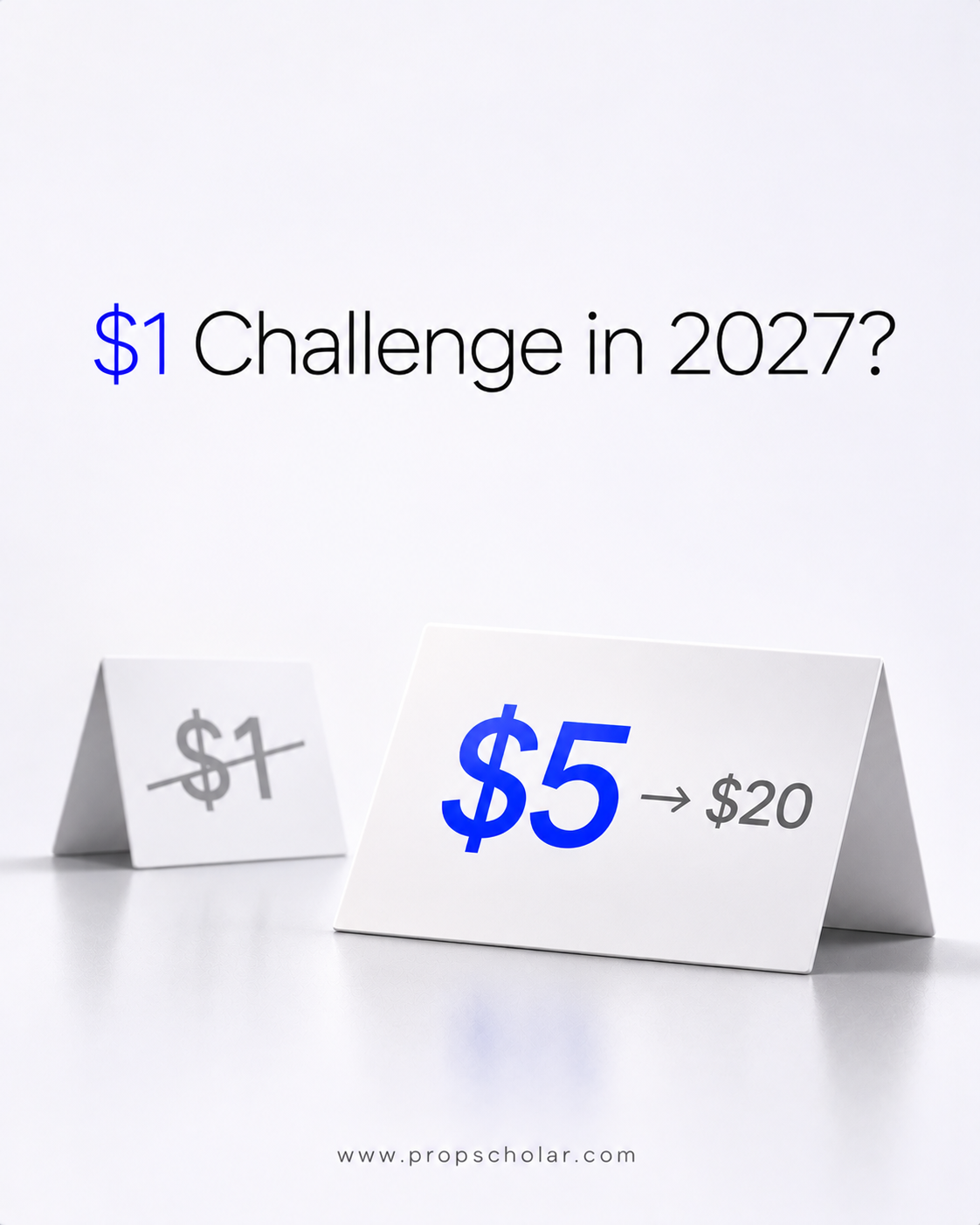
Looking for a $1 Prop Firm Challenge in 2027? The $5 Alternative That Pays $20
12 min read

Payments
UPI Prop Firm India 2027: Start a Rs.499 Trading Evaluation With UPI
11 min read

Evaluation Models
Free Funded Account in 2027? What Free Challenges, Free Demos and Pay After Pass Really Cost You
11 min read

Payments
How to Buy Your First USDT Challenge From Bangladesh: Step-by-Step for Beginners
13 min read